By adopting an approach to expenditure restraint which places emphasis on the reassessment of existing spending priorities and improving the efficiency and effectiveness of the public sector, the Government has been able to substantially reduce expenditures while introducing new policy spending in a number of high priority areas, including to meet its election commitments.
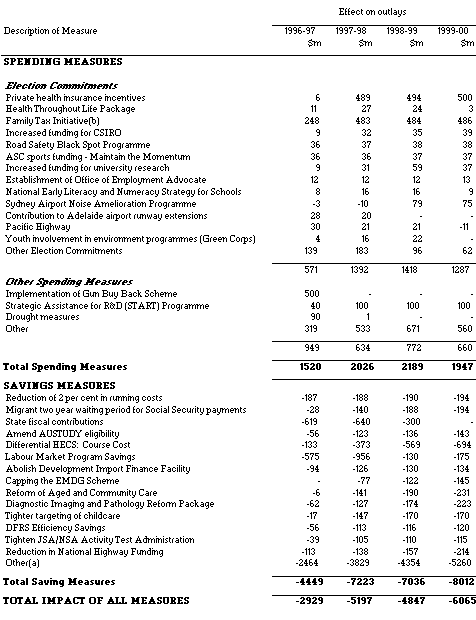
The Government has introduced election spending commitments (costing $0.6 billion in 1996-97 and $1.4 billion in 1997-98) as well as providing additional funding of $0.9 billion in 1996-97 and $0.6 billion in 1997-98 in other high priority spending areas.
The Government has also introduced a range of savings measures which will reduce outlays excluding net advances by $4.4 billion in 1996-97 and $7.2 billion in 1997-98. These savings measures are sufficient to fund the new policy spending of the Government as well as contributing the bulk of the fiscal consolidation. Table 4 presents the major spending and savings measures and their impact on Commonwealth outlays. Further details on outlays spending and savings measures are contained in Statement 3.
Provision has been made in the forward estimates for outlays and revenue effects that would have arisen from the National Heritage Trust Fund, contingent upon the partial privatisation of Telstra. However, no specific outlays or revenue measures have been identified in this Budget.
A range of revenue measures will increase revenue by $1.3 billion in 1996-97 and $2.5 billion in 1997-98. These measures are focussed on addressing anomalies within the existing tax system and removing opportunities for tax evasion and avoidance. The Government has also moved to reduce the revenue loss associated with some tax expenditures (including the generous taxation treatment of superannuation and research and development expenditure). Tax expenditures should be viewed as providing assistance similar to that provided through the outlays side of the budget. Further discussion of tax expenditures is contained in Appendix B of Statement 4. New tax relief measures in areas such as family assistance and health will be introduced costing $0.4 billion in 1996-97 and $0.6 billion in 1997-98. In addition a proportion of the tax benefits from the family tax initiative are delivered through outlays as set out in Table 4 (see footnote (b)).
Table 5 presents the major revenue initiatives and their impact on total revenue; further details are contained in Statement 4.
Table 4: Major Spending and Savings Measures
Table 5: Major Revenue Measures
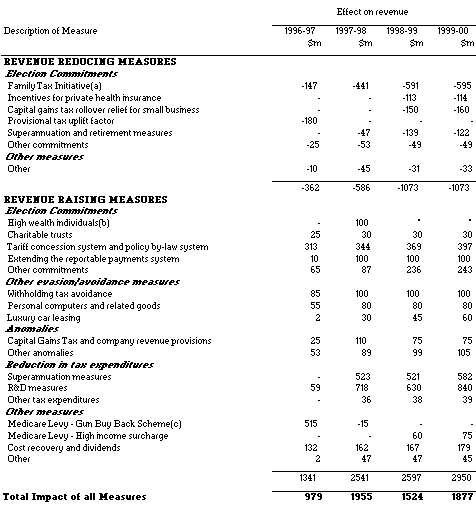
Table 6 presents the major economic parameters assumed in preparing the budget estimates presented in the Budget documents. They comprise economic forecasts for 1996-97 (discussed in detail in Part I of Statement 2) and projections for the period to 1999-2000 to represent a scenario over that period.
Table 6: Major Economic Parameters (percentage change from previous year)
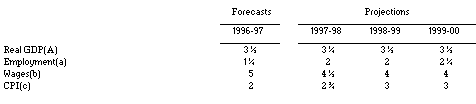
The outlays and revenue estimates in the 1996-97 Budget are consistent with the economic forecasts and projections in Table 6. Variations in economic outcomes from this scenario will have implications for the outlays and revenue estimates. Details of the estimated sensitivity of the outlays and revenue estimates to changes to the economic parameters are presented in Statements 3 and 4 respectively.

