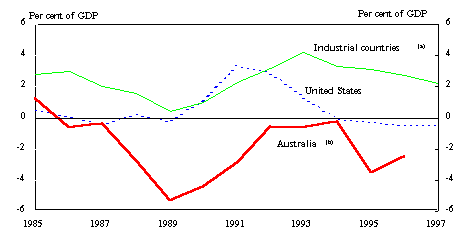
Panel A of Chart 7 illustrates that over the last decade private sector net lending in Australia has been consistently negative, indicating that private sector saving has fallen short of private sector investment. In contrast, private sector lending in the United States has been positive, or at worst marginally negative, and, for industrial countries on average, it has been positive.
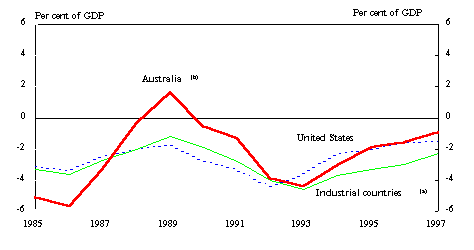
Since Australia has a saving shortfall from the private sector, the public sector cannot draw on national savings (Panel B), without courting risks by increasing its exposure to international capital markets.
The aim of the Government’s fiscal consolidation strategy is to increase the level of national saving (and reduce pressure on the CAD) by raising public sector saving. The OECD and IMF have recently reviewed the experience of several episodes of fiscal consolidation in industrial countries.
The IMF and OECD studies also examined the impact of fiscal consolidation on GDP growth. Both studies recognise that the complexity of interactions between economic growth, interest rates and debt ratios do not lend themselves to establishing clear lines of causality between fiscal consolidation and economic growth. However, both studies identify several fiscal consolidation episodes which were achieved in conjunction with higher rates of growth within a relatively short period. The IMF study also concludes that placing greater emphasis on cutting outlays rather than increasing revenue appears to increase the likelihood of success.
The IMF study also found that where the fiscal consolidation is large and part of a broader adjustment and reform agenda, it is more likely to be perceived by the private sector as a credible government commitment and revive private sector confidence and expectations so that growth is given a boost.
The fiscal strategy set out in this Budget will result in a significant improvement in public finances — reducing Commonwealth general government net debt by an estimated 6 per cent of GDP over the forward estimates period — and provide a framework, through the Charter of Budget Honesty (see Appendix C for details), for maintaining sound fiscal discipline in the future. In addition, the fiscal strategy forms part of a broader adjustment programme which includes key structural reforms (particularly in the area of the labour market). With the consolidation focussed on reducing outlays, it is also aimed at addressing the underlying cause of the deterioration in the Commonwealth budget position. Based on the findings of the OECD and the IMF, these factors indicate that the fiscal consolidation is most likely to lead to an increase in the level of national saving.
