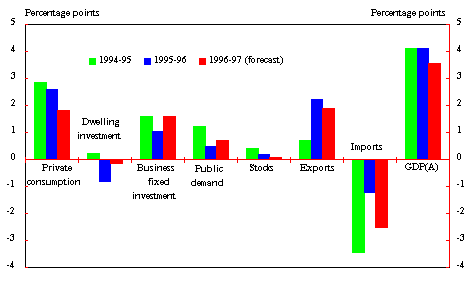
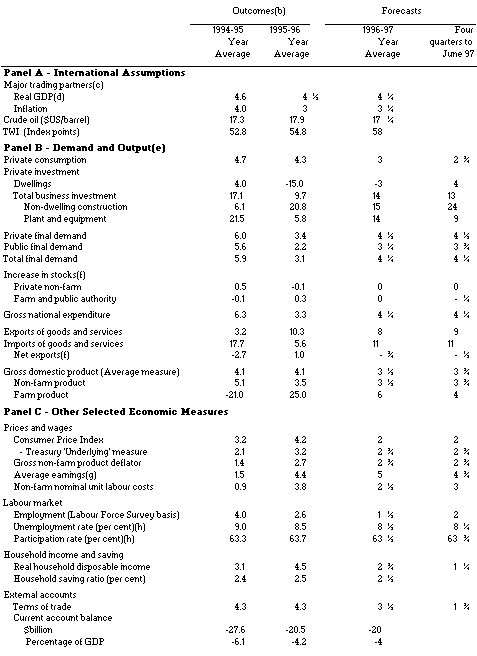
The domestic economic forecasts for 1996-97 are summarised in Panels B and C of Table 2 and in Chart 14.
The forecasts provide a guide to likely developments in the economy based on key assumptions, historical relationships between economic variables and judgements about likely outcomes. 8 Attention is best directed at the broad profile represented by the forecasts, rather than at the point estimates which are required for preparing budget estimates of outlays and revenues. The forecasts have been prepared after careful assessment of the underlying assumptions and the identifiable risks and uncertainties surrounding the outlook. These uncertainties are always present, but they appear to be evenly balanced, both in aggregate and for major components. 9
The forecasts are based on national accounts data up to and including preliminary outcomes for the June quarter 1996.
GDP growth is expected to slow a little to 3½ per cent in 1996-97, with non-farm GDP growth remaining steady and gross farm product rising less rapidly than in 1995-96. In contrast, GNE growth is expected to strengthen to around 4¼ per cent. An acceleration in business investment growth and the waning influences of the stock and dwelling cycles are likely to more than offset slower private consumption growth. Public final demand growth is expected to be slightly stronger than in 1995-96, with the impact of fiscal consolidation on general government expenditure more than offset by the effects of short-term costs associated with fiscal consolidation and stronger public enterprise investment. A substantial deterioration in net export volumes is expected to more than offset the strengthening in GNE growth.
Private consumption growth is expected to moderate to 3 per cent in 1996-97, an outcome slightly below the average of the past twenty years. While continuing at a solid rate, real household disposable income growth is expected to slow relative to the 1995-96 experience. In part, this easing reflects the impact of slower growth in transfer payments to individuals, but it is also influenced by a fall in farm incomes, albeit from a relatively high level, and slower employment growth. Continued steady growth in private sector net wealth should also support consumption. In year-average terms, the household saving ratio in 1996-97 is forecast to be similar to that recorded in the past two years.
General uncertainties surrounding the outlook for consumption primarily relate to prospects for disposable income, and hence wages and employment (both discussed below). However, a more specific uncertainty concerns likely movements in the household saving ratio. Despite the upward revision in the June quarter 1996 National Accounts, the saving ratio is still at historically low levels. Consequently, it is possible that consumers might start to rebuild savings, leading to lower private consumption growth. As noted earlier, however, this issue is complicated by the propensity for the saving data to be revised.
TABLE 2: BUDGET FORECASTS AND FORECASTING ASSUMPTIONS(a)
A slow recovery in dwelling investment is expected to begin during the course of 1996-97, consistent with leading indicators for this sector. There has been some reduction in the large excess supply of dwellings built up during the latest housing upturn. Housing affordability is likely to remain high — mortgage interest rates have fallen, house prices are rising slowly and growth in household income is solid. Continued income growth may also stimulate stronger investment in alterations and additions.
The pace of the recovery is likely to be restrained by the continuing excess supply of housing and the possibility of a lower level of underlying demand than in previous cycles. However, because desired household formation is not directly measurable, estimates of underlying demand for housing, the current level of oversupply and the speed with which it might be reduced are uncertain. Excess supply at the national level also masks regional and sectoral differences — for example, in some market segments such as medium-density housing in inner-city areas of Sydney and Melbourne, low vacancy rates suggest there may already be excess demand. As a result, the timing and strength of the upturn in activity are likely to vary across States and across market sectors.
Growth in business investment is expected to strengthen in 1996-97, consistent with a positive investment environment. Aggregate capacity utilisation remains high, business confidence is positive and profits are expected to continue rising, maintaining the corporate profit share and the net rate of return on the corporate capital stock around current levels.
Surveys of investment intentions for 1996-97 support this positive outlook. The second Capex estimate (taken in April/May 1996) is around 14 per cent higher than the first estimate (taken three months earlier) and is 23 per cent higher than the comparable estimate for 1995-96. While expectations are strong for both construction and equipment investment, the picture varies across the major industry sectors. Mining and service-related sectors are anticipating strong growth in investment, with more modest outcomes expected for manufacturing. This is consistent with the relatively lower levels of capacity utilisation and the more subdued trading outcomes reported in manufacturing. Nevertheless, the prospect of an upturn in the dwelling and stock cycles suggests a more positive outlook for activity in this sector which, in turn, should support investment levels toward the end of the year and beyond.
Non-dwelling construction is expected to grow particularly strongly through 1996-97, supported by continuing solid growth in engineering construction (reflecting a number of major road constructions, mining infrastructure projects and private sector Olympic developments), as well as strength in some components of non-residential building. As a share of GDP, it is likely to remain well below earlier peaks, but in line with average historical experience. Equipment investment will be stimulated by the favourable influences identified above and, as a share of nominal GDP, is expected to rise to a level around the average experienced since the early 1960s. 10
The results of the capital expenditure intentions survey have been interpreted conservatively in forming these forecasts. However, as always, the outlook for business investment is susceptible to shifts in business confidence and actual outcomes can differ widely from initial estimates. With the outlook being uneven — concentrated more in the mining and service-related industries — changed perceptions about underlying influences (such as commodity prices) could have a large impact in either direction.
Private non-farm stocks are expected to make no contribution to growth in 1996-97, while ongoing sales growth is expected to be sufficient to enable a continued moderate decline in the stocks-to-sales ratio. Considerable uncertainty continues to surround likely developments in the stock cycle. Although the stocks-to-sales ratio appears broadly consistent with longer-term trends, surveys generally indicate that businesses have not reduced stock levels to the extent intended, suggesting that there may still be some correction over the course of 1996-97.
Growth in public final demand is forecast to strengthen in 1996-97. Public consumption expenditure is expected to rise at a similar rate as in 1995-96. At the Commonwealth level, implementation of election commitments will partially offset the impact of the fiscal consolidation measures on public spending in the short term. Overall, in constant price terms, Commonwealth consumption expenditure is forecast to rise slightly. Other than in 1995-96, when growth was constrained by the deferral of planned expenditure, the forecast growth rate is among the lowest since 1979-80. At the State and local level, some further moderation in consumption growth is in prospect, in line with ongoing fiscal reforms.
The strengthening of overall public final demand growth thus reflects an acceleration in public investment growth. At the Commonwealth level this will predominantly reflect Telstra’s investment programme. State and local public enterprise investment should strengthen from its 1995-96 level which was affected by the sale of large electricity-related assets. 11
The farm sector is expected to make only a small contribution to GDP growth in 1996-97 as growth in farm production slows after the rebound in 1995–96. Crop harvests are expected to rise as a result of increases in area sown, but the rate of increase will be well below that of 1995-96. Falling wool clips will be a restraining influence on total farm production. While remaining at a relatively high level, farm income is expected to fall in 1996-97 as lower rural prices and increased costs outweigh the effect of the modest increase in output.
A sharp acceleration in import volume growth is expected to result from the stronger outlook for import-intensive components of demand and the lagged response to relative price movements in favour of imports. Export volume growth is expected to remain strong, supported by increases in domestic capacity and a favourable international environment. However, some easing in growth is expected relative to 1995-96, reflecting the extent to which exports of some non-rural commodities and elaborately transformed manufactures were boosted by transitory factors in that year. Overall, in contrast to the previous year, net export volumes are expected to detract from growth in 1996-97.
Wage pressures, which started to build in the second half of 1994-95, are expected to remain present in 1996-97. While there has been some moderation in the growth in AWOTE for full-time adults in recent quarters, other more forward-looking indicators have been less encouraging. Wage outcomes from enterprise agreements rose steadily during 1995 and have continued to move up in 1996. The Department of Industrial Relations’ Workplace Agreements Database indicated a pick-up in the average annual wage increase per employee for formal Federal wage agreements from around 4 per cent in late 1994 to over 5 per cent in the first half of 1996.
Over the forecast period, wage pressures overall are not expected to intensify but are nonetheless likely to require continued policy vigilance. Influences expected to prevent further acceleration in wage growth are the continuing relatively high level of unemployment, the marked slowing in inflation and the continuing competitive pressures faced by business. Abstracting from the effects of Commonwealth voluntary redundancies, average earnings are forecast to grow by 4½ per cent in 1996-97.
The risks around the wage outlook, though reasonably balanced, are an important area of uncertainty for future employment growth and inflation and for the outlook for the economy more generally. To the extent that lower inflation, continuing high levels of unemployment and competitive business conditions combine to keep wage outcomes lower than forecast, there will be positive effects on inflation and employment growth. On the other hand, if the recent increase in the size of enterprise bargaining claims translates into higher outcomes and — more importantly — spreads, this would boost wage growth with adverse consequences for employment and inflation. The possibility of higher wage outcomes in key sectors (for example, in the metals, construction and transport sectors) spreading more widely and the ACTU’s recent ‘living wage’ claim succeeding in its present form pose the greatest risks to aggregate wage outcomes.
Wages, salaries and supplements income growth is forecast to decelerate from 1995-96, as the slowing in year-average employment growth more than offsets the strengthening of wage growth (after incorporating the effects of Commonwealth redundancies). Corporate profit growth is forecast to strengthen in 1996-97, with growth in productivity exceeding growth in real producer wages. Consequently, the profit share is expected to rise slightly in 1996-97. The net rate of return on capital is expected to rise, as growth in profits is forecast to exceed growth in the net capital stock (in nominal prices).
With continued non-farm GDP growth and an expected deceleration in real wage growth, employment growth should accelerate through 1996-97. However, a slowing in employment growth in year-average terms is likely given the weak outcomes in the second half of 1995-96. The current level of job vacancies and the expectations reported in business surveys support a short-term outlook of modest employment growth. 12
Increasing employment opportunities and higher real wages through the course of 1996-97 should encourage people to enter or re-enter the workforce, resulting in modest rises in the participation rate. With the labour force expected to grow solidly through 1996-97, the unemployment rate is expected to decline only gradually to around 8¼ per cent in the June quarter 1997, compared with 8.6 per cent in the June quarter 1996.
As always, uncertainties about the labour market outlook relate to those surrounding activity and real wages, and the ongoing impact of social and demographic factors on the participation rate.
The underlying rate of inflation is forecast to be 2¾ per cent in the year to the June quarter 1997, slightly below the outcome in the year to the June quarter 1996.
The pass-through into retail prices of lower import prices was an important moderating influence on underlying inflation during much of 1995-96. Although the extent of pass-through is dependent on demand conditions and competitive pressures, historical relationships suggest that much of the total impact is still to be reflected in retail prices. The stronger exchange rate is thus likely to be an important moderating influence on underlying inflation in the year ahead.
A moderate acceleration in nominal unit labour cost growth through 1996-97 is likely to maintain some upward pressure on prices. Although wage growth (excluding redundancies) is expected to remain similar to that in the previous year, some easing in labour productivity growth — towards its structural rate — is expected through 1996-97 following the cyclical catch-up through 1995-96.
‘Headline’ CPI inflation is expected to be lower than underlying CPI inflation in 1996-97, mainly as a result of falls in mortgage interest charges following recent cuts to mortgage interest rates by financial institutions.
Broader measures of prices, such as the domestic demand and GNE deflators, are also expected to increase only slowly, reflecting low consumer price inflation and falls in the prices of investment goods. The increase in the non-farm GDP deflator is also expected to be low, although slightly higher than the domestic demand deflators because of the forecast improvement in the terms of trade.
The current account deficit is forecast to fall slightly in 1996-97, to around 4 per cent of GDP. A rise in the net income deficit and the deterioration in net export volumes (discussed above) will be offset by a continued improvement in the terms of trade.
The expected rise in the terms of trade over the course of 1996-97 is not anticipated to be as strong as in recent years. This deceleration primarily reflects the outlook for commodity prices in foreign currency terms, with weakness in rural prices (resulting from an easing in grain prices from the high levels recorded in 1995-96, and continued weakness in wool and beef markets) offsetting rises in non-rural prices.
