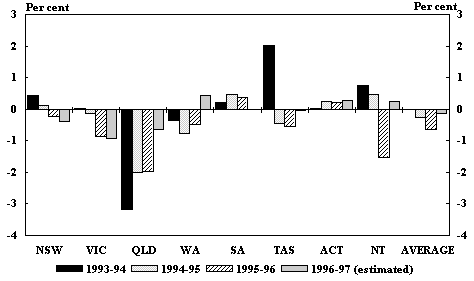
The State public sector surplus is expected to fall further in 1997-98 to around $0.1 billion. However, in subsequent years, some improvement is expected with recent State budget and NFO projections showing small but increasing underlying surpluses in the State general government sector.
Chart 1: State Public Sector Underlying Deficit (per cent of GSP)(a)
Source: Based on 1996-97 Government Financial Estimates, Australia, ABS Catalogue No. 5501.0, 1997-98 State budgets where available, otherwise unpublished ABS data and 1997 NFO.
Chart 2 shows the declining trend in the ratio of net debt to gross state product (GSP) since the early 1990s. This trend is expected to continue in 1997 due to the effect of economic growth and the continuation of headline surpluses in most States. These surpluses will result, in part, from asset sales.
In 1995-96, there were large asset sales including the sale of electricity assets in Victoria (worth around $10.7 billion), BankWest ($900 million) and BankSA ($730 million). There have been further asset sales in 1996-97, the largest being Victoria's sale of the Loy Yang A ($4.9 billion) and Hazelwood ($2.4 billion) power stations.
Chart 2: State Public Sector Net Debt (per cent of GSP)as at 30 June(a)
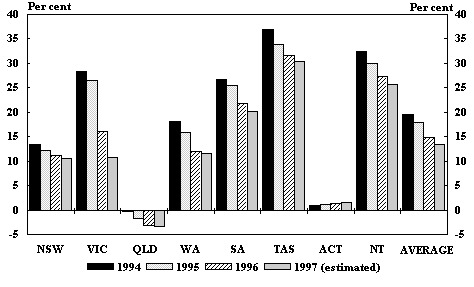
(a) Net debt is defined as gross debt less financial assets. For 1997, 1997-98 State budget estimates of net debt have been used where available. For other States, net debt is calculated by adding to the ABS net debt figure the sum of general government and PTE headline deficits (less net advances paid to PTEs). The average is the unweighted average.
Source: Unpublished ABS data, 1997-98 State budgets where available, otherwise Commonwealth Treasury estimates for 1997.
Fiscal developments in individual jurisdictions are summarised below.
New South Wales is expected to record a significant deterioration in 1997-98 in the underlying position of its public sector which is projected to move into deficit. The growth in underlying outlays in 1997-98 is expected to be around twice that of revenue notwithstanding the introduction of new taxation measures.
Current outlays are expected to increase significantly in education and health in 1997-98 as they have in 1996-97. There will also be strong growth in underlying capital outlays in 1997-98 reflecting the capital projects associated with the 2000 Olympics and investment in transport infrastructure.
Substantial taxation measures were announced in the 1997-98 Budget. The major measures include an electricity distributors' levy on businesses which have benefited from competition-induced price reductions, an increase in the rate of land tax and a change in the definition of the residential property exemption threshold. A 10 per cent duty is also to be introduced on the cost of accommodation in and around the Sydney central business district.
New South Wales has a short term fiscal target of achieving a sustainable surplus in the general government sector by 1998-99.
Victoria's financial position has strengthened considerably in recent years. This has resulted from significant asset sales and public sector reforms, including expenditure restraint in service delivery, and increases in own-source revenue. The improvement in Victoria's financial position has been reflected in a substantial reduction in the State's net debt.
In underlying terms, the Victorian public sector is expected to record surpluses in 1996-97 and 1997-98. The reduction in the surplus in 1997-98 is expected to reflect strong growth in underlying capital outlays. The 1997-98 Budget announced reductions in a number of taxes, primarily payroll tax and petroleum franchise fees, to bring Victoria's tax rates into closer alignment with the State average.
Victoria is committed to medium-term fiscal targets, which include the achievement of a sustainable current account surplus and further reductions in debt.
Queensland remains in the strongest financial position of all the States and is the only jurisdiction in a net asset position (that is, with financial assets exceeding financial liabilities). Queensland's superior fiscal position reflects, in part, its policy of borrowing only for economic infrastructure which is able to service the debt, and funding social infrastructure from recurrent revenue.
However, a significantly lower public sector underlying surplus is expected in 1996-97 resulting from large increases in both current and capital outlays.
Western Australia remains in a relatively strong financial position as a consequence of strong economic growth flowing through to own-source revenue, and earlier public sector reforms.
Western Australia's public sector is expected to record a decline in its underlying deficit in 1997-98 and to achieve moderate surpluses in the medium term as the historically high level of spending on capital works in the PTE sector is reduced.
Western Australia's fiscal objectives include reducing public sector net debt as a share of GSP and reducing its interest burden. In its 1997-98 Budget, Western Australia announced its intention to implement fiscal responsibility legislation which will set out key fiscal principles, the process for setting and monitoring medium term fiscal targets, and financial reporting requirements.
South Australia has made steady progress in reducing its net debt to GSP ratio from the peak reached in 1991-92, although the ratio remains high in comparison to most other States. The high net debt ratio was associated with the need to provide financial assistance for its State Bank and State Government Insurance Commission in the early 1990s.
The public sector is expected to be broadly in balance in 1996-97. This improvement is due largely to an expected pick-up in revenue combined with relatively low growth in underlying outlays.
The South Australian Government's fiscal objectives are to eliminate its underlying deficit in the non-commercial sector by 1997-98 and further reduce public sector net debt.
Tasmania's net debt to GSP ratio remains the highest of any jurisdiction. Its large debt burden is attributable to its reliance on public sector borrowings through the 1980s, partly associated with investment in the State's hydro-electric scheme. In recognition of the difficulties facing Tasmania as a result of a deterioration in its fiscal position, it was agreed at the 1997 Premiers' Conference that Tasmania will defer half of its 1997-98 fiscal contribution to the Commonwealth until 1998-99.
The public sector is expected to be broadly in balance in 1996-97, following small surpluses in the previous two years. The deterioration is due to higher underlying outlays growth and lower revenue growth.
Tasmania's medium-term fiscal strategy has focused on the continued reduction of net debt, debt servicing costs and State taxes, complemented by public sector reforms. However, significant budgetary pressures remain, including the ongoing expenditure requirements associated with an ageing population.
Although the Australian Capital Territory continues to have a relatively low level of net debt, its budgetary position is expected to deteriorate with the weakness evident in the Territory's economy.
The Australian Capital Territory is expected to record a significant public sector underlying deficit in 1997-98 as a result of a decline in revenue to the general government sector and continued growth in outlays. In recognition of the difficulties facing the Territory, it was agreed at the 1997 Premiers' Conference that it will defer half of its 1997-98 fiscal contribution to the Commonwealth until 1998-99.
The Northern Territory is expected to record a small public sector underlying deficit in 1996-97 following a surplus the previous year. The significant deterioration in the Northern Territory's fiscal position is expected to result from strong growth in outlays. The public sector underlying deficit is expected to increase slightly in 1997-98. The ratio of public sector net debt to GSP is expected to decline slightly in 1997 but remain well above the State average.
The Northern Territory economy has grown faster than the average for all jurisdictions in recent years, with this growth reflected in own-source revenue. Moreover, under the horizontal fiscal equalisation principles, the Northern Territory continues to receive a relatively large share of the pool of Commonwealth general revenue assistance, reflecting the fiscal disabilities associated with its small and widely dispersed population.
The Northern Territory's medium term fiscal strategy is to address its structural budget imbalance and its high level of public sector debt through the restraint of outlays growth and reduced reliance on borrowings. One of the Northern Territory's fiscal objectives is to restrict any increase in gross debt to five per cent or less of total expenditures.


