
(a) Estimates.
The conditions imposed on individual SPPs vary considerably in both degree and form. They may involve:
The balance to be set between the Commonwealth's policy objectives and the desirability of maximising the States' flexibility on SPPs is not easily resolved and depends on the circumstances pertaining to particular areas of expenditure and policy. For example, the extent to which an SPP may restrict State budget flexibility depends on the degree to which States would have undertaken the expenditure concerned anyway, had they received the same level of funding through general purpose payments. For some large State expenditure items funded through SPPs, it could be expected that all of these funds would be directed to the same purpose regardless of the form of funding.
SPPs that are paid 'through' the States account for around 40 per cent of total SPPs. These SPPs have a minimal impact on State budgets as they are essentially Commonwealth own-purpose outlays, with the States acting as the Commonwealth's agent.
Some SPPs include conditions which influence State own-purpose outlays through the use of 'matching' funding requirements. These conditions are commonly expressed in terms of inputs (that is expenditure levels) rather than outcomes. These arrangements have been questioned on the grounds that they may reduce the incentive for the States to pursue efficiency measures because a State cannot direct productivity gains to other expenditure priorities or use them to improve its fiscal position. Nevertheless, expenditure is often used as a proxy for a performance indicator because of the difficulty inherent in defining and agreeing an output or outcome indicator for a programme.
Table 19 shows estimated SPPs for 1996-97 and 1997-98.
Table 19: SPPs 'To' and 'Through' the States and Territories, 1993-94 to 1997-98 ($million)
(a) Estimates.
At the 1996 Premiers' Conference the Commonwealth advised the States that there would be a reduction in SPPs in 1996-97 of no more than 3 per cent against the forward estimates as a result of the budget processes in that year. In the event, the reduction in SPPs to the States was 2.5 per cent against the forward estimates. At the 1997 Premiers' Conference the Commonwealth advised the States that the reduction in SPPs through the budget processes would be a maximum of 1.3 per cent against the forward estimates in 1997-98. The measures contained in the Budget resulted in a reduction in SPPs to the States of $49 million, or around 0.5 per cent, against the forward estimates in 1997-98.
SPPs are expected to account for around 52 per cent of total gross payments to the States in 1997-98. SPPs 'to' the States are expected to total $10.9 billion or 31 per cent of total gross payments, while SPPs 'through' the States are expected to be $7.2 billion or 21 per cent of the total. Chart 7 shows trends in SPPs as a proportion of total gross payments to the States since 1977-78, including trends in payments 'to' and 'through' the States. The chart contains adjustments for a number of classification changes and large one-off factors so as to allow comparisons on a consistent basis. [2]
Chart 7: Specific Purpose Payments as a Percentage of Total Gross Payments to the States, 1977-78 to 1997-98
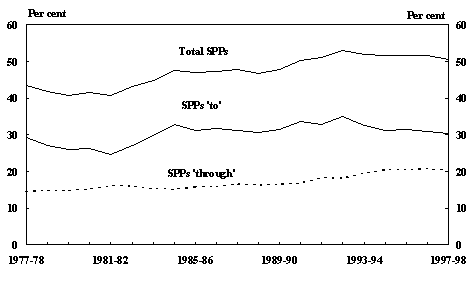
Chart 7 shows that SPPs have increased as a percentage of total Commonwealth payments to the States by around 7 percentage points over the last twenty years. This reflects, in part, the relatively generous escalation arrangements which have applied to SPPs compared to general purpose payments. Although the escalation arrangements for SPPs are diverse, a number have had agreed escalation formulae based, for example, on population growth and price movements.
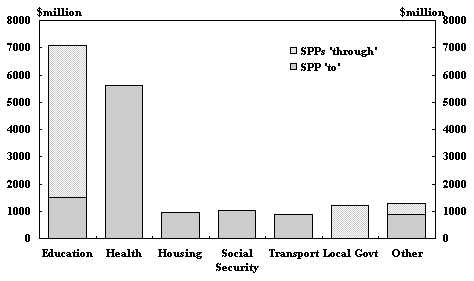
Chart 8 illustrates the composition of major specific purpose programmes ('to' and 'through' the States) in 1997-98. Education and health account for the great bulk of payments.
Chart 8: Composition of Estimated Specific Purpose
Payments 'To'
and 'Through' the States, 1997-98
More detailed information on SPPs including State splits for 1997-98 and data on repayments, advances and interest is contained in the Appendix.


