Part I: Overview and Fiscal Outlook
A stronger than expected world economic outlook is ameliorating the slowing in the Australian economy and the growth forecast for 1999-2000 has been revised upwards. This has not had a significant effect on the fiscal outlook, where policy measures have been the dominant factor in some decline in expected surpluses in the near term.
Economic growth in Australia is expected to be a very solid 3½ per cent in 1999-2000, following robust growth of around 4½ per cent in the two previous years. The forecast for 3½ per cent economic growth in 1999-2000 has been revised up from 3 per cent at Budget.
Employment is expected to increase by around 2¼ per cent, with unemployment now forecast to average around 7 per cent in 1999-2000, down from 7.6 per cent in 1998-99. Inflation is forecast to increase slightly to around 2¼ per cent, while the current account deficit is expected to remain at around 5½ per cent of GDP in 1999-2000, although with a declining trend through the year.
In 2000-01, growth is expected to be a strong 3¾ per cent, with employment growth remaining firm at around 2 per cent, raising the prospect of some further decline in unemployment. Ongoing inflation (that is, leaving aside the impact on prices of indirect tax changes flowing from the Government’s taxation reform package) is estimated to be around 2½ per cent through the year to the June quarter 2001.
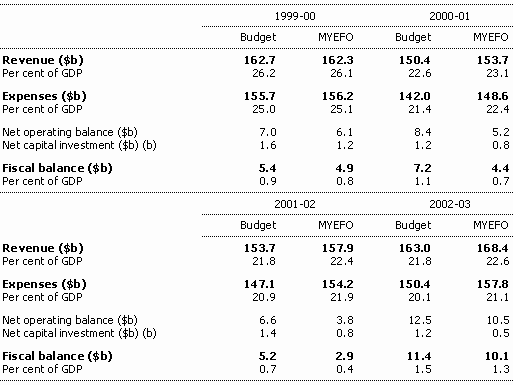
Consistent with the continuing strong performance of the Australian economy, the budget is expected to remain in surplus in 1999-2000. That remains the case throughout the forward estimates period, though the transitional costs of The New Tax System reduce the surplus in 2000-01. In addition, Australia’s contribution to the United Nations peacekeeping operation in East Timor will involve significant additional expenditure over the forward estimates period.
To partially offset the cost of Australia’s involvement in East Timor, the Government has announced that it will implement a Defence - East Timor levy (as an addition to the Medicare levy) in 2000-01. The revenue from the levy will ensure that overall fiscal settings in 2000-01 remain appropriate to the needs of the economy.
Tables 1 and 2 show the revised fiscal projections for 1999-2000 and the forward estimates period. 1.
Table 1: Commonwealth General Government Accrual Aggregates(a)
(a) All estimates are produced on a
Government Finance Statistics (GFS) basis. Consistent with GFS standards, revenues and
expenses exclude economic revaluations. Revenues and expenses in Parts IV and V are
provided primarily on an accounting standards (AAS31) basis.
(b) Net acquisition of non-financial assets.
Table 2: Commonwealth General Government Cash Aggregates
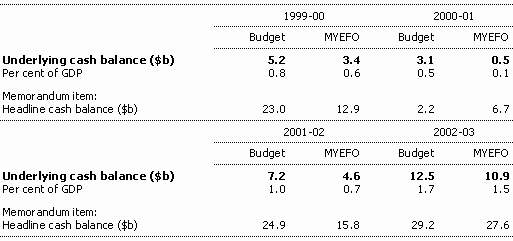
Consistent with continuing budget surpluses, significant further reductions in general government net debt are expected over the next four years. In 1999-2000, Commonwealth general government net debt is anticipated to fall to $61 billion, or 9.8 per cent of GDP. Net debt is expected to fall further in 2000-01, bettering the Government’s target of halving the net debt to GDP ratio over the five years to 2000-01.
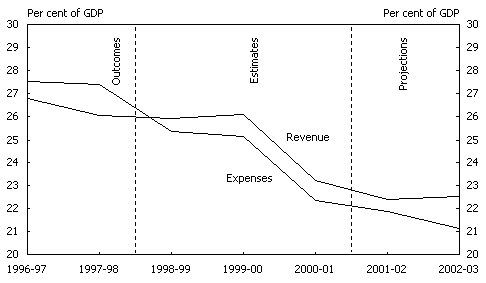
Over the forward estimates period, both revenue and expenses are expected to fall significantly as a proportion of GDP (see Chart 1). These reductions are mainly due to the introduction of The New Tax System, in particular the abolition of wholesale sales tax and financial assistance grants to the States and the implementation of personal income tax cuts.
Chart 1: General Government Budget Aggregates(a)
Panel A: Accrual Revenue and Expenses
Panel B: Fiscal Balance
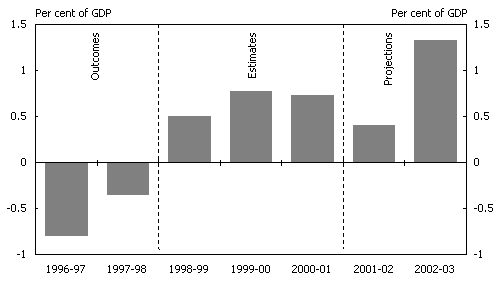
(a) Accrual data for 1996-97 and 1997-98 are from the annual Consolidated Financial Statements. From 1998-99, the accounting treatment of certain revenue items, in particular taxation revenue and some dividends, has changed. See Statement 4 of 1999-2000 Budget Paper No. 1 Budget Strategy and Outlook for further information.
Chart 2: Underlying Cash Balance(a)
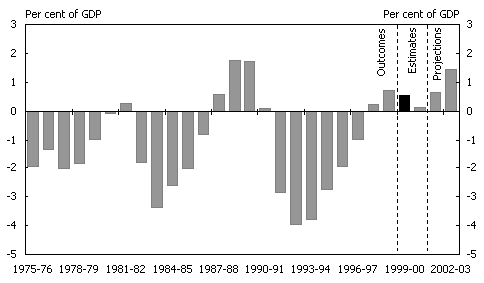
(a) From 1998-99 onwards the underlying cash balance includes payments by the Commonwealth in respect of accumulated public trading enterprise superannuation liabilities. This detracts around $1¼ billion from the surplus annually.
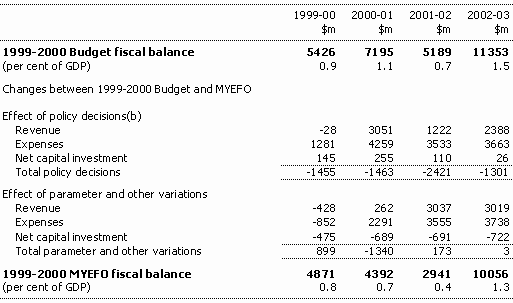
Table 3 provides a reconciliation of the current general government fiscal balance estimates with those at the 1999-2000 Budget, showing the effect of policy decisions and parameter and other variations.
Table 3: Reconciliation of General Government Fiscal Balance Estimates(a)
(a) All
estimates in this table are produced on a GFS consistent basis.
(b) Excluding the public debt net interest effect of policy measures.
Major new policy decisions since the Budget include:
- additional defence and aid expenditure of $3.7 billion over the next four years to support Australia’s peacekeeping and humanitarian operations in East Timor. Part of this cost will be met by a temporary Defence — East Timor levy in 2000-01 (see Box 1);
- legislative changes to The New Tax System package. These changes include making
basic food Goods and Services Tax (GST) free, compensation for pensioners and allowees,
measures on the environment, and reduced income tax cuts for income earners over $50,000.
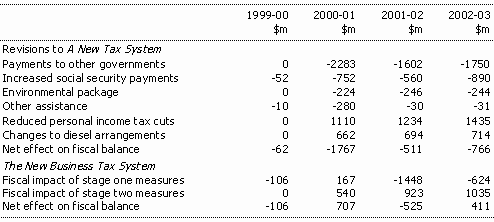
The estimated net budget cost of these revisions is $1.8 billion in 2000-01,
$0.5 billion in 2001-02 and $0.8 billion in 2002-03 (see Box 2);
- the implementation of The New Business Tax System (with the reform producing a net positive effect on revenue of $707 million in 2000-01 and $411 million in 2002-03, more than offsetting a net cost to revenue in the other two years) (see Box 2); and
- an expansion of the Social Bonus measures associated with the sale of the second tranche of Telstra. These measures include a range of initiatives to promote access to information technology and telecommunications services for all Australians, including in rural and regional areas (the total cost of these measures is $281 million over four years from 1999-2000).
| Box 1: Budgetary Implications of
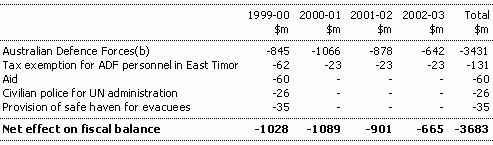
Australia’s Involvement in East Timor The Government is committed to supporting the United Nations (UN) efforts to bring about peace and security in East Timor. This involves a significant deployment of Australian Defence Force (ADF) personnel, and a net addition to ADF capability to ensure overall readiness can be maintained. The Government is also providing assistance to refugees and aid for humanitarian relief and reconstruction. These commitments will come at a total budgetary cost of $3.7 billion over four years, the elements of which are outlined in the following table. Considerable uncertainties surround these estimates. East Timor Costs(a)
(a) Further details on individual measures are provided in Appendix A. To partially offset the costs of Australia’s involvement in East Timor, the Government has announced that it will implement a temporary Defence — East Timor levy on individual taxpayers. The levy will be set at 0.5 per cent for individual taxpayers with total taxable income from $50,001 to $100,000 per annum and at 1.0 per cent for individual taxpayers with total taxable income above $100,000 per annum. As with the Guns Buyback Levy in 1996-97, the revenue from this measure will be used to fund an unanticipated and significant cost to the Budget and will be implemented for only one financial year. The levy will apply from 1 July 2000 and will raise $900 million in 2000-01. In addition, the UN will reimburse Australia for some of the costs of deployment once the UN assumes responsibility for peacekeeping operations. This transition is anticipated to occur early in the year 2000. UN reimbursements are expected to amount to $314 million over the next four years. |
Box 2: Tax Reform Amendments and New Initiatives Since Budget, the Government has amended A New Tax System and introduced its New Business Tax System reforms. These measures are detailed in Appendix A. The amendments to A New Tax System were announced on 28 May 1999, following negotiations with the Australian Democrats. They include the exemption of basic food from the GST, reducing revenue by approximately $3 billion in 2000-01. Since GST revenue goes to the States, the Commonwealth was required to make increased payments to the States, and take over other payments that would have been made by the States, to ensure the States were not worse off from GST base changes. The Government also provided additional increases in pensions and allowances and additional expenditure on the environment. To partly offset these costs, there was a reduction in the personal income tax cuts for high income earners and amended reforms to diesel fuel excise. There is a net cost to the Commonwealth Budget of $1.8 billion in 2000-01. On 21 September 1999 and 11 November 1999, the Government announced reforms to provide Australia with a modern, internationally competitive and fair business tax system. The key elements include: lowering the company tax rate and changes to the capital gains tax regime; simplifying the tax system to reduce the compliance burden on small businesses and primary producers; implementing a unified entity regime; and a range of measures to improve the integrity of the tax system and amend international taxation arrangements. In aggregate, these measures are broadly budget neutral over the forward estimates. Fiscal Impact of Tax Reform Amendments and New Initiatives
|
The effect of new policy expenditure on the fiscal balance is partly offset in 1999-2000 by positive parameter and other variations of $0.9 billion. These variations reflect a substantial reduction in estimated expenses and net capital investment, that more than outweighs a moderate reduction in forecast revenue. The reduction in expenses from parameter and other variations includes:
- a $395 million saving on unemployment benefit payments arising from a reduction in
the expected number of unemployed people; and
- an $850 million reduction in expenses reflecting the inclusion of a provision for expected underspends by departments and agencies in 1999-2000
On the revenue side, although the outlook for economic activity in nominal terms in 1999-2000 is unchanged — real GDP is revised up while inflation is lower — a small downward variation has been incorporated, largely reflecting slightly weaker than expected taxation collections to date. The downward variation in aggregate taxation revenues reflects the net effect of revisions to most components. Two variations predominate:
- company tax collections have been reduced, chiefly as a result of higher deductions
claimed by companies for Y2K expenditure and indications that taxable income growth is not
matching broader measures of corporate performance; and
- partly offsetting this, refunds of individual income tax have been much lower to date than anticipated, and are likely to remain so for the year as a whole, given the large proportion of returns now processed.
In 2000-01, parameter and other variations reduce the expected fiscal balance by around $1.3 billion. Significant variations contributing to this expected outcome include:
- a $193 million increase in estimated personal benefit and health care payments by
the Department of Veterans’ Affairs;
- a $303 million upward revision in the estimated cost of the Private Health Insurance Rebate, in line with actual data on spending and membership take up; and
- a $504 million increase in public debt net interest expenses as a result of new policy expenditure, a rise in international and domestic interest rates and the flow-through effects of the delayed payment of Telstra 2 instalment receipts relative to the timing assumed at Budget.
Additional details on variations in estimated revenue since the
1999-2000 Budget are provided in Part IV, while variations in expenses and net
capital investment are discussed further in Part V. A full description of all policy
decisions taken since the 1999-2000 Budget can be found in Appendix A.
1. The principal reason for the sizeable difference between
the fiscal and underlying cash balances in 2000-01 is the bring-forward of company tax
liabilities under the new Pay-As-You-Go system. This bring-forward substantially boosts
accrual taxation revenue (and therefore the fiscal balance) in 2000-01. However, cash
payments of the amount brought forward are received from companies in delayed interest
free instalments over the following 2½ to 5 years (providing a delayed boost to the
underlying cash balance).
2. Each year an allowance for underspends is included in the contingency
reserve at MYEFO for the established tendency of departments and agencies to underspend
their budgets in the current financial year.