|
|
| Home | Search | Site Map | Help | |




Chapter One: Global and Regional Context
The Global Aid Environment
There are strong linkages between the process of globalisation and the international aid environment. The opening up of markets, decisive role of trade and high mobility of capital are key features. A challenge for the international community is to ensure that globalisation continues to work to consolidate development and reduce poverty.
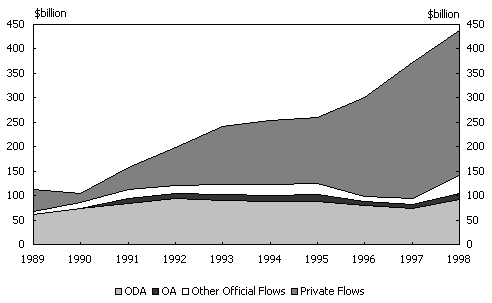
Diagram 1: Total net resource flows to aid recipient countries1
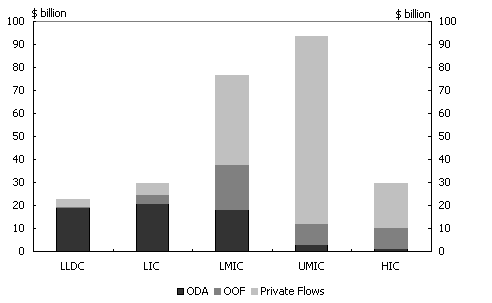
Some developing countries are taking advantage of the potential for increased trade and investment. However, the main recipients of private flows continue to be the world's stronger developing countries. Many poorer countries are finding it difficult to capitalise on these opportunities, and remain highly dependent on aid.
Diagram 2:Total net resource flows to aid recipient countries2, 1998
Donors have two important roles in this climate. They must strive to meet pressing and at times overwhelming humanitarian needs. Donors also have a crucial catalytic role in building the capacity of developing countries to tap into private investment and reduce poverty over the longer-term. Support for governance and a more open trading system will be crucial.
There are common themes among international donors in responding to these challenges: fostering partnerships with recipients, enhancing the coherence of policies towards developing countries, and sharpening agencies' focus on results. In particular, Development Assistance Committee (DAC) members are committing an increasing proportion of their aid based on evidence of effectiveness. Enhancing the quality of aid programs will be critical to ensure that they are effective in reducing poverty.
A feature of the current aid environment is the willingness of the international donor community to work together to achieve common aims. Australia plays an active role in these efforts, as exemplified by Australia's engagement in major global issues, our leading role in East Timor and in responding to the East Asian financial crisis.
International ODA flows
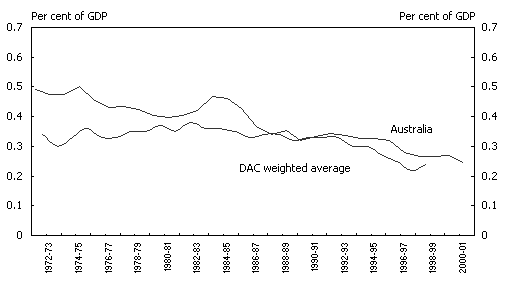
The current (1998) DAC average ODA/GNP ratio stands at 0.24 percent. The last few years have seen a levelling out in the general trend of falling ODA levels, with a rise of more than 7 per cent in 1998 after five years of decline. This partly reflects donor commitment to short-term measures to deal with the Asian crisis.
Diagram 3: ODA/GNP ratios of Australia and DAC weighted average3
Aid Issues in the Asia Pacific Region
Australia's aid program focuses on the Asia Pacific. There are 800 million people living in poverty in the region, the largest concentration of people living in poverty in the world. Aid will continue to play an important role in realising the region's development potential, particularly for poorer countries that receive very limited private financing.
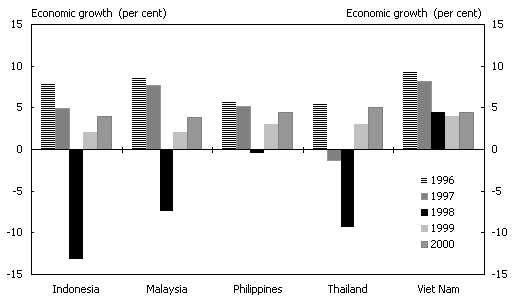
Diagram 4: Economic growth in East Asian economies (1996-2000)
The East Asian financial crisis underscored vulnerabilities in the economic and social gains achieved by many Asian countries. Millions of people fell back into poverty, threatening 30 years of development progress. Together with other donors, Australia is continuing its active engagement to assist regional countries return to sustained growth and limit the potential for recurrence of the crisis. Forecasts suggest that countries recovering from the East Asian financial crisis will achieve significant growth in 2000. Improved governance is the key to the region's long-term recovery and sustainable future. Strengthening economic management, public sector reform, civil society and legal and judicial development are key elements of this.
Indonesia was severely affected by the financial crisis and has a major challenge to return to sustainable growth. The new government is embarking on significant economic and civil reforms as it seeks to rebuild economic growth and welfare gains eroded during the crisis. Australia is committed to assisting Indonesia with aid flows that are significantly higher than pre-crisis levels.
The creation of a stable and viable East Timor presents a major challenge and is crucial to the stability of the region. Australia will continue its major commitment to the East Timorese, to help build the foundations for a democratic and independent nation.
Papua New Guinea continues to face major development challenges. It has some of the worst social indicators in the world, particularly in education and health. The new Treaty on Development Cooperation strengthens Australia's partnership with PNG, and will enable the two governments to focus on performance in targeting Australia's aid.
Pacific Island countries continue to face their own set of development issues, particularly a vulnerability to external social, economic and environmental forces. Australia provides crucial assistance for education and training, health, environment and natural resources and promoting private sector development.
Australia's Future Aid Agenda
Focus on poverty reduction
To have the greatest impact on poverty reduction and sustainable development the Australian aid program will continue to build developing country capacity in key areas including health, education, rural development and infrastructure. Equally, it will promote good governance as an essential contributor to participative development and economic growth that delivers sustainable benefits for poor people. This includes strengthening the capacity of institutions to formulate and implement economic and social policy and to participate in the growth of the world economy.
Aid donors and recipients both recognise that, in the absence of effective governance, aid efforts in support of poverty reduction and economic growth will be undermined. Australia's policy in dealing with partner governments is to make a practical difference through active engagement. This applies to economic governance as well as civil and political rights. Australia's support is focused on practical measures aimed at building capacity in partner countries to institute reforms. Their policies and commitment to reform will be taken into account when considering the allocation of Australian aid.
Maximising sustainable poverty reduction through development cooperation is not easy, but it is achievable. It requires prioritising Australia's aid on the basis of good country and sectoral knowledge of the underlying causes of poverty. It also requires understanding that such interventions can only be truly effective where domestic policies are supportive. Australia aims to provide well targeted, highly effective aid through country and sectoral strategies and other planning tools.
Partnerships for development
Ensuring Australia's aid meets partner needs is a key priority. Strong partnerships with recipient countries are fundamental to the development and delivery of Australia's aid program. Australian aid is guided by strategies that are developed in consultation with partner countries and are consistent with their broader development plans. Australia will maintain the commitment to build local capacity, transfer skills and involve local personnel in the design, implementation, monitoring and evaluation of aid activities.
Delivering quality aid
Australia's aid needs to have appropriate objectives and design, be managed in a professional manner, and achieve sustainable outcomes. The performance of Australian aid will continue to be measured to maintain and improve the quality of programs.
Community involvement in the aid program
The Australian Government is committed to involving the Australian community in delivering the aid program. Many Australians play an active role in grassroots aid work, either as volunteers or as members of non government organisations. The aid program will support and encourage these efforts. The Australian Government will also support an active program of community outreach, providing development education and information services, particularly to regional and rural Australia. These activities aim to build community understanding, involvement in, and support for Australia's aid program.
Community involvement and outreach will further enhance the Australian identity of the aid program, built around Australian expertise and goods. About 80 per cent of the aid program is sourced from Australian (and New Zealand) suppliers. This provides a significant boost for Australia's regional and rural areas, which are a major source of goods and services. At the same time opportunities for recipient countries to be involved in the delivery of Australian aid will be maximised, to build local capacity and promote partnerships between these countries and Australia.
1 ODA - Official Development Assistance. OA - Official Assistance (flows that meet all the tests of ODA but are directed to more advanced countries).
2 Countries classified as follows: Least Developed Countries (LLDC), Lower Income Countries (LIC), Lower Middle Income Countries (LMIC), Upper Middle Income Countries (UMIC) and High Income Countries (HIC). OOF - Other Official Flows (official sector transactions to aid eligible nations that do not meet ODA/OA criteria).
3 Source: DAC 1998