
|
|
| Home | Search | Site Map | Help | |




Appendix C: Tax Expenditures
This appendix provides a brief overview of the effect on revenue of the concessional taxation treatment of specific groups and/or activities. Consistent with data published in previous Tax Expenditures Statements (TES), all the data contained in this appendix have been compiled on a cash basis.
Individuals and businesses derive financial benefits from various tax concessions. These concessions are usually delivered by tax exemptions, deductions, rebates or reduced rates. They can either reduce or delay the collection of tax revenue. The Government can use taxation concessions to allocate resources to different activities in much the same way that it can use direct expenditure programmes. For this reason, and noting their direct impact on the fiscal balance, these tax concessions are generally called `tax expenditures'.
Table C1 provides estimates for the period from 1996-97 to 2003-04 of aggregate tax expenditures. These estimates are based on data compiled for the 1997-98 Tax Expenditures Statement published in July 1999.
The New Tax System and The New Business Tax System involve significant reforms to both expenses and revenues - some of which will impact on the costings of tax expenditures. The treatment of The New Tax System in the figures in Table C1 is as follows:
- Those measures that do not fundamentally alter the way in which a tax is assessed, and therefore do not affect the benchmarks against which a tax expenditure is costed (see Attachment A of the 1997-98 TES), include the impact of The New Tax System in their estimates/projections. For example, any tax expenditures relating to personal income will take into account the new personal income tax rates which, under The New Tax System, come into effect from July 2000.
- The impact of The New Tax System measures that fundamentally alter the way in which a tax is assessed, and which therefore require an alteration to the benchmark, such as changes to the taxation regime applying to trusts, have not been included in the tax expenditure costings below.
Tax expenditures based on revised benchmarks for The New Tax System and The New Business Tax System are due to be released in the 1999-2000 Tax Expenditures Statement later this year.
Table C1: Aggregate Tax Expenditures 1996-97 to 2003-04
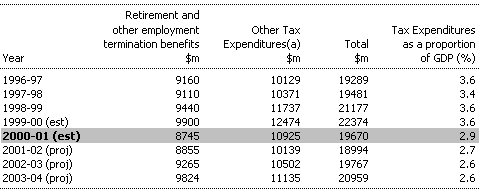
(a) These estimates do not include measures allowing delayed payments of tax.
In analysing the data presented in Table C1, there are a number of considerations that must be kept in mind.
- These figures will understate the total cost to revenue of tax expenditures. The TES does not provide a comprehensive listing of all tax expenditures, and some of those that are identified have not been costed due to a lack of data.
- Tax expenditures in the form of delayed tax payments (such as depreciation allowances, which merely defer tax revenue collections to a later date), have been excluded from the estimates of aggregate tax expenditures.
- Changes over time in methodology and available data used for calculating the cost of particular expenditures means that there can be quite large revisions to tax expenditure estimates. Therefore, particular tax expenditure estimates may not be strictly comparable from year to year.
- Forward projections for the outyears can be subject to considerable uncertainty. Caution should be exercised when trying to draw conclusions on longer-term trends.
- Individual expenditures can have further methodological issues. For example, see Appendix B of 1997-98 Tax Expenditures Statement, which discusses methodological issues in relation to Retirement and Other Employment Termination Benefits.