|
|
| Home | Search | Site Map | Help | |




Part II: Overview of General Government Net Capital Investment and Capital Appropriations
Table 3: Estimates of Commonwealth General Government
Net Capital Investment(a)
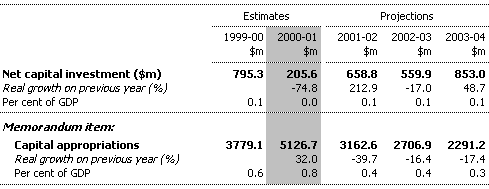
(a) Net capital investment is defined as the change in the balance sheet value of non-financial assets (for example, property, plant and equipment). There are some significant classification differences between the net capital investment estimates reported in this Statement - which is prepared using accounting standard estimates of non-financial assets - and the GFS estimates used in the calculation of the fiscal balance.
Net capital investment for the general government sector is estimated at $206 million in 2000-01 and $2.1 billion over the forward years.
The contraction in net capital investment in 2000-01 largely reflects property sales in the Department of Defence, the Commonwealth Scientific and Industrial Research Organisation (CSIRO) and DOFA.
Estimates presented in Table 3 are disaggregated and are more fully explained in Part III of this statement, which deals with expenses and net capital investment by portfolio.
Reconciliation of Net Capital Investment since the 1999-2000 Budget
Table 4: Reconciliation of Estimates of Commonwealth General Government Net Capital Investment(a)
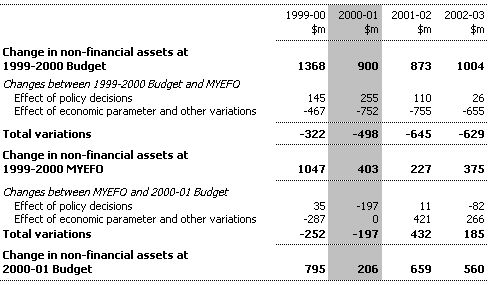
(a) Net capital investment is defined as the change in non-financial assets. Capital policy decisions as shown above do not include capital measures that fall outside this definition, for example equity injections to reduce an agency's balance sheet liabilities.
Table 4 provides a reconciliation of the 2000-01 Budget, MYEFO and 1999-2000 Budget net capital investment estimates, showing the effect of policy decisions and economic parameter and other variations since the estimates were published in the 1999-2000 Budget.
The variations in capital investment estimates since MYEFO reflect the impact of policy decisions and other changes.
Policy Decisions
The effect of policy decisions has been to increase net capital investments by $35 million in 1999-2000, decrease net capital investment by $197 million in 2000-01, increase net capital investment by $11 million in 2001-02 and decrease net capital investment by $82 million in 2002-03. These movements are largely due to:
- the provision by the Government of additional funding to the Department of Defence of $208 million in 2000-01 for the enhancement of two Collins class submarines and for other key activities, including logistic support and the introduction of new corporate and information management systems;
- the Government providing the Australian Broadcasting Corporation (ABC) and Special Broadcasting Service Corporation (SBS) with capital funding of $37 million and $29 million respectively over four years for Digital broadcasting - resourcing for digital equipment;
- the provision of $22 million in the Budget year and $69 million over the Budget and forward years for Indian Ocean Territories Infrastructure Development Programme. This supports the Government's objective of bringing the public infrastructure on the Cocos (Keeling) Islands and Christmas Island up to mainland standards;
- the Establishment of the Administrative Review Tribunal in the Attorney-General's portfolio. The Government will provide a capital injection of up to $15 million in 2000-01 to make possible the merger of the Administrative Appeals Tribunal, the Social Security Appeals Tribunal, the Refugee Review Tribunal and the Migration Review Tribunal;
- decisions by the Government to provide additional capital funding to the Australian Taxation Office to develop computer software for implementation of the Business Tax Reform measures and to develop computer software to deliver the Fuels Sales Grants Scheme; and
- property sales in the Department of Defence and the CSIRO totalling $541 million and $107 million respectively over the Budget and forward years.
Parameter and Other Variations
Parameter and other variations since MYEFO have led net capital investment to decrease by $287 million in 1999-2000, remain unchanged in 2000-01, increase by $421 million in 2001-02 and by $266 million in 2002-03. These variations are largely due to:
- variations in opening balances following completion of 1998-99 agency audits by the Australian National Audit Office (ANAO). This reduced non-financial assets by $30 million in 1999-2000;
- a decrease of $139 million in 1999-2000, reflecting an increase in disposals of housing stock by the Defence Housing Authority (DHA);
- an increase in the contingency reserve to compensate for an apparent conservative bias in agencies' capital expenditure strategies. With the introduction of accrual budgeting, a number of agencies are still in the process of fully developing their out-year asset replacement strategies; and
- a reallocation between expenses and capital expenditure in Defence, including for Australia's participation in East Timor. The Defence capital budget is financed from within an overall global budget that covers both recurrent and capital requirements. This has resulted in an increase in capital expenditure of $193 million in 1999-2000, a decrease in capital expenditure of $28 million in 2000-01 and increases of $368 million in 2001-02 and $22 million in 2002-03.
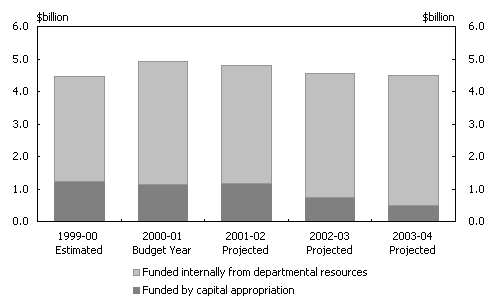
Chart 1: Capital Expenditure in General Government Agencies(a)
(a) Capital expenditure is defined as the purchase of non-financial assets exclusive of inventories.
Chart 1 shows that the Commonwealth is moving towards agencies funding a greater proportion of their capital expenditure from internal sources. This reflects the adoption of the accrual budgeting framework, which funds agencies for the full price of their inputs, including for the depreciation of their assets. Accordingly, agencies are now able to budget and fund internally the replacement of capital assets as their useful life comes to an end.
Chart 2: Summary of Capital Appropriations
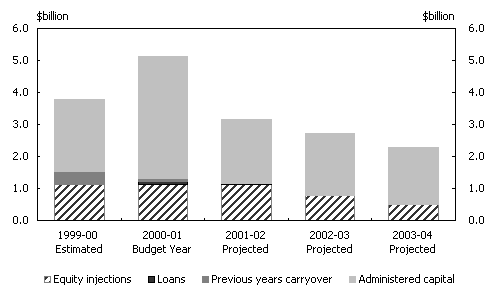
The Government anticipates making an aggregate capital investment of $5.1 billion in 2000-01 and a total of $13.2 billion over the Budget and forward years.
The large increase in administered capital in 2000-01 relates to the Commonwealth's commitment that the States and Territories will be no worse off under the implementation of The New Tax System. The States and Territories will be advanced $1.7 billion in 2000-01, an investment in a financial asset from the Commonwealth's perspective, which will be repayable without interest.
Four agencies account for three-quarters of the capital appropriations over the Budget and forward years:
- the Department of Finance and Administration, at $3.4 billion, predominantly to fund the payment of superannuation liabilities as Commonwealth employees resign or retire;
- the Department of Education, Training and Youth Affairs (DETYA), at $2.4 billion, to fund Higher Education Contribution Scheme (HECS) loans on behalf of students of higher education institutions and ABSTUDY Supplement Loan Scheme;
- the Department of Defence, at $2.3 billion, which is associated with the additional Government contribution to Defence that is required to fund Defence's departmental outcome appropriation to the Government agreed level of global funding; and
- the Treasury, at $1.8 billion, largely being the advance to States and Territories associated with the implementation of The New Tax System.
The Government is providing the ABC with a $150 million loan facility to assist in the second stage of its relocation to new premises in Ultimo, New South Wales and to enable the ABC to re-finance, on budget, current commercial debt facilities as they mature.