
|
|
| Home | Search | Site Map | Help | |



The Commonwealth Charter of Budget Honesty Act 1998 requires that the Final Budget Outcome be based on external reporting standards. In accordance with the Charter, the major external standards used in the Final Budget Outcome are the Australian Bureau of Statistics (ABS) accrual Government Finance Statistics (GFS) framework and Australian Accounting Standards, including Australian Accounting Standard No. 31 Financial Reporting by Governments (AAS31). The Charter also requires that departures from applicable external reporting standards be identified.
The major fiscal aggregates (including the fiscal and underlying cash balances) are based on the accrual GFS framework. The next section provides a brief overview of the GFS framework, including the major fiscal aggregates, and the AAS reporting framework. Further information can be found in Budget Strategy and Outlook 2002-03, Statement 10: External Reporting Standards and Budget Concepts.
The GFS reporting framework is a specialised statistical system designed to support economic analysis of the public sector. It allows comprehensive assessments to be made of the economic impact of government and is consistent with international statistical standards (the System of National Accounts 1993 (SNA93) and the International Monetary Fund's (IMF) Government Finance Statistics Manual 2001). Additional information on the Australian accrual GFS framework is available in the ABS publication Information Paper: Accruals-based Government Finance Statistics, 2000 (Cat. No. 5517.0).
The GFS conceptual framework is divided into a number of separate statements. The GFS statements reported in the Final Budget Outcome are the operating statement, balance sheet, cash flow statement and a statement of other economic flows. Each of these statements is designed to draw out analytical aggregates or balances of particular economic significance. Taken together, these aggregates provide for a thorough understanding of the financial position of the public sector entities. A discussion of each of these statements follows.
The operating statement presents details of transactions in GFS revenues, GFS expenses and the net acquisition of non-financial assets (net capital investment) for an accounting period.
GFS revenues are defined as transactions that increase net worth and GFS expenses as transactions that decrease net worth - general government net worth is the difference between the stock of assets and liabilities and is further defined in the balance sheet section below.
GFS revenues less GFS expenses gives the GFS net operating balance. Conceptually, the net operating balance measures government saving plus capital transfers.
The net acquisition of non-financial assets (net capital investment) measures the change in the stock of non-financial assets owned by the government due to transactions. As such, it measures the net effect of purchases, sales and consumption (for example, depreciation of fixed assets and use of inventory) of non-financial assets during an accounting period.
Net acquisition of non-financial assets equals gross fixed capital formation, less depreciation, plus changes (investment) in inventories, plus other transactions in non-financial assets.
The fiscal balance (or GFS net lending/borrowing) is the net operating balance minus net capital investment.
The fiscal balance measures the Commonwealth's investment-saving balance. That is, it measures in accrual terms the gap between government savings plus net capital transfers and investment in non-financial assets. As such, it approximates the contribution of the Commonwealth general government sector to the balance on the current account in the balance of payments.
The balance sheet shows stocks of assets, liabilities and GFS net worth. Net debt is also reported in the balance sheet.
Net debt is defined as the sum of selected financial liabilities (deposits held; advances received; government securities; loans; and other borrowing) minus the sum of selected financial assets (cash and deposits; advances paid; and investments, loans and placements). Net debt is a common measure of the strength of a government's financial position. High levels of net debt impose a call on future revenue flows to service that debt.
The net worth of the general government sector is defined as assets less liabilities. For the public financial corporations and public non-financial corporations sectors, the formula becomes assets less liabilities less shares and other contributed capital. Net worth is an economic measure of wealth. It reflects the contribution of the Commonwealth to the wealth of Australia.
The cash flow statement identifies how cash is generated and applied in a single accounting period. The cash flow statement reflects a cash basis of recording (rather than an accrual basis) where the information has been derived indirectly from underlying accrual transactions and movements in balances. This, in effect, means that transactions are captured when cash is received or when cash payments are made. Cash transactions are specifically identified because cash management is considered an integral function of accrual budgeting.
The underlying cash balance (GFS surplus/deficit) is the cash counterpart of the fiscal balance, reflecting the Commonwealth's cash investment-saving balance. The underlying cash balance measure is conceptually equivalent under the current accrual framework and the previous cash framework. For the general government sector, the underlying cash balance is calculated as shown below.
Net cash flows from operating activities
plus
Net cash flows from investments in non-financial assets
less
Net acquisitions of assets acquired under finance leases and similar arrangements5
equals
Underlying cash balance
The headline cash balance is calculated by adding `cash flows from investments in financial assets for policy purposes' to the underlying cash balance. Cash flows from investments in financial assets for policy purposes include equity transactions and net advances.6 Examples of equity transactions include equity injections into controlled businesses and privatisations of government businesses. Net advances include net loans to the States, net loans to students under the Higher Education Contribution Scheme (HECS), and contributions to international organisations that increase the Commonwealth's financial assets.
The statement of other economic flows outlines changes in net worth driven by economic flows other than GFS revenues and GFS expenses. GFS revenues, GFS expenses and other economic flows sum to the total change in net worth during a period. The majority of other economic flows for the Commonwealth general government sector arise from price movements in its assets and liabilities.
To assist in analysing the public sector, GFS data are presented by institutional sector. GFS distinguishes between the general government sector, the public non-financial corporations sector and the public financial corporations sector, as shown in Figure A1.
Figure A1: Institutional structure of the Public Sector
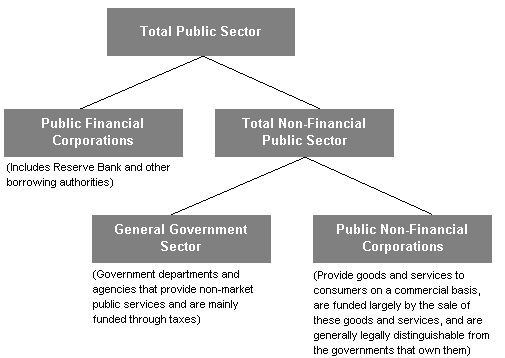
Budget reporting focuses on the general government sector. The general government sector provides public services that are mainly non-market in nature, and for the collective consumption of the community, or involve the transfer or redistribution of income. These services are largely financed through taxes and other compulsory levies, although user charging and external funding have increased in recent years. This sector comprises all government departments, offices and some other bodies.
Australian Accounting Standard No. 31 Financial Reporting by Governments (AAS31) requires governments to prepare accrual-based general purpose financial reports, including in relation to the assets they control and any liabilities incurred, their revenues and expenses, and cash flows. Reporting under this framework is intended to provide a consolidated overview of the financial performance and position of government, including in the area of financing and investing activities.
There are three main general purpose statements that must be prepared in accordance with the AAS31 framework. These are:
In addition to these general purpose statements, the standard requires notes to the financial statements to be prepared which report disaggregated information in relation to the financial performance and financial position of the government. The notes should also include other information seen as relevant to users.
While AAS31 provides a general framework for accrual budgeting and financial reporting by governments, compliance with all other applicable accounting standards is required. Exceptions to this rule are explicitly stated in AAS31.
A full set of AAS31 financial statements and accompanying notes prepared for the general government sector can be found in Part III. These statements are derived from audited financial statements with the exception of the Department of Defence, where an audit opinion is pending.
There is a general consistency of treatment of the elements of financial statements between GFS and accounting standards. Both frameworks are based on the concept of economic events that give rise to stocks and flows. As a result, the definitions of stocks are broadly similar under the two frameworks and relate to the control of economic benefits, while flows are defined with reference to changes in stocks.
The GFS and AAS31 definitions of the scope of the public sector agree in almost all cases, with AAS31 recommending the same segmentation of the public sector into general government, public non-financial corporations and public financial corporations sectors.
Transactions are generally treated in a similar manner by GFS and accounting standards; however, where GFS is a framework designed to facilitate macro-economic analysis, AAS31 is designed as a standard for general purpose financial reporting. The different objectives of the two systems lead to some variation in the treatment of certain items. This differing treatment relates predominantly to the definitions of revenues and expenses under the two frameworks.
In particular, revaluations of assets and liabilities are classified differently under the AAS31 and GFS standards. Major revaluations include: writedowns of bad and doubtful debts (excluding those that are mutually agreed); changes in the valuation of superannuation liabilities; and gains and losses due to changes in foreign exchange rates and interest rates.
Under AAS31 reporting, valuation changes may affect revenues or expenses and therefore the operating result. However, under GFS reporting, revaluations are not considered to be transactions (that is, they are considered to be other economic flows) and accordingly do not form part of revenues or expenses. Therefore, most revaluations are not taken into account in the calculation of the GFS net operating balance or fiscal balance. However, revaluations still impact on GFS assets and liabilities, as can be seen in the statement of other economic flows.
Some of the major differences between the GFS and AAS31 treatments of transactions are outlined in Table A1. Further information on the differences between the two systems is provided in the ABS publication Information Paper: Accruals-based Government Finance Statistics, 2000 (Cat. No. 5517.0).
Table A3: Selected differences between AAS31 and GFS reporting standards
| Issue |
AAS31 Treatment |
GFS Treatment |
| Asset writedowns |
Treated as part of operating expenses. |
Treated as revaluations (other economic flows), except for mutually agreed writedowns, and therefore removed from expenses. |
| Gains and losses on assets |
Treated as part of operating revenues/expenses. |
Treated as revaluations (other economic flows) and therefore removed from revenues/expenses. |
| Provisions for bad and doubtful debts |
Treated as part of operating expenses and included in the balance sheet as an offset to assets. |
Act of creating provisions
is not considered an economic event and is therefore not considered an
expense or included in the balance sheet. |
| Interest flows related to swaps and other financial derivatives |
Treated as operating revenues and expenses. |
Treated as financing transactions and so not included in revenues and expenses. |
| Acquisition of defence weapons platforms |
Treated as capital expenditure. Defence weapons platforms appear as an asset on the balance sheet. Depreciation expense on assets is recorded in the operating statement. |
Treated as an expense. Defence weapons platforms do not appear as an asset on the balance sheet and no depreciation is recorded in the operating statement. |
| Commonwealth general government sector investments in public corporations |
Investments in public corporations are valued at historic cost in the balance sheet. |
Investments in public corporations are valued at current market value. For publicly listed corporations, the share price is used to calculate market value. For non-listed corporations, the current value of net assets is used. |
| Public debt net interest |
Premiums and discounts on the repurchase of debt are included in public debt net interest expenses at the time of repurchase, regardless of whether the stock is cancelled at that time. Issue premiums and discounts are amortised over the life of the stock. |
Repurchase premiums and discounts are treated as economic revaluations at the time the debt is repurchased (provided it is valued at historical cost). The GFS cash flow statement includes repurchase premiums or discounts in the year that the repurchased stock is cancelled or matures. |
| Finance leases |
Treats finance leases as if an asset were purchased from borrowings. That is, the lease payment is split into an interest component (which is shown as an operating expense) and a principal component. The asset and the liability are recorded on the balance sheet. This convention does not apply to the cash flow statement, which does not record the acquisition of the asset or the liability. |
As per the accounting standard, except that the GFS cash flow statement includes the acquisition of the asset as a supplementary item for the calculation of the surplus/deficit (underlying cash balance). |
Table A2 reconciles GFS revenue and expenses with their AAS31 counterparts.
Table A4: Reconciliation of GFS and AAS31 revenue and expenses
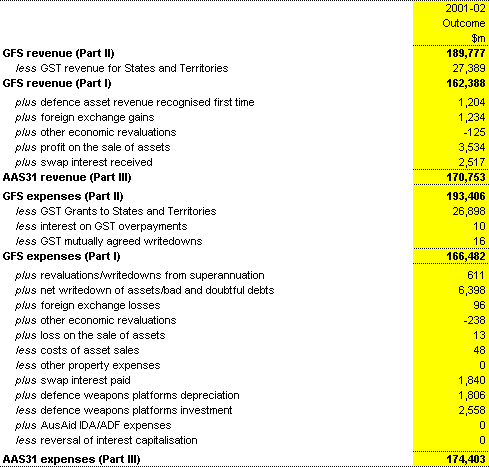
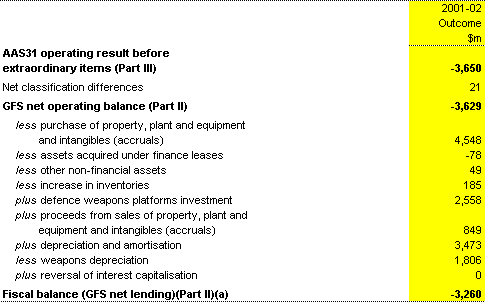
Table A3 reconciles the accounting operating result to the GFS net operating balance and the fiscal balance (GFS net lending).
AAS31 revenues less expenses calculate the AAS31 net operating result. Similarly, GFS revenues less expenses calculate the GFS net operating balance.
Consequently, the reconciliation between the AAS31 operating result before extraordinary items and the GFS net operating balance relates directly to differences in the definitions of revenues and expenses, as shown in Table A2 above.
The second part of the reconciliation shows the adjustment for net capital investment required to derive the fiscal balance from the GFS net operating balance.
As discussed previously, fiscal balance is calculated as the net operating balance less net capital investment. This is a useful economic indicator as it represents the gap between government saving (less capital transfers) and investment, and so is included at the end of the GFS operating statement. In AAS31 there is no equivalent measure to the fiscal balance. That is, the AAS31 statement of financial performance stops at the operating result and includes no information on net capital investment. Under the accounting standards framework, the equivalent indicator to the fiscal balance would show whether profits (that is, the net operating result) are sufficient to fund net capital investment.
Table A5: Reconciliation of AAS31 net operating result and fiscal balance
Under the Intergovernmental Agreement on the Reform of Commonwealth-State Financial Relations (the IGA), all GST receipts are appropriated to the States and Territories and thus are not available for expenditure by the Commonwealth. As such, the GST is a State tax, with the Commonwealth acting as the States' agent in the collection of the tax. Consequently, collections of GST from taxpayers and payments of the GST revenue to the States are not recorded as revenues and expenses of the Commonwealth in Part I.
Under the IGA, the Commonwealth has guaranteed that the budgetary position of each individual State and Territory will be no worse off than it would have been had the GST reforms not been implemented (referred to as the Guaranteed Minimum Amount (GMA)). Grants to the States to meet this no worse off funding benchmark are given the notional accounting title of `general budget assistance to the States' (GBA) and are recorded as expenses of the Commonwealth.7 GBA comprises Budget Balancing Assistance (BBA) grants paid in accordance with the provisions of the IGA (based on mid-June estimates) and adjustments to account for any divergence between this amount and the amount required to meet the GMA (given actual GST cash collections).8
General budget assistance to the States in 2001-02 was $549 million greater than the 2002-03 Budget estimate, reducing both the fiscal and underlying cash balances. This was predominantly due to actual cash GST collections falling below the Budget estimate.
In Part II the accounts are presented including GST as Commonwealth revenue.
The two different accounting approaches (applied in Part I and Part II respectively) result in different net impacts on the fiscal balance in 2001-02. In Part I, the total net impact on the fiscal balance equals general budget assistance to the States. In Part II, the fiscal balance impact is the difference between GST revenue and the Guaranteed Minimum Amount (GMA) paid to the States in 2000-01 (comprising BBA grants and GST grants made under the Commissioner of Taxation's mid-June determination of cash GST receipts). This results in the fiscal balance outcome shown in the Government Finance Statistics (GFS) general government operating statement in Part II being $466 million greater than the fiscal balance reported in Part I and elsewhere in the Final Budget Outcome. A reconciliation of GFS revenue and GFS expenses in Part I and Part II is presented in Table A2.
The two different accounting approaches also flow through to differences in GFS net worth, resulting in GFS net worth in Part II being $505 million greater than GFS net worth reported in Part I and elsewhere. This difference results from the inclusion of GST receivables and payables in the GFS balance sheet in Part II.
The different accounting approaches have the same net impact on cash flows. Therefore the underlying cash balance is the same whether it is calculated using the State tax or Commonwealth tax approach.
Further information on accounting for GST and budget assistance to the States can be found on page 10 of the Final Budget Outcome 2000-01.
5 The underlying cash balance treats the acquisition and disposal of non-financial assets in the same manner regardless of whether they occur by purchase/sale or finance lease - acquisitions reduce the underlying cash balance and disposals increase the underlying cash balance. However, finance leases do not generate cash flows at the time of acquisition or disposal equivalent to the value of the asset. As such, net acquisitions of assets under finance leases are not shown in the body of the cash flow statement but are reported as a supplementary item for the calculation of the underlying cash balance.
6 Cash flows from investments in financial assets for policy purposes used to be known as net advances under the cash budgeting framework.
7 The term `general budget assistance to the States' explains aggregate changes in Commonwealth expenses under a States' agent accounting arrangement and does not appear in the IGA, which governs the actual payments from the Commonwealth to the States. GBA is calculated as the GMA less actual GST cash collections.
8 The Commonwealth finalises payment of the annual GST revenue and BBA grants to the States in mid-June. As a result, if the final outcome for GST collections for the year differs from the Commissioner of Taxation's mid-June determination then GBA will not equal BBA grants paid.