
|
|




The Australian Government funds the Australian Centre for International Agricultural Research (ACIAR) to assist Australian researchers and institutions and international research centres develop solutions to agricultural problems in developing countries. The objective of ACIAR is to develop international agricultural research partnerships that reduce poverty, improve food security and enhance natural resources management in developing countries and Australia. Collaboration with researchers in developing countries is integral to all ACIAR projects, and ACIAR provides training and infrastructure to help build the capacity of these countries to undertake and apply research.
The total appropriation for ACIAR in 2001-02 is $45.4 million. This funding will support more than 180 bilateral research projects in 27 countries, with a primary focus in the Asia-Pacific region. Under its multilateral program, ACIAR will support 19 International Agricultural Research Centres through grants that link them to Australia's agricultural research organisations. Approximately three quarters of ACIAR's research and development budget is spent on bilateral programs and one quarter on the multilateral program.
Diagram 12: Estimated bilateral research expenditure by region 2001-02
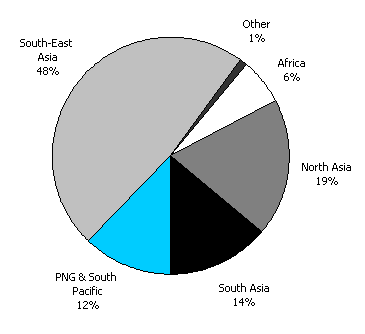
ACIAR manages bilateral projects focussing on agricultural systems economics and management, agricultural development policy, crop sciences, animal sciences, postharvest technologies, land and water resources, forestry and fisheries. ACIAR works with partner governments to identify agricultural and natural resource problems, and develop research and development projects. Collaboration with partners to apply the results of research through extension and technology transfer is a critical part of ACIAR's efforts to build expertise in developing countries. Estimated expenditure on bilateral programs in 2001-02 is $27.7 million.
The major bilateral partners of ACIAR are China, Indonesia, Viet Nam, India, Papua New Guinea, the Philippines and Thailand. During 2001-02, Australia will strengthen support for Indonesia and the Philippines by implementing a suite of new projects. Research activities will also commence in the new partner countries of East Timor and the Democratic People's Republic of Korea. ACIAR is working closely with AusAID on institution-building initiatives in Viet Nam, Cambodia and PNG and on rural development programs in PNG, India and southern Africa.
Bilateral projects that will be supported by ACIAR in 2001-02 include:
Diagram 13: Estimated multilateral research expenditure by region 2001-02
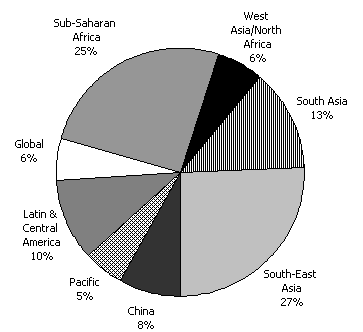
Through its multilateral program ACIAR leverages Australian development assistance by supporting international agricultural research that aims to enhance rural livelihoods, develop sustainable agriculture and improve natural resource management. Funds are provided to International Agricultural Research Centres for their core programs and also as grants for projects that complement bilateral research and development activities. Estimated expenditure on the multilateral program in 2001-02 is $10.0 million.
Examples of projects that will be funded under the multilateral program in 2001-02 include:
ACIAR's impact assessment activities will continue in 2001-02, to provide a systematic basis for establishing research priorities and to determine the impact of research activities both in partner countries and in Australia.
ACIAR funds training and development activities to assist the progress and implementation of its research. While most training is built into research projects, the John Allwright Fellowship scheme provides support to a small number of developing country scientists involved in ACIAR projects for postgraduate study at Australian universities.
ACIAR also supports cross-program training, including a range of short courses on topics such as technical writing in English, research proposal preparation, management of research and extension programs, experimental design and statistical evaluation, research and development priority setting, and biotechnology and intellectual property management. Many of these activities are financed by the Crawford Fund, which will receive $0.65 million of government funding in 2001-02.