
|
|
| Home | Search | Site Map | Help | |




The goods and services tax (GST) is levied on a broad range of goods and services across the economy at a rate of 10 per cent. Some goods and services (such as basic food, education and health services) are GST-free. For some other goods and services (such as financial supplies and residential accommodation), GST does not apply to the final sale, however the GST that has been paid on the inputs is not refundable.
The introduction of the GST was a part of The New Tax System, which included reduced personal and company taxes, a reduction in petroleum and diesel excise, the abolition of wholesales sales tax (WST) and the abolition of some State taxes.
Table A1: Reconciliation of GST cash revenue
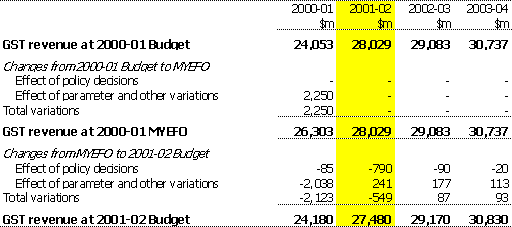
Estimated GST revenue in 2001-02 has been revised down by around $550 million since the Mid-Year Economic and Fiscal Outlook 2000-01 (MYEFO). This is primarily due to the impact of new policy decisions, including the decision to allow full input tax credits for motor vehicles purchased after Budget night.
Forecast GST cash revenue in 2000-01 has also been revised downwards by around $2.1 billion. This significant revision mainly reflects a reassessment of the net effect of transitional factors on GST revenue in the first year.
In addition, the estimated proportion of GST revenue relating to sales in 2000-01 but collected in 2001-02 has been revised upwards since MYEFO. This arises mainly because a greater share of GST revenue than originally expected is being paid by quarterly rather than monthly payers, and only three quarterly payments are being made in 2000-01. In addition, more GST collected on imports is being recognised in activity statement collections than initially estimated. This overall revision has led to a downwards revision to GST revenue in 2000-01, but has little impact on expected GST revenue in 2001-02.
Abstracting from transitional factors - which have been difficult to identify and estimate - the underlying GST base appears to be close to initial expectations.
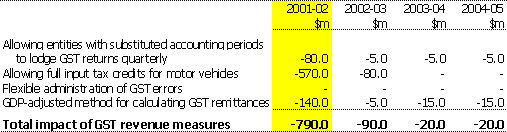
The Government has introduced a number of measures to improve GST collection arrangements and to bring forward the provision of input tax credits for motor vehicles. The revenue costs of these measures, which are predominantly transitional, are effectively borne by the Commonwealth rather than the States through the provisions of the funding guarantee under the new financial arrangements with the States.
Table A2: GST revenue measures since the 2000-01 Budget
2001-02 |
2002-03 |
2003-04 |
2004-05 | |
Australian Taxation Office: |
-80.0 |
-5.0 |
-5.0 |
-5.0 |
Entities using substituted accounting periods will be able to lodge GST returns on a quarterly basis, subject to the existing $20 million annual turnover threshold and election rules, from the first quarterly period of the 2001-02 income year. Previously, entities using substituted accounting periods were required to submit their GST returns monthly. The measure was introduced into Parliament on 5 April 2001 and will take effect on 1 July 2001.
Further details may be found in the Explanatory Memorandum to the Taxation Laws Amendment Bill (No. 3) 2001.
2001-02 |
2002-03 |
2003-04 |
2004-05 | |
Australian Taxation Office: |
-570.0 |
-80.0 |
- |
- |
GST registered businesses will be entitled to full input tax credits for motor vehicles, including trucks, acquired after midnight Budget night, 22 May 2001.
Under The New Tax System, WST, generally 22 per cent on vehicles, was replaced with 10 per cent GST, leading to lower tax. GST registered businesses are able to claim back the GST they pay on inputs used to make taxable and GST-free supplies. Businesses able to claim input tax credits would go from 22 per cent WST to no tax at all. The Government was concerned to minimise the disruption to the market that could have occurred if businesses were to defer purchasing motor vehicles in anticipation of these cost reductions. Accordingly, the A New Tax System (Goods and Services Tax Transition) Act 1999 included provisions to phase in input tax credits for all motor vehicles. Input tax credits for new vehicle purchases were denied for the first 12 months of the GST, 50 per cent input credits were to be allowed in the second year of operation from 1 July 2001 and full input tax credits were to be available from the third year onwards.
The measure will pull forward the start date for full input tax credits from 1 July 2002 to midnight Budget night, 22 May 2001. The measure should reduce the cost of motor vehicles to businesses by around 9.1 per cent, compared to prices before 1 July 2000.
2001-02 |
2002-03 |
2003-04 |
2004-05 | |
Australian Taxation Office: |
- |
- |
- |
- |
This measure ensures that the Commissioner of Taxation has the discretion to provide taxpayers with simpler ways to correct errors in GST returns. It reinforces existing practice whereby taxpayers have been remedying GST errors made in a Business Activity Statement (BAS) by making a compensating change in the next BAS. This avoids the need for taxpayers to submit an amended BAS for an earlier period. The measure was announced on 5 April 2001 and has effect from 1 July 2000.
2001-02 |
2002-03 |
2003-04 |
2004-05 | |
Australian Taxation Office: |
-140.0 |
-5.0 |
-15.0 |
-15.0 |
GST-registered taxpayers with turnover of $2 million or less generally have the option to pay quarterly GST instalments worked out for them by the Australian Taxation Office (ATO) using the GDP-adjusted method. Furthermore, certain primary producers and special professionals (such as authors, entertainers and sportspersons) who opt for the GDP-adjusted method pay two GST instalments in respect of each income year, with the instalments corresponding with the third and fourth quarters of the income tax year.
This measure was announced on 22 February 2001 and applies to tax periods ending on or after 22 February 2001.
Taxpayers who choose this option will pay quarterly instalments but will only have to submit one annual GST return, due not later than the time they submit their annual income tax return (or 28 February 2002 for the current year). Those taxpayers will receive customised instalment forms from the ATO that reduce information reporting requirements, particularly in respect of other taxes that do not apply. For the 2000-01 year, where it is not yet possible to base the third and fourth instalments on an annual GST amount, the instalments will be an amount equal to the second quarter BAS.
For cases where previous years' adjusted payments are not suitable, provisions to vary the instalments advised by the ATO are available. To ease the transition to this system for taxpayers who elect to vary their payments, there will be a one-off 25 per cent margin for error instead of 15 per cent in the September 2001 quarter.
Further details may be found in the Explanatory Memorandum to the Taxation Laws Amendment Bill (No. 3) 2001.