




Australian Taxation Office
- Outcomes and output groups
- Changes to outcomes and outputs
- Outcome 1 - Description
- Outcome 1 - Resourcing
- Outcome 1 - Contribution of outputs
- Performance information for Outcome 1
- Evaluations
Section 2: Outcomes and outputs information
Outcomes and output groups
The map on the following page shows the relationship between Government outcomes and the contributing outputs for the Australian Taxation Office (ATO). Financial detail for Outcome 1 by output appears in Table 2.1 while non-financial information for Outcome 1 appears in Table 2.2.
Map 2: Outcomes and output groups
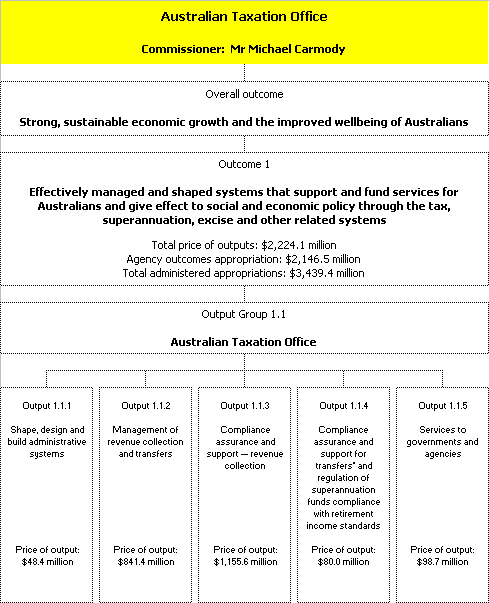
* Transfers - movement of money that is not revenue for example tax offsets, grants, super guarantee vouchers and benefits distribution.
Changes to outcomes and outputs
There are changes to the outcome and outputs from the previous year.
The original ATO outcomes and outputs framework was developed while the ATO was in the early stages of preparing for Tax Reform. At the time, the ATO could not predict what impact reform would have on the nature and volume of its work. As Tax Reform progressed and the administrative implications of an integrated design were better understood, the ATO recognised the need for an updated framework that was both robust and flexible enough to:
- reinforce strategic management of the systems administered by the ATO;
- support ATO strategic directions; and
- provide greater transparency for Parliament.
The new framework, developed as part of the ATO's Pricing Agreement 2002-05, reflects the business deliverables and the new approaches to the way we plan and manage internally to meet those deliverables. It also reflects changes following an audit by the Australian National Audit Office, ATO Performance Reporting under the Outcomes and Outputs Framework (Audit Report No. 46 2000-01). Together, the outputs and new measures provide greater transparency in reporting.
The ATO's role has broadened beyond revenue collection to delivering a range of economic and social policy through integrated systems and processes. This broader role is reflected in the new outcome and outputs framework, the ATO's organisational structure and governance processes.
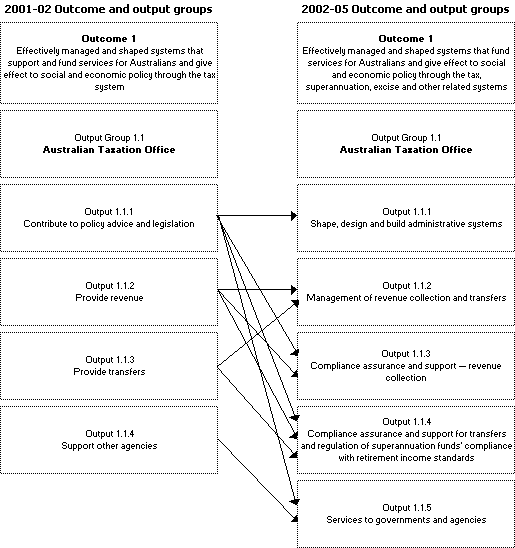
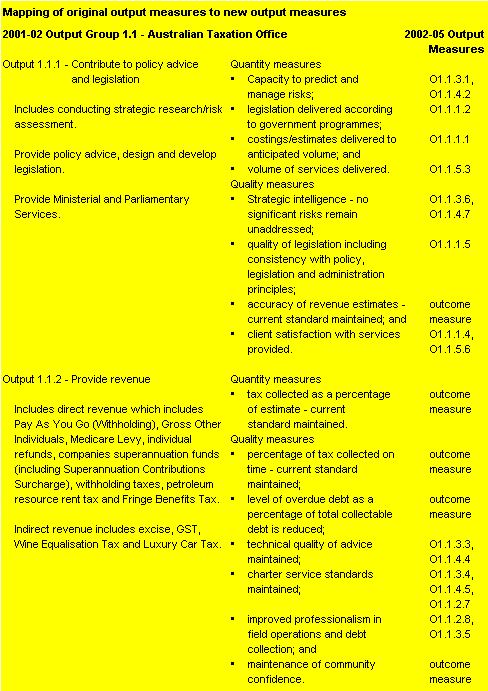
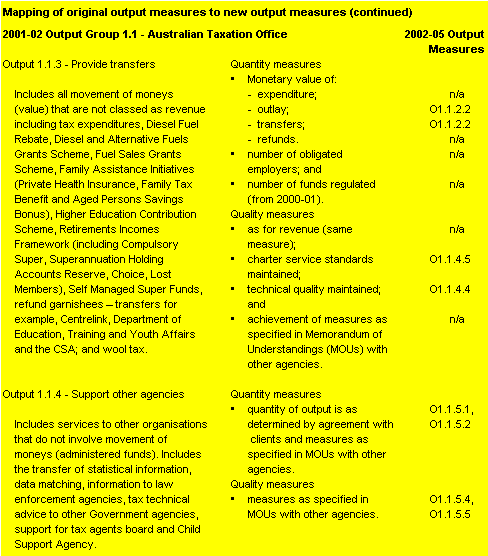
Map 3 (on the following page) shows the mapping of the original outputs to the outputs in the new framework. Map 4 details the mapping of the original output measures to the new measures under the new framework. Relevant measures have been incorporated into the new framework.
The new framework is reflected in the ATO's internal planning documents from 2002-03.
Map 3: Outcomes and output groups
Map 4: Mapping of original outputs to outputs in new framework
Map 4: Mapping of original outputs to outputs in new framework (continued)
Outcome 1 - Description
Effectively managed and shaped systems that support and fund services for Australians and give effect to social and economic policy through tax, superannuation, excise and other related systems.
The single government outcome relating to the ATO properly reflects the nature of the services of the ATO. It provides an integrated platform for a viable and sustainable revenue administration. This is achieved through ensuring:
- effective and efficient administrative design for systems the ATO administers, consistent with policy intent and meeting community needs;
- an effective relationship and communication with taxpayers and Government;
- cost-effective collection of tax, transfers of revenue (to other agencies) and delivery of benefits through the tax system;
- compliance behaviour is maintained through providing comprehensive education and support services to the community and developing compliance strategies to address compliance risks; and
- community confidence is maintained through working in partnership with the community to foster community ownership of the tax system and providing timely and professional service;
to enable Government to deliver on social and economic policy. The integrated approach enables cost-effective delivery of both revenue and transfers.
Measures affecting Outcome 1
A Better Superannuation System - allow temporary residents to access their superannuation after they have departed Australia
The Government will allocate $14.3 million over five years for the Australian Taxation Office (ATO) to implement and administer the scheme to allow temporary residents to access their superannuation after they have departed Australia.
This measure will involve expenditure of $2.3 million in 2002-03, $1.5 million in 2003-04, $1.5 million in 2004-05 and $1.5 million in 2005-06 which is being fully absorbed within the existing resourcing of the ATO. The Government has provided additional funding of $7.5 million in 2001-02.
See also the related revenue measure titled A Better Superannuation System - allow temporary residents to access their superannuation after they have departed Australia in the Treasury portfolio in Budget Paper No. 2.
A Better Superannuation System - Government superannuation co-contribution for low income earners
From 1 July 2002, a Government superannuation co-contribution will be introduced in place of the existing rebate for personal superannuation contributions made by eligible low income earners. The co-contribution will match personal undeducted contributions by low income earners made on or after 1 July 2002.
A maximum co-contribution of $1,000 will be payable in respect of individuals whose assessable income and reportable fringe benefits do not exceed $20,000 per annum. The maximum co-contribution will be reduced by 8 cents for each dollar of assessable income and reportable fringe benefits over $20,000 (up to $32,500). The co-contribution will be treated as an undeducted contribution for tax purposes.
To be eligible for the co-contribution, an individual must not be aged 71 or more and must be ineligible to claim a tax deduction for their personal contributions. Persons who receive spouse, but not employer, superannuation support will be eligible for a tax deduction for their personal contributions.
See the related expense measure titled A Better Superannuation System - Government superannuation co-contribution for low income earners - implementation and administration (below) and also the related revenue measure titled A Better Superannuation System - replacement of the rebate for personal superannuation contributions in the Treasury portfolio in Budget Paper No. 2.
A Better Superannuation System - Government superannuation co-contributions for low income earners - implementation and administration
The Government has allocated $29.5 million over four years to the Australian Taxation Office (ATO) to implement and administer the co-contribution for low income earners. This measure will involve expenditure of $16.8 million in 2002-03, $4.5 million in 2003-04, $4.1 million in 2004-05 and $4.1 million in 2005-06.
This measure is being fully absorbed within the existing resourcing of the ATO.
See the related expense measure titled A Better Superannuation System-Government superannuation co-contribution for low income earners in the Treasury portfolio (above).
A Better Superannuation System - quarterly Superannuation Guarantee contributions
The Government will provide the Australian Taxation Office with funding of $31.9 million to implement and administer the changes to the Superannuation Guarantee arrangements that will require all employers to make Superannuation Guarantee contributions on behalf of their employees at least on a quarterly basis instead of a yearly basis. The funding includes provision for a communication campaign. This measure will take effect from 1 July 2003.
See also related capital and revenue measures titled A Better Superannuation System - quarterly Superannuation Guarantee contributions in the Treasury portfolio in Budget Paper No. 2.
ATO pricing review - enhanced ATO resources
The Government accepted the recommendation of the independent pricing review of the Australian Taxation Office (ATO) for additional funding for base tax administration functions. The measures will improve service levels, help in achieving further gains in voluntary compliance and lead to increased revenue over the forward estimates period and beyond.
In addition, the independent pricing review identified large business compliance and small business (income tax and fringe benefits tax) field services as areas warranting further investment. Additional funding for large business compliance activities, including research, advice, education, revenue management and active compliance, will result in increased taxation revenue. Increased funding for small business field services will improve the advisory services provided to small businesses, enhance the ATO's capacity to identify emerging risks and assist in improving compliance behaviour.
See also the related revenue measure titled ATO pricing review - additional revenue from enhanced ATO resources in the Treasury portfolio in Budget Paper No. 2.
Baby Bonus
The Government will be providing further tax relief to families, through the introduction of the Baby Bonus. The Baby Bonus recognises that one of the hardest financial times for families is the birth of their first child, when one partner gives up or reduces their paid employment.
The Baby Bonus is to take effect on 1 July 2002 and will apply to a first child born on or after 1 July 2001. As a transitional measure, for families who already have children it will apply to a child born on or after 1 July 2001. Parents adopting or otherwise gaining legal custody of a first child will also be eligible. Every year for up to five years a parent will be able to claim up to $2,500 of the tax payable on their income earned in the year prior to the birth of their child. A minimum annual benefit of $500 will be available to parents with annual incomes of $25,000 or less. Where the parent returns to work, the entitlement will be reduced in proportion to the income earned. The benefit will also be transferable between spouses.
See the related expense and capital measures titled Baby Bonus - implementation and administration and the revenue measure titled A Better Superannuation System -superannuation from the Baby Bonus in the Treasury portfolio in Budget Paper No. 2.
Baby Bonus - implementation and administration
The Government will allocate $41.7 million over five years to the Australian Taxation Office (ATO) to implement and administer the Baby Bonus.
This measure will involve expenditure of $12 million in 2002-03, $8 million in 2003-04, $7.5 million in 2004-05 and $7 million in 2005-06 to implement and administer the Baby Bonus which will be absorbed within the existing resources of the ATO. Funding of $7.2 million has been provided in 2001-02.
See also the related expense measure titled Baby Bonus (previous page), related capital measure titled Baby Bonus - implementation and administration and the revenue measure titled A Better Superannuation System - superannuation from the Baby Bonus in the Treasury portfolio in Budget Paper No. 2.
Choice of superannuation fund and portability
The Government has allocated $28.7 million for the Australian Taxation Office (ATO) to administer choice of superannuation and undertake an extensive community education campaign to inform employees and employers of their rights and obligations in relation to choice of superannuation; and inform superannuation funds and their members about portability of existing superannuation balances. The Government will give employees the choice to determine the superannuation fund into which their Superannuation Guarantee contributions are paid, and allow members of accumulation funds to move existing benefits to their fund of choice.
These policies will increase competition, efficiency and performance within the superannuation industry and benefit members through lower fees and charges and increased returns.
This measure will involve expenditure of $12.7 million in 2002-03, $10.3 million in 2003-04, $3.4 million in 2004-05 and $2.3 million in 2005-06 which is being fully absorbed within the existing resourcing of the ATO.
Extension to the Diesel Fuel Rebate Scheme
The Government will extend eligibility for the Diesel Fuel Rebate Scheme to all diesel used for electricity generation by retail/hospitality businesses for their own use, where there is no access to commercial supplies of electricity.
The proposal extends the current scheme that provides a rebate on diesel fuel excise for the off-road use of diesel by the farming, mining, rail and shipping industries and hospitals that generate electricity using diesel fuel where there is no access to commercial supplies of electricity. This will reduce the costs of small retail/hospitality businesses generating electricity from diesel fuel where there is no access to commercial supplies of electricity.
Intergovernmental Agreement - enhanced resources for GST administration
The Government has accepted the recommendation of the independent pricing review of the Australian Taxation Office (ATO) for additional funding for tax administration functions, including GST administration.
Under the Intergovernmental Agreement on the Reform of Commonwealth-State Financial Arrangements, all GST revenue is provided to the States and Territories (the States) and collected on their behalf on a fee for service basis by the ATO.
The Commonwealth and the States at the Ministerial Council meeting of 22 March 2002 agreed additional funding will be provided to the ATO to manage greater than anticipated GST workloads and to enhance small business (goods and services tax) field services and compliance capabilities (identified by the independent pricing review as an area warranting further investment). The States pay the Commonwealth for these costs.
Further details may be found in Budget Paper No. 3, and Budget Paper No. 2 in the expense item titled Intergovernmental Agreement - enhanced resources for GST administration.
Streamlined Company Registration
The Government will simplify procedures for company registration by combining the Australian Securities and Investments Commission's company registration process with the Australian Business Number (ABN) application process managed by the Australian Taxation Office. This will reduce red tape and save businesses time and money by removing duplication.
Outcome 1 - Resourcing
Table 2.1 shows how the 2002-03 appropriations translate to total resourcing for Outcome 1, including administered expenses, revenue from government (appropriation), revenue from other sources, and the total price of outputs.
Table 2.1: Total resources for Outcome 1 ($'000)
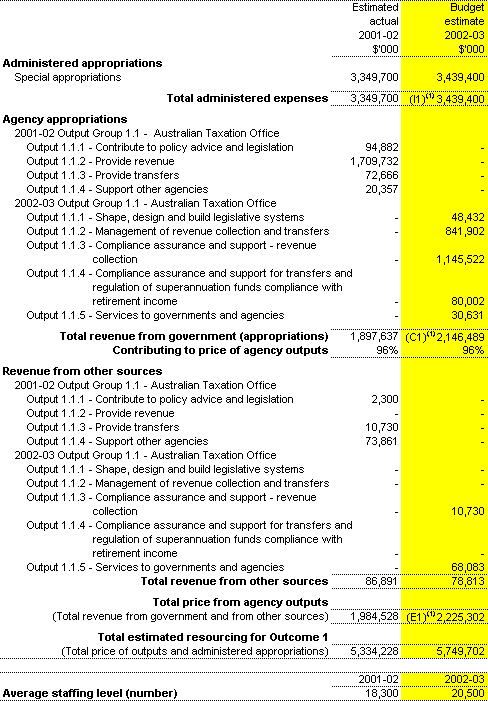
(1) C1, E1 and I1 show the links back to Table 1.1.
Outcome 1 - Contribution of outputs
Table 2.2 details the performance indicators used to assess our achievement of Outcome 1, and shows the link between the outputs and the outcome.
There are five distinct outputs that contribute to Outcome 1:
- Output 1.1.1: reflects the ATO's role in effectively shaping the systems to give effect to the legislation administered by the organisation;
- Output 1.1.2: represents the operational aspects of managing the tax, superannuation and excise systems;
- Output 1.1.3: represents the processes required to assure and support compliance with tax obligations, providing the community with information and assistance;
- Output 1.1.4: represents the processes required to assure and support compliance with transfers and superannuation obligations administered by the ATO, providing the community with information and assistance; and
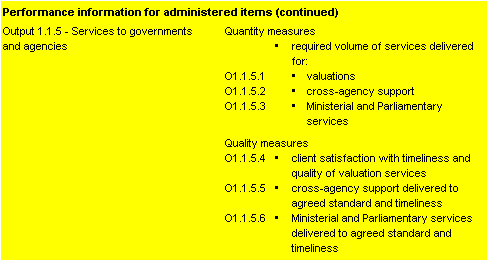
- Output 1.1.5: reflects the range of services the ATO provides to the Treasurer and Assistant Treasurer, the Parliament and to other APS agencies.
Performance information for Outcome 1
As 2002-03 will be the first year of this Outcome and Outputs Framework, some of the reporting measures for Outcome 1 require benchmarks to be developed to measure performance over time. Work is currently being done to ensure that the performance targets set in the Framework are effective and can be used as an instrument for continuous improvement.
Table 2.2: Performance information for Outcome 1
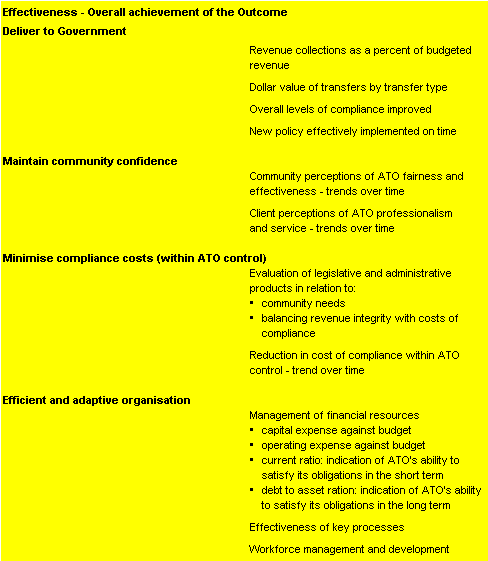
Table 2.2: Performance information for Outcome 1 (continued)
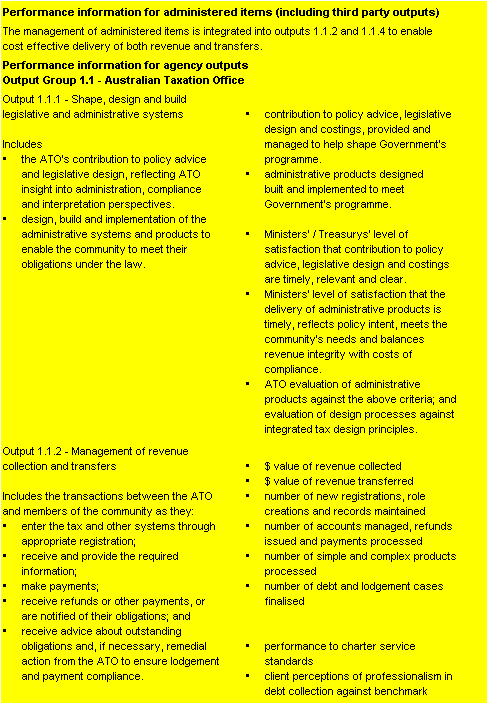
Table 2.2: Performance information for Outcome 1 (continued)
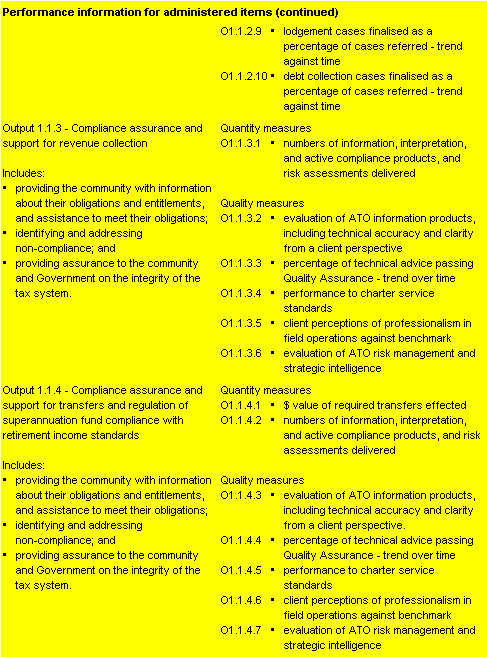
Table 2.2: Performance information for Outcome 1 (continued)
Evaluations
The Australian National Audit Office and ATO Internal Audit have a rolling programme of issues that are audited during the financial year. Other issues are evaluated within the ATO during the financial year as required. Results of evaluation will be shown in the ATO Annual Report.


