



Chapter Nine: Australian Centre for International Agricultural Research
The mission of the Australian Centre for International Agricultural Research (ACIAR) is to achieve more productive and sustainable agricultural systems through international agricultural research partnerships, for the benefit of both developing countries and Australia. ACIAR uses the skills of Australian researchers and institutions and international research organisations to develop solutions to agricultural problems in developing countries. The Centre collaborates with counterparts in developing countries, implementing projects on agreed priorities.
ACIAR's main focus for research is the Asia-Pacific region, reflecting the emphasis of the broader aid program and the Centre's expertise in funding agricultural research. Some exceptions exist, based on ACIAR's role in building capacity and Australia's comparative advantage in particular agricultural disciplines.
Funding in 2003-04 for ACIAR will be $46.8 million. ACIAR allocates approximately three quarters of its research and development budget to bilateral programs and the remaining quarter to the multilateral program. The Centre is focusing its bilateral and multilateral research to best match partner country needs and research capacities to Australian expertise, both geographically and in terms of research priorities. ACIAR will continue to conduct both ex ante and ex poste studies of project impacts.
Bilateral programs
In 2003-04, ACIAR is supporting more than 200 bilateral projects in the Asia-Pacific region. ACIAR works with partner countries to identify and prioritise agricultural and natural resource problems, against which research and development projects are developed and assessed. Bilateral research projects are conducted through programs: agricultural systems' economics and management; agricultural development policy; animal and crop sciences; land and water resources; fisheries; forestry; and post harvest technologies. Collaboration with partners throughout the project's lifecycle ensures partner country participation and capacity building. Estimated bilateral research expenditure in 2003-04 will be $27.2 million.
ACIAR's major bilateral partners are Papua New Guinea (PNG), Indonesia, the Philippines, Vietnam, China and India. The Centre is increasing its level of research to support the specific needs of PNG and the Pacific Islands. ACIAR has recently commenced projects in Burma and, with AusAID support, is administering a major project in Afghanistan, implemented by the International Maize and Wheat Improvement Centre. Investment in Africa will be reduced to focus on specific agricultural sectors in South Africa.
Examples of bilateral projects that will be supported in 2003-04 include:
- improving productivity of the cocoa, coconut and oil palm industries in PNG through the increased participation of women and youth;
- the equitable management of groundwater for Pacific atolls and small islands;
- controlling the fasciolosis disease in cattle and buffaloes in Indonesia, the Philippines and Cambodia; and
- managing pest fruit flies to increase production of fruit and vegetable crops in Vietnam.
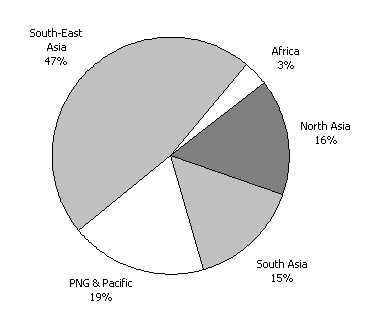
Diagram 13: Estimated ACIAR agricultural research assistance 2003-04
Multilateral programs
Under its multilateral program, ACIAR supports selected international agricultural research centres, particularly those with the ability to deliver projects in the Asia-Pacific region. ACIAR administers the Australian Government's multilateral contribution to the International Agricultural Research Centres (IARCs) - internationally funded autonomous non-profit organisations that conduct agricultural research in developing countries. Core funding is provided to those IARCs with a comparative advantage. Increasingly, project-specific funding is provided to link IARCs to Australia's agricultural research organisations and those of developing countries. Estimated funding to ACIAR's multilateral program in 2003-04 is $9.7 million.
Examples of projects to be funded under ACIAR's multilateral program in 2003-04 include:
- support for the development of a framework for conservation of the unique plant resources of the Pacific region;
- research to promote sustainable forestry management within a decentralised policy framework in Indonesia; and
- sustainable controls for endoparasites affecting sheep and goats in South-East Asia.
Training programs
ACIAR funds formal and informal training and development activities for agricultural researchers, through courses and projects. In addition, the Centre allocates funds to two fellowship schemes. The John Allwright Fellowship Scheme allows around 40 scientists involved in ACIAR projects to undertake postgraduate studies at Australian universities; and the John Dillon Fellowship Scheme supports around six scientists and agricultural economists from developing country institutions, through short-term placements at similar research organisations in Australia. Some training activities are financed by the ATSE Crawford Fund, which will receive $0.65 million of government funding through ACIAR in 2003-04. Total estimated training expenditure in 2003-04 is $2.4 million.
Communicating research
ACIAR uses a range of media to communicate results of ACIAR-supported research and development to potential beneficiaries, both in developing countries and Australia. Research results and project-related information are disseminated via scientific publications and summaries in hard and soft copy and increasingly, ACIAR publications and information are being placed on developing country websites and translated into a number of languages. In 2003-04, an estimated $0.7 million will be spent on research dissemination and communication.
Further information on ACIAR's programs is set out in ACIAR's Annual Operational Plan 2003-04. See <http://www.aciar.gov.au>.