|
The Commonwealth Budget – Overview 2003-04 |
|
|
Against the tide — Australia expects cash surpluses Sound economic policy |
|
|
Governments and economies need to have the flexibility to respond to unforeseen difficulties. Through good management and forward planning, this Government has been able to ensure that Australia is well placed to deal with these uncertain times while delivering tax cuts and spending on high priorities. |
|
Strong economic management |
|
|
This Budget delivers the Government's sixth surplus. An underlying cash surplus of $2.2 billion is expected in 2003-04 with surpluses in the three following years. The Government's fiscal position continues to be guided by its strategy of achieving budget balance, on average, over the economic cycle. This strategy aims to maximise sustainable economic growth and, ultimately, the living standards of all Australians. The fiscal strategy is complemented by a sound monetary policy framework. Together they provide the conditions for economic growth with low inflation and low interest rates. In the words of the OECD, Australia now has an economy that is ‘notably resilient to shocks, both internal and external’ and the ‘effects of previous reforms will continue to help the economy to combat shocks in the immediate future’. |
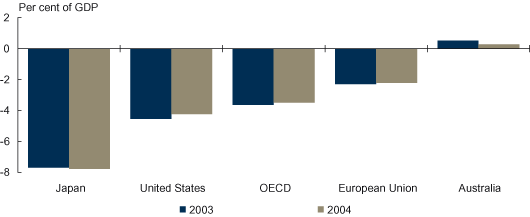
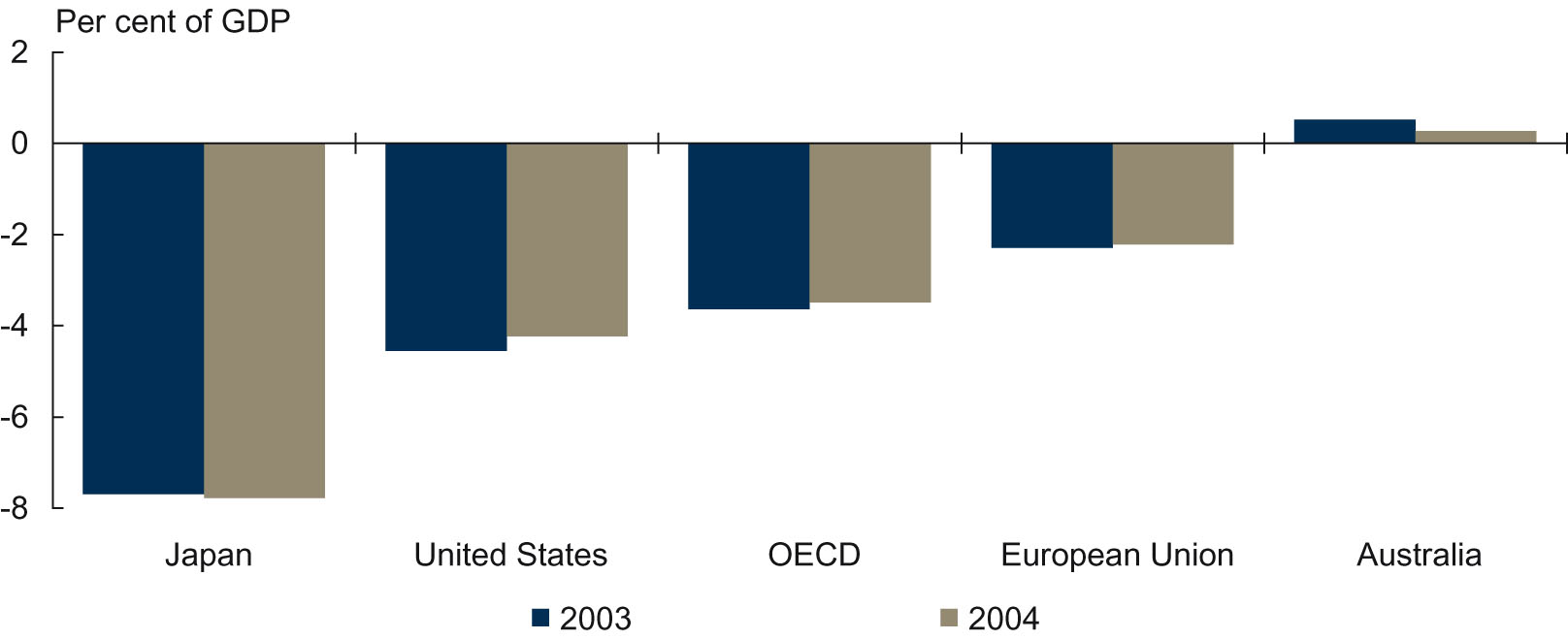
Australia continues to do better on its budget performance than most developed countries. OECD projections show most OECD countries are expected to record budget deficits in 2003 and 2004. The average budget deficit for the OECD as a whole is expected to be 3½ per cent of GDP. Far–reaching reforms, including tax reform, have made the Australian economy more competitive and resilient and provided budgetary flexibility. On 1 July 2000, this government introduced the largest tax cuts ever. This Budget provides further relief for Australian taxpayers. From 1 July 2003, Australian taxpayers will share in personal income tax cuts worth $10.7 billion over the next four years. |