



Section 2: Outcomes and outputs information
Outcomes and output groups
Map 2 on the following page shows the relationship between Government outcomes and the contributing outputs for the Australian Taxation Office (ATO). Financial detail for Outcome 1 by output appears in Table 2.1 while non-financial information for Outcome 1 appears in Table 2.2.
Output cost attribution
The ATO uses a process of cost centre mapping to estimate its actual costs incurred on each of the five outputs.
Mappings are based on cost centre manager estimates. Enabling costs such as information technology and accommodation to be attributed to cost centres using actual usage where effective to do so. Headcount or other drivers are used when attribution by actual usage is not an appropriate option. Corporate overhead and some information technology related costs are not attributed to cost centres but are instead allocated to outputs as a final step in the costing process.
The price of outputs outlined in Table 2.1 is based on the estimated 2002-03 result, adjusted for planned movements in 2003-04.
Map 2: Outcomes and output groups
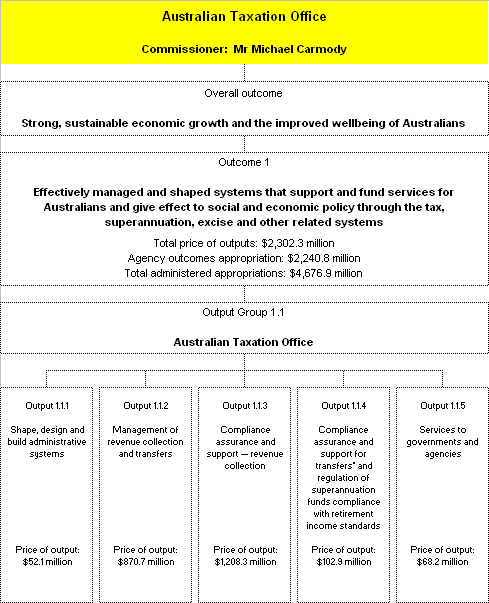
* Transfers - movement of money that is not revenue for example tax offsets, grants, super guarantee vouchers and benefits distribution.
Changes to outcomes and outputs
There are no proposed changes to the outcome or outputs.
Outcome 1 - Description
Effectively managed and shaped systems that support and fund services for Australians and give effect to social and economic policy through tax, superannuation, excise and other related systems.
The single government outcome relating to the ATO properly reflects the nature of the services of the ATO. It provides an integrated platform for a viable and sustainable revenue administration. This is achieved through ensuring:
- effective and efficient administrative design for systems the ATO administers, consistent with policy intent and meeting community needs;
- an effective relationship and communication with taxpayers and Government;
- cost-effective collection of tax, transfers of revenue (to other agencies) and delivery of benefits through the tax system;
- compliance behaviour is maintained through providing comprehensive education and support services to the community and developing compliance strategies to address compliance risks;
- community confidence is maintained through working in partnership with the community to foster community ownership of the tax system and providing timely and professional service;
to enable Government to deliver on social and economic policy. The integrated approach enables cost-effective delivery of both revenue and transfers.
Measures affecting Outcome 1
Fuel tax reform
From 1 July 2008, the Government will provide grants to the producers and importers of fuels that are currently exempt from excise (and customs) duty and which are used in internal combustion engines. These grants are part of arrangements to make these fuels subject to fuel excise and will apply for a transitional period. The grants will be progressively reduced, raising the effective excise (that is, excise less grant) for untaxed fuels from zero prior to 1 July 2008, to their final rates in five even annual steps commencing from 1 July 2008.
The transitional grants form part a programme that will establish a long term sustainable taxation framework for fuels by addressing a number of anomalies in the current fuel tax system and providing increased certainty for investors, while meeting existing Government commitments and providing time for industry to adjust.
In addition, the Government will continue to provide production grants for fuel ethanol from 18 September 2003 under the same basis as announced in the Mid-Year Economic and Fiscal Outlook 2002-03. The Government will also provide grants for the production and importation of biodiesel, from 18 September 2003. Both grants will be reduced in five equal annual instalments from 1 July 2008.
See also the related revenue measure titled Fuel tax reform in the Treasury portfolio.
Measures for a Better Environment - cleaner fuel
The Government will introduce a package of measures to deliver on its Measures for a Better Environment commitment to encourage conversion from the dirtiest fuels to the most appropriate and cleanest fuels as announced by the Prime Minister in May 1999.
The proposed Energy Grants (Credits) Scheme (EGCS) will be extended to include liquefied natural gas (LNG) and biodiesel (but not blends of biodiesel and diesel) as alternative fuels eligible for an on-road credit.
LNG will be approved under the EGCS from 1 July 2003. Biodiesel will be approved once the fuel standard for biodiesel under the Fuel Quality Standards Act 2000 has come into effect.
The grant rate for LNG will be 8.130 cents per litre and the grant rate for biodiesel will be 18.510 cents per litre.
From 1 January 2006, the Government will fund grant payments for a period of two years for the production or import of low sulphur premium unleaded petrol. This measure is part of the Government's approach to encourage the introduction of higher quality clean fuels into the market. A similar measure will be implemented for diesel with less than 10 parts per million sulphur from 1 January 2007 for two years duration.
The measure will bring forward production of higher quality fuels before they are mandated under the provisions included in the Fuel Quality Standards Act 2000. The initiative will be reviewed in the period prior to implementation to ensure that it aligns with the timing of new fuel standards and market conditions.
The off-road grant rates under the proposed EGCS will be increased for the agriculture sector to compensate for the additional excise (and customs) duty levied on high sulphur diesel between 1 July 2003 and 31 December 2005. The excise differential, designed to encourage the production of ultra low sulphur diesel, was announced as part of the Measures for a Better Environment package in May 1999.
The additional grant will apply to claims for an off-road credit made between 1 July 2003 and 31 December 2005 for fuel purchased for use in agriculture.
The additional grant amount will be a weighted average of the differences between the excise rates applying to ultra low sulphur diesel and high sulphur diesel, calculated based on the market share of each fuel.
Further details on the Government's Measures for a Better Environment commitment may be found in the Prime Minister's Press Release of 31 May 1999.
See also the related revenue measure titled Measures for a Better Environment - cleaner fuel in the Treasury portfolio.
Outcome 1 - Resourcing
Table 2.1 shows how the 2003-04 appropriations translate to total resourcing by Output for Outcome 1, including administered expenses, revenues from government (appropriations), revenue from other sources, and the total price of outputs.
Table 2.1: Total resources for Outcome 1
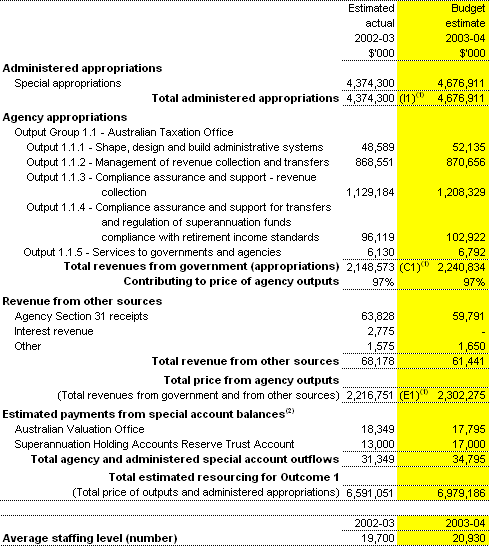
(1) C1, E1 and I1 show the links back to Table 1.1.
(2) Special account inflows and outflows are shown in further detail in Table 1.5 Estimates of special account flows and balances. Please note that these figures are accrual based and exclude transactions between the Australian Valuation Office and the Australian Taxation Office.
Outcome 1 - Contribution of outputs
Table 2.2 details the performance indicators used to assess our achievement of Outcome 1, and shows the link between the outputs and the outcome.
There are five distinct outputs that contribute to Outcome 1:
- Output 1.1.1: reflects the ATO's role in effectively shaping the systems to give effect to the legislation administered by the organisation;
- Output 1.1.2: represents the operational aspects of managing the tax, superannuation and excise systems;
- Output 1.1.3: represents the processes required to assure and support compliance with tax obligations, providing the community with information and assistance;
- Output 1.1.4: represents the processes required to assure and support compliance with transfers and superannuation obligations administered by the ATO, providing the community with information and assistance; and
- Output 1.1.5: reflects the range of services the ATO provides to the Treasurer and Assistant Treasurer, the Parliament and to other APS agencies.
Performance information for Outcome 1
The ATO's outcome and outputs framework has been in place since 1 July 2002. Work was done during the year to ensure that the stated measures give an accurate report of the performance against Outcome 1. As such, some measures have been refined so that the ATO can report a more complete picture of performance.
Table 2.2: Performance information for Outcome 1
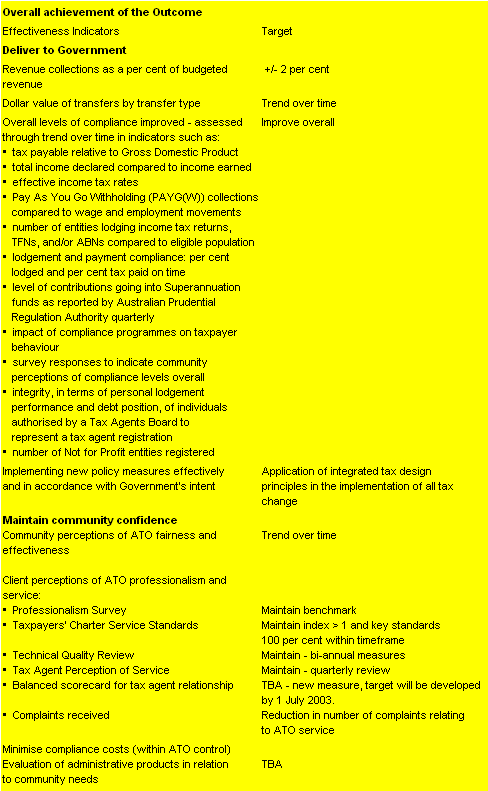
Table 2.2: Performance information for Outcome 1 (continued)
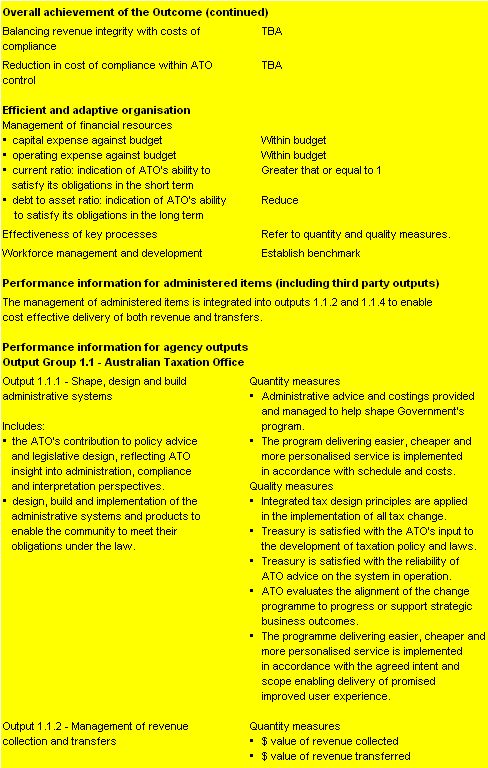
Table 2.2: Performance information for Outcome 1 (continued)
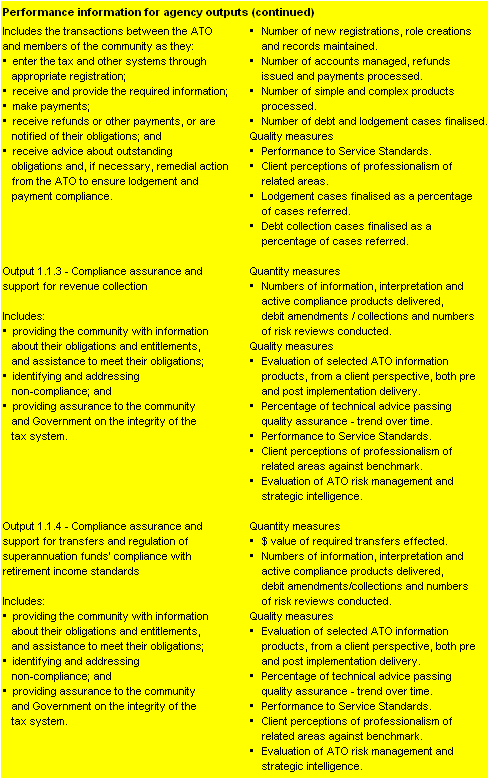
Table 2.2: Performance information for Outcome 1 (continued)
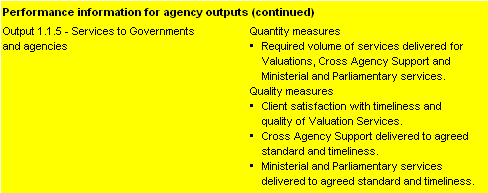
Evaluations
The Australian National Audit Office and ATO Internal Audit have a rolling programme of issues that are audited during the financial year. Other issues are evaluated within the ATO during the financial year as required. Results of evaluation will be shown in the ATO Annual Report.