



Section 2: Outcomes and outputs information
Outcomes and output groups
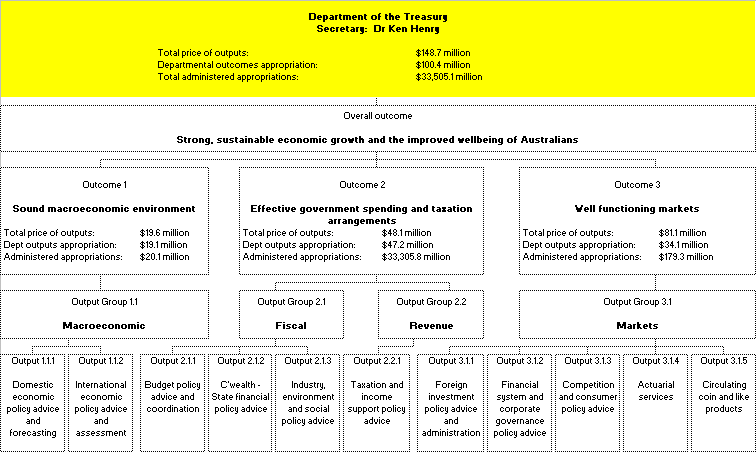
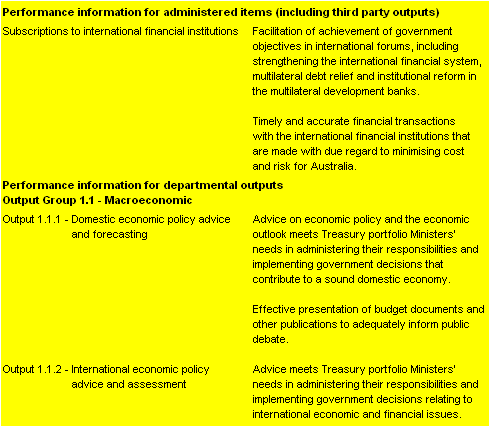
The map on the following page shows the relationship between government outcomes and the contributing outputs for the Department of the Treasury. Financial details for Outcomes 1, 2 and 3, by output, appear in Tables 2.1.1, 2.1.2 and 2.1.3 respectively, while non-financial information for the three outcomes appear in Tables 2.2.1, 2.2.2 and 2.2.3 respectively.
Output cost attribution
The Department of the Treasury uses a process of cost allocation to estimate the costs of each output identified in Table 2.1.1 (page 19), Table 2.1.2 (page 22) and Table 2.1.3 (page 28) respectively.
The cost of each output is comprised of direct and indirect costs. Direct costs are assigned to outputs according to detailed cost profiles. Indirect costs that comprise corporate and overhead items such as information technology, accommodation and human resource management are allocated to outputs based on a consumption (cost driver) basis.
Map 2: Outcomes and output groups
Changes to outcomes and outputs
The Department of the Treasury amended its outputs and output groups from 1 July 2002. This change was detailed in Treasury's Portfolio Additional Estimates Statements 2002-03 on pages 18 and 19.
There has been no change to the outcomes or outputs structure since this time.
Outcome 1 - Description
Sound macroeconomic environment
A sound macroeconomic environment is an essential foundation for strong sustainable economic growth and the improved wellbeing of Australians. It is characterised by stable prices, low interest rates, healthy economic and employment growth, and a sustainable external position.
As many influences on macroeconomic outcomes are beyond the control of the Government, policy aims to improve the prospects for the Australian economy, rather than to target specific outcomes or major economic indicators. Success is judged more by medium to long-term performance relative to Australia's past and to other countries, rather than by particular results in any year.
Measures affecting Outcome 1
There are no measures affecting Outcome 1 in the 2003-04 Budget.
Outcome 1 - Resourcing
Table 2.1.1 shows how the 2003-04 appropriations translate to total resourcing for Outcome 1, including administered expenses, revenues from government (appropriations), revenue from other sources, and the total price of outputs.
Table 2.1.1: Total resources for Outcome 1
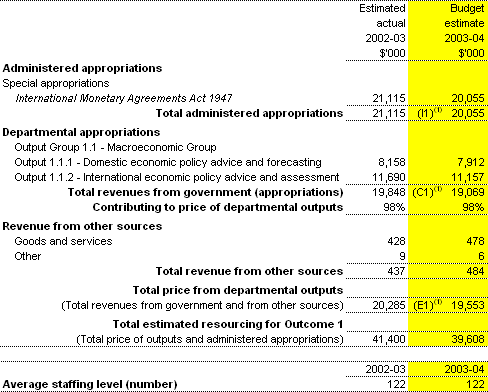
(1) C1, E1 and I1 show the links back to Table 1.1 on page 10.
Outcome 1 - Contribution of outputs
The Department of the Treasury aims to contribute to a sound macroeconomic environment by monitoring and assessing economic conditions and prospects, both in Australia and overseas, and by providing advice on the formulation and implementation of effective macroeconomic policy, including monetary and fiscal policy.
The Department of the Treasury provides advice on advancing Australia's interests at forums such as the Group of Twenty and the Manila Framework Group, and international institutions such as the World Bank, International Monetary Fund, Asian Development Bank and the Organisation for Economic Cooperation and Development, and in the Asia-Pacific Economic Cooperation process. Australia is making a significant contribution to international efforts to sustain international economic stability and growth through these forums.
The Department of the Treasury also provides bilateral financial and technical assistance in support of economic reform and strengthened economic governance, in particular to Papua New Guinea.
The effectiveness of the Department of the Treasury's contribution to a sound macroeconomic environment is judged primarily by feedback from Treasury portfolio Ministers on the quality and relevance of Treasury's advice.
Performance information for Outcome 1
Table 2.2.1: Performance information for Outcome 1
Evaluations
Feedback will be sought from key clients on a regular basis on the effectiveness of Treasury's policy advice.
Results of evaluations will be presented, as appropriate, in The Treasury Annual Report 2003-04.
Outcome 2 - Description
Effective government spending and taxation arrangements
Government spending and taxation arrangements contribute to the overall fiscal outcome but also influence strong sustainable economic growth and the improved wellbeing of Australians.
Spending measures should be effective in meeting their stated objectives, minimise behavioural distortions and deliver significant economic and other benefits compared with costs, thus contributing to the wellbeing of Australians.
Taxation measures should meet revenue objectives (or other public policy objectives) and have regard to the principles of economic efficiency, horizontal and vertical equity and transparency whilst minimising compliance and administrative costs. By meeting these objectives, taxation measures contribute to wellbeing, either directly or by providing the revenue base to finance government services.
Treasury provides policy advice to portfolio Ministers in order to promote Government decisions that further these objectives.
Measures affecting Outcome 2
Languages Other Than English courses provided by ethnic schools - variation in Budget Balancing Assistance as a result of making courses GST-free
The Government will make State or Territory recognised Languages Other Than English (LOTE) courses provided by non-profit ethnic schools GST-free, with effect from 1 January 2002.
Currently, LOTE courses provided by ethnic schools are taxable supplies under the GST because the schools providing them do not qualify for GST-free treatment. The Minister for Education, Science and Training will make a determination under existing legislative provisions of the A New Tax System (Goods and Services Tax) Act 1999 to make LOTE courses GST-free.
The reduction in GST revenues will result in increased Budget Balancing Assistance payments to the States and Territories.
See also the related revenue measure titled GST Determination to make Languages Other Than English courses provided by ethnic schools GST-free in Appendix A of Budget Paper No. 3.
Outcome 2 - Resourcing
Table 2.1.2 shows how the 2003-04 appropriations translate to total resourcing for Outcome 2, including administered expenses, revenues from government (appropriations), revenue from other sources, and the total price of outputs.
Table 2.1.2: Total resources for Outcome 2
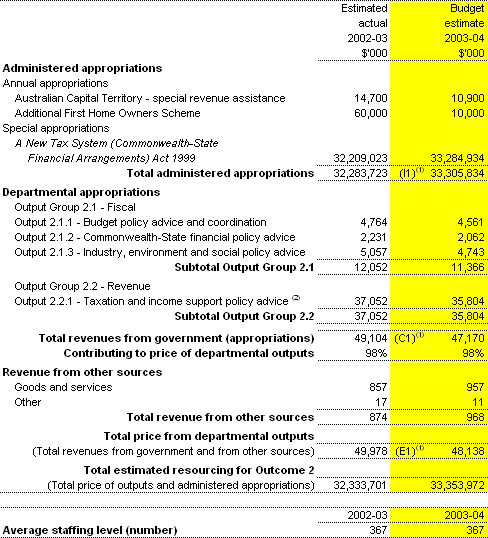
(1) C1, E1 and I1 show the links back to Table 1.1 on page 10.
(2) Appropriations include $2 million in each of 2002-03 and 2003-04 for the Inspector General of Taxation, which has not yet commenced operations. The Inspector General will be separately reported in future Portfolio Budget Statements following the establishment of the agency in 2003-04.
Outcome 2 - Contribution of outputs
Effective government spending and taxation arrangements are crucial to achieving the Government's objectives for the economy and hence the wellbeing of Australians. Ongoing advice to the portfolio Ministers from the Department assists in formulating, implementing and explaining government spending and taxation decisions.
More specifically, in the coming year the Department will provide advice on:
- budget policies, including arrangements for the distribution of resources between the Commonwealth and other levels of government, which are consistent with sustainable public finances and macroeconomic objectives;
- government expenditure programmes, with a focus on those programmes with significant economic or budgetary implications;
- policies relating to the Commonwealth's debt portfolio and the management of the portfolio;
- taxation policies and legislative design proposals which contribute to the reform of the Australian taxation system in terms of efficiency, equity and administrative simplicity;
- policies to promote the efficient and sustainable use of resources and to improve the competitiveness and productivity of Australian industries, thereby promoting higher levels of sustainable economic growth; and
- development and implementation of policies relating to retirement incomes, including superannuation and the age pension, and other income support arrangements intended to promote the wellbeing of Australians.
In 2003-04, the Department of the Treasury will devote significant resources to:
- monitoring and advising on those issues (such as national security and defence) impacting on the immediate budget position, as well as longer term issues arising from the Intergovernmental Agreement, including health and ageing. In this context the Productivity Commission research report on the implications of the future ageing of Australia's population will form the catalyst for further work on the fiscal pressures facing all levels of government;
- providing advice on those issues identified by the Government as its key strategic priorities (including demographic changes, work and family policies, education, energy, science and innovation, the environment and rural and regional policy);
- implementing decisions arising from the Government's review of the Commonwealth securities market;
- implementation of decisions arising from the review of international taxation;
- governance and accountability in the tax system, including the expected first full year of operation of the Inspector General of Taxation and possible issues arising from the review of governance arrangements for the statutory agencies of the Commonwealth;
- further stages in legislation relating to the taxation of financial arrangements and leasing, the definition of charities, and a substantial programme of other tax legislation; and
- further development of consultation processes which give effect to the Treasurer's May 2002 announcement on consultation arrangements.
The effectiveness of the contribution of these outputs to the outcome will be gauged primarily in terms of feedback from Treasury portfolio Ministers as to whether policy advice and new taxation legislation meets their needs in formulating, implementing and explaining government spending and taxation decisions.
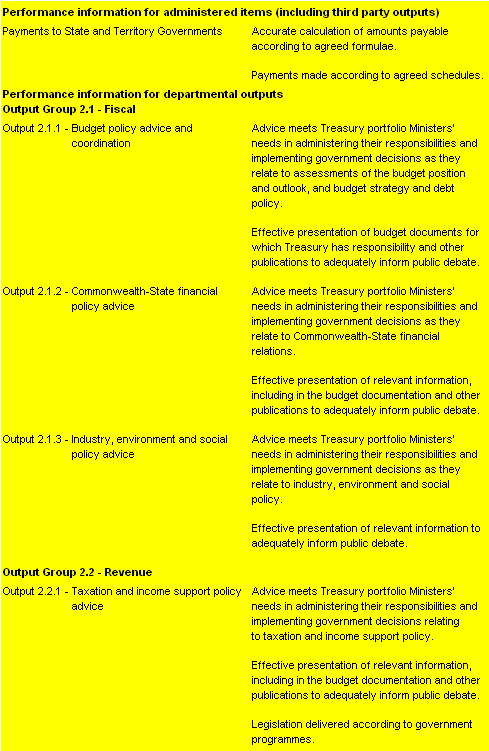
Performance information for Outcome 2
Table 2.2.2: Performance information for Outcome 2
Evaluations
Feedback will be sought from key clients on a regular basis on the effectiveness of policy advice and payments to State and Territory Governments. Results of evaluations will be presented, as appropriate, in The Treasury Annual Report 2003-04.
Outcome 3 - Description
Well functioning markets
Well functioning markets contribute to high sustainable economic and employment growth and the wellbeing of Australians, by enabling resources to flow to those parts of the economy where they can be used most productively. Well functioning markets operate when investors and consumers have confidence and certainty about the regulatory framework, and are able to make decisions that are informed and free of market distortions and impediments.
The Department of the Treasury provides advice on policy processes and reforms that promote a secure financial system and sound corporate practices, remove impediments to competition in both product and services markets, and safeguard the public interest in areas such as consumer protection and foreign investment.
Measures affecting Outcome 3
Australian Reinsurance Pool Corporation - establishment cost
The Government has announced a scheme for the provision of temporary terrorism risk reinsurance cover until market coverage resumes. The scheme will commence on 1 July 2003 and will be managed by a statutory authority to be established for that purpose, the Australian Reinsurance Pool Corporation. The cost of the authority will be met by the scheme once it has commenced operation.
The Government will provide up to $5 million to the Department of the Treasury in 2003-04 to meet establishment costs. The authority will repay this amount in full in the same financial year and so the injection will have no overall impact on the budget.
Financial Reporting Council - funding to support expanded role
The Government will provide $4 million over four years to support the expanded role of the Financial Reporting Council under Part 9 of the Government's Corporate Law Economic Reform Programme (CLERP 9). This expanded role will include oversight of audit standard setting and auditor independence issues. The Auditing and Assurance Standards Board will be moved under the control of the Financial Reporting Council with auditing standards being given the force of law.
On-going funding will be subject to a review by October 2006.
Royal Australian Mint - additional funding
The Government will provide additional funding of $13.5 million over four years to Department of the Treasury for the Royal Australian Mint. Of this amount, $9.5 million over four years will allow the Mint to undertake a staged capital replacement programme of its antiquated coin producing equipment.
The remaining $4 million in 2003-04 is a one-off equity injection to meet periodic fluctuations in the Mint's working capital requirements. It is expected that the working capital will be replenished when revenue becomes available and therefore the equity injection will have no impact on the underlying cash or fiscal balance.
Outcome 3 - Resourcing
Table 2.1.3 shows how the 2003-04 appropriations translate to total resourcing for Outcome 3, including administered expenses, revenues from government (appropriations), revenue from other sources, and the total price of outputs.
Table 2.1.3: Total resources for Outcome 3
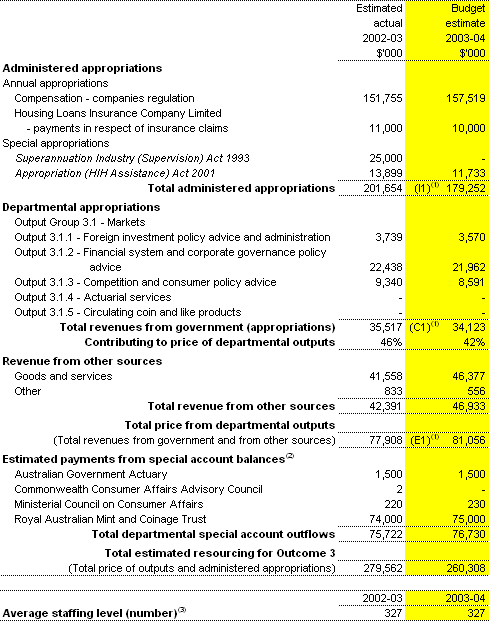
(1) C1, E1 and I1 show the links back to Table 1.1 on page 10.
(2) Further details on special accounts appear in Table 1.5 on page 14.
(3) Average staffing level includes the Royal Australian Mint.
Outcome 3 - Contribution of outputs
The Department of the Treasury provides advice to portfolio Ministers to assist them carry out their responsibilities in formulating, implementing and explaining the policies needed to achieve well functioning markets - markets that are competitive, efficient, informed, fair and transparent.
Advice is provided to the Government on foreign investment proposals and on general foreign investment policy matters, including Australia's participation in multilateral and bilateral agreements on investment and trade. In addition, the Department of the Treasury promotes awareness and understanding of the Government's foreign investment policy in the community and in the business sector, both in Australia and overseas, and monitors compliance with policy.
In relation to the financial system, the Department of the Treasury provides policy advice on the legislative framework for prudential supervision of financial institutions (including in the areas of banking, insurance and superannuation) by the Australian Prudential Regulation Authority and other regulation of those institutions. It monitors issues and developments in the financial sector, and provides advice on their policy implications. In 2003-04, the Department will continue to provide advice on policy issues emerging in the general insurance sector, including the recommendations of the HIH Royal Commission and implementation of the Medical Indemnity (Prudential Supervision and Product Standards) Act 2003, and options to improve the safety of superannuation.
Participation will continue in the Insurance Issues Working Group of the Heads of Treasuries, to consider reforms that can be implemented to improve the availability and affordability of various classes of insurance.
Policy advice relating to the HIH Assistance Scheme will continue to be provided to the Government. In addition, the ongoing involvement in relation to terrorism replacement insurance will continue, through the provision of policy advice and technical support to the Australian Reinsurance Pool Corporation, in its initial stages.
The Department of the Treasury provides advice on competition and consumer policy matters, monitors the effectiveness of the competition, consumer protection and pricing provisions in the Trade Practices Act 1974 and the Prices Surveillance Act 1983, and advises on legislative amendments. In addition, the Department participates with other government departments and agencies in formulating policy for the progress of structural reform in key sectors of the economy, including energy, transport and communications. The Department will be undertaking work to implement the Dawson Review recommendations in relation to the competition provisions of the Trade Practices Act 1974.
Consumer affairs policy advice will focus on regulatory and non-regulatory options to promote consumer protection. Industry self-regulatory mechanisms will be facilitated, and secretariat services will be provided to the Ministerial Council for Consumer Affairs, the Commonwealth Consumer Affairs Advisory Council and the Minister's Electronic Commerce Expert Group. Product safety initiatives will focus on appropriate use of regulatory powers under the Trade Practices Act 1974, supporting the development of relevant voluntary safety standards and facilitating the removal of unsafe products from the market.
The Department of the Treasury will continue to provide the Executive for the Takeovers Panel, to promote efficiency and shareholder protection in the market for control of Australian companies.
In the coming year, the Department of the Treasury will continue to monitor the transition to the new system of financial services regulation. The legislation introducing the new system commenced on 11 March 2002, and is subject to a two-year transitional period before its full implementation. The Department of the Treasury will continue to develop reforms to ensure that Australia's regulatory framework remains at the forefront of world's best practice.
The Department of the Treasury will implement reforms covering independence of auditors, legislative backing for auditing standards as well as issues surrounding strengthening the regulatory framework for corporate governance more broadly. Progress will also continue on reforms to Australia's corporate insolvency laws.
Secretariat services will continue to be provided to the Financial Reporting Council, which oversees Australia's accounting standard setting arrangements, and will have a future role oversighting audit standard setting and auditor independence issues following the implementation of proposals to strengthen corporate reporting and disclosure under CLERP 9.
There will be ongoing involvement in progressing international cooperation in financial market regulation, corporate governance, financial reporting and corporate insolvency. Priority will be given to bilateral efforts to promote the recognition of national regulatory frameworks covering financial products and service providers.
The Australian Government Actuary (AGA) will provide services relating to financial matters: for example, benefits depending on contingencies such as injury, death or retirement. The AGA also assists departments and agencies with policy development in areas where it has specialist expertise.
The Royal Australian Mint (RAM) as an operating division of the Department of the Treasury, has responsibility for producing circulating and numismatic coin for Australia. The RAM is planning a capital equipment upgrade commencing in 2003-04. The Department of the Treasury will continue to chair the RAM Advisory Board and also provide advice relating to the currency system.
Performance information for Outcome 3
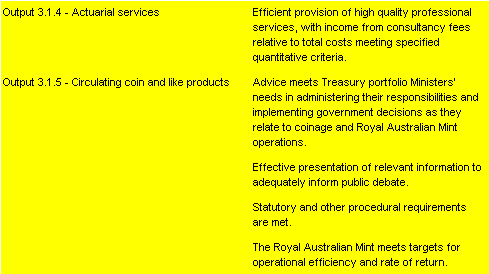
Table 2.2.3: Performance information for Outcome 3
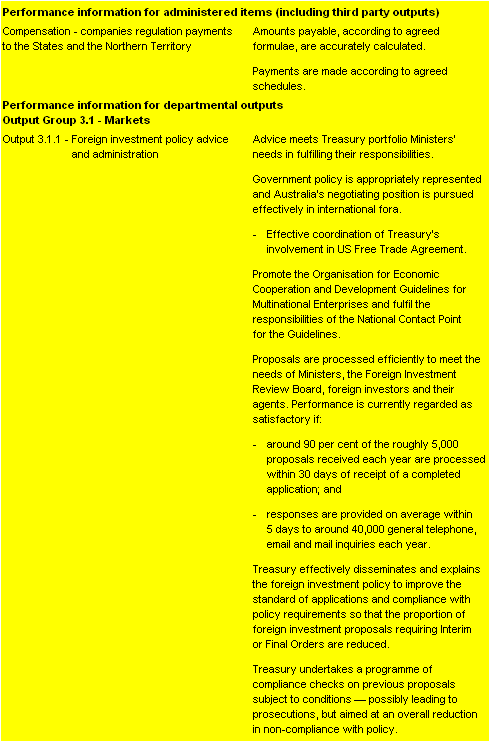
Table 2.2.3: Performance information for Outcome 3 (continued)
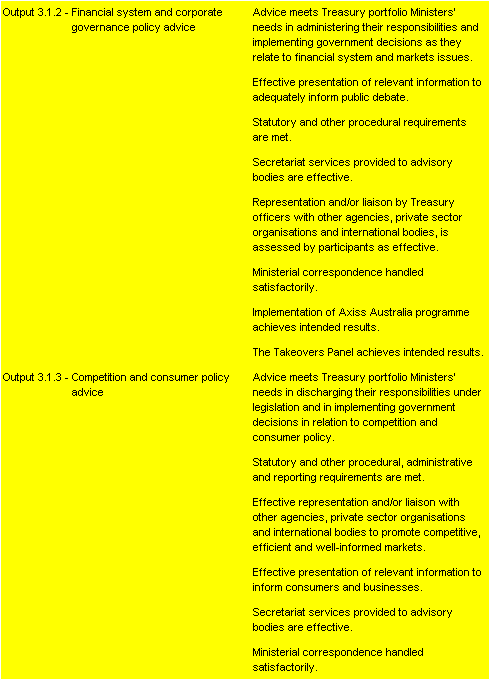
Table 2.2.3: Performance information for Outcome 3 (continued)
Evaluations
Feedback will be sought from key clients on a regular basis on the effectiveness of policy advice. Ongoing evaluation will be conducted of foreign investment policy administration in the context of statutory deadlines and target response rates. Results of the evaluations will be presented, as appropriate, in The Treasury Annual Report 2003-04.