




Appendix D: Accrual and cash taxation estimates
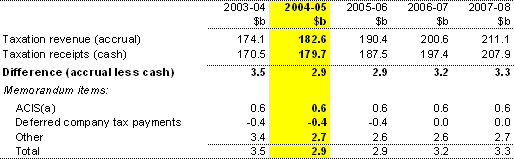
Table D1: Estimates of taxation revenue on an accrual and cash basis
- Automotive Competitiveness and Investment Scheme
Accrual estimates are prepared using the tax liability method (TLM) of revenue recognition. Under the TLM, taxation revenue is recognised at the time a taxpayer makes a self-assessment or when an assessment of a tax liability is raised by the Australian Taxation Office or the Australian Customs Service. This method retains some elements of cash revenue recognition — for example, revenue is recognised when cash payment occurs prior to an assessment being raised.
Specific drivers of the difference between the accrual and cash taxation revenue estimates are discussed below.
Automotive Competitiveness and Investment Scheme
The Automotive Competitiveness and Investment Scheme (ACIS) operates by providing customs duty credits to exporters of Australian automotive products. The credits can be used to offset future customs duty on specific imports.
Under accrual accounting, an expense is recognised when the ACIS credits are issued. The later redemption of the credits results in an increase in the difference between the accrual and cash estimates for customs duty revenue, because the customs duty accrual revenue is recognised at the point of credit redemption but no cash is received. ACIS credits account for $560 million of the difference between the accrual and cash estimates in 2004-05.
Deferred company tax payments
The PAYG arrangements for companies and superannuation funds (introduced as part of The New Tax System) better align tax payments with the period in which income is earned. In the absence of transitional arrangements, this would have created an overlap of tax payments, because payments of tax obligations for 1999-2000 (under the previous payment arrangements) and PAYG instalments for 2000-01 (under the new payment arrangements) both occurred during 2000-01. For a medium-sized company, for example, there would have been six payments due, instead of the usual four.
The Government implemented transitional arrangements to assist these taxpayers move to the new PAYG system, by allowing them to spread some of their tax payments in interest free instalments for up to 5 years. While the full amount of the tax obligations was included in accrual revenue for 2000-01, the year in which the liabilities were recognised, the cash estimates will continue to be affected for the 5 year period, reflecting when the deferred tax payments will be received.
The impact of these deferred payments has been to increase the cash taxation receipt estimates by around $390 million in 2003-04 and $360 million in 2004-05, while they have no impact on the accrual estimates in either year.
Other
This category consists of timing differences between the recognition of accrual and cash revenue and instances where revenue has been recognised but payment is no longer expected to be received. For example:
- receivables arise where tax liabilities are recognised in one period, but the taxpayer is not expected to pay the liability until a later period;
- remissions occur where tax liabilities are recognised, but circumstances are taken into account and the Commissioner of Taxation reduces the amount of various penalties and interest required to be paid;
- a tax liability may be written off where the previously recognised revenue is no longer expected to be received; and
- a credit amendment may be issued where a tax assessment is amended (for example, where a court decision leads to a change in the interpretation of the tax laws).
To the extent that revenue includes tax assessments for which payment may not be received, expenses are recognised (that is, in respect of remissions and write-offs of bad and doubtful debts). The higher revenue is offset by these expenses, leaving the fiscal balance unaffected.
Continued next page...