




Attachment D
Tax expenditures
Individuals and businesses derive financial benefits from various tax concessions. These concessions can be delivered in a variety of ways: by a tax exemption, tax deduction, tax rebate, reduced tax rate or by deferring a tax liability. Tax concessions can either reduce or delay the collection of tax revenue.
The benefits of most tax concessions could be delivered equally by direct expenditures. Hence tax concessions are an alternative to direct expenditure as a method of delivering government assistance or meeting government objectives. Accordingly, tax expenditures have an impact on the budget surplus or deficit, as do direct expenditures.
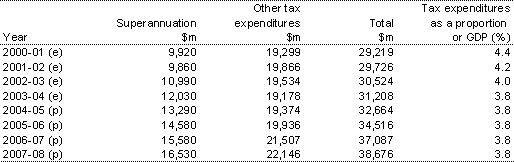
Table 18 provides aggregate tax expenditure estimates for the period from 2000-01 to 2007-08.
Table 18: Aggregate tax expenditures 2000-01 to 2007-08(a)
- Preliminary estimates only — final estimates will be published in the 2004 Tax Expenditures Statement.
Measured tax expenditures as a proportion of GDP are estimated to decline from around 4.4 per cent of GDP in 2000-01 to 3.8 per cent by 2007-08.
Further detail on tax expenditures will be provided in the 2004 Tax Expenditures Statement.