



Appendix C: Australian Accounting Standards financial statements
(continued)
Notes to the AAS financial statements
Note 1: External reporting standards and accounting policies
The Charter of Budget Honesty Act 1998 requires that the Mid-Year Economic and Fiscal Outlook be based on external reporting standards and that departures from applicable external reporting standards be identified.
The financial statements included in this Appendix have been prepared on an accrual basis in accordance with applicable Australian Accounting Standards (AAS), including AAS 31 Financial Reporting by Governments except as noted below. AAS will change from 2005-06, with the introduction of Australian Equivalents to the International Financial Reporting Standards released in July 2004. Given the timing of the release, the financial statements in this Appendix are prepared on the same basis as the 2004-05 Budget and not in accordance with the Australian Equivalents to the International Finance Reporting Standards.
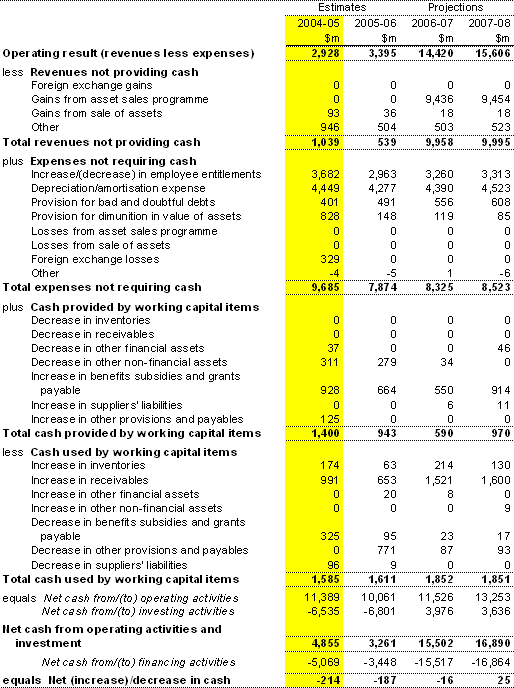
AAS requires governments to prepare accrual based general purpose financial reports. This means that assets, liabilities, revenues and expenses are recorded in financial statements when transactions have an economic impact on the government, rather than when the cash flow associated with these transactions occurs. Consistent with AAS, a statement of financial performance, a statement of financial position and a statement of cash flows have been prepared for the budget year and the three forward years.
The accounting policies in this Appendix are generally consistent with the requirements of AAS. While the scope for financial reporting recommended in AAS 31 is the whole of government (that is, the Australian Government public sector), in accordance with the Charter of Budget Honesty Act 1998, the presentation covers the general government sector only. This Appendix includes notes showing disaggregated information.
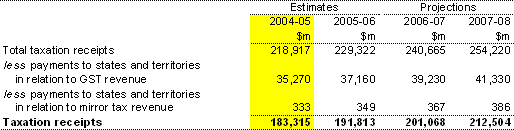
AAS would suggest the gross amount of goods and services tax (GST) be included in the Australian Government’s financial statements. However, under the Intergovernmental Agreement on the Reform of Commonwealth-State Financial Relations, GST is collected by the Australian Taxation Office as an agent for the states and territories, and appropriated to the states and territories. Therefore, accrued GST revenues and associated payments to the states and territories are not recorded in the financial statements.
Note 2: Reconciliation of cash
Note 2(a): Consolidated Revenue Fund
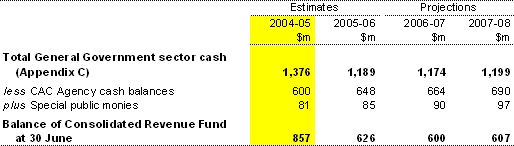
The estimated and projected cash balances reflected in the statement of financial position for the Australian Government general government sector (Table C2) include the reported cash balances controlled and administered by Australian Government agencies subject to the Financial Management and Accountability Act 1997 and the reported cash balances controlled and administered by entities, subject to the Commonwealth Authorities and Companies Act 1997 (CAC Act), that implement public policy through the provision of primarily non-market services.
Revenues or monies raised by the Executive Government automatically form part of the Consolidated Revenue Fund by force of section 81 of the Australian Constitution. For practical purposes, total Australian Government general government sector cash, less cash controlled and administered CAC Act entities, plus special public monies, represents the Consolidated Revenue Fund referred to in section 81 of the Australian Constitution. On this basis, the balance of the Consolidated Revenue Fund is shown below.
Note 3: Income taxation revenue — accrual
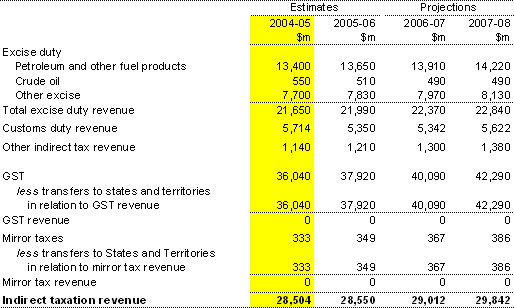
Note 4: Indirect taxation revenue — accrual
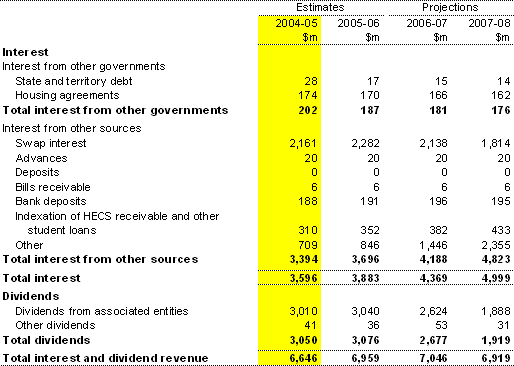
Note 5: Interest and dividend revenue
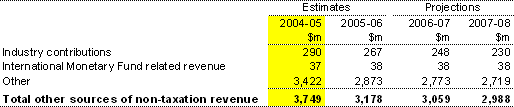
Note 6: Other sources of non-taxation revenue
Note 7: Employee expenses
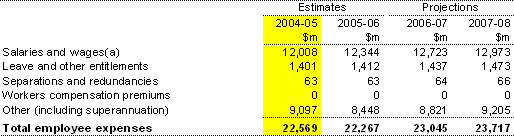
- Salaries and wages do not include superannuation.
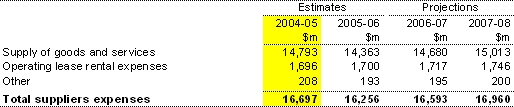
Note 8: Suppliers expenses
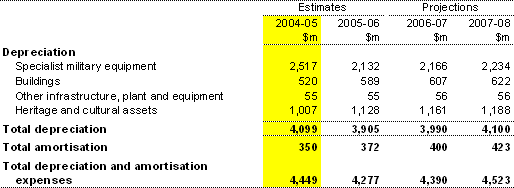
Note 9: Depreciation and amortisation expenses
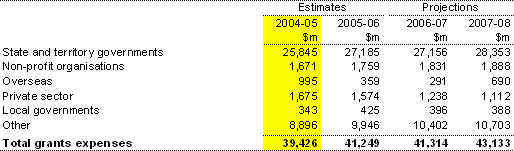
Note 10: Grants expenses
Note 11: Government securities
For 2004-05 and the forward years, transactions relating to debt management activities have been netted in the statements of financial position and cash flows. In the statement of financial position, the financial assets — investments category excludes financial assets acquired for debt management purposes, while the debt — government securities category is shown net of financial assets acquired for debt management purposes. In the statement of cash flows, the investing activities — cash used/received — other categories exclude cash used to acquire/redeem financial assets for debt management purposes, while the financing activities — cash used — net repayments of borrowings category is shown net of these amounts.
This netting treatment has been applied because of the uncertainty associated with the actual split between government securities and financial assets acquired for debt management purposes.
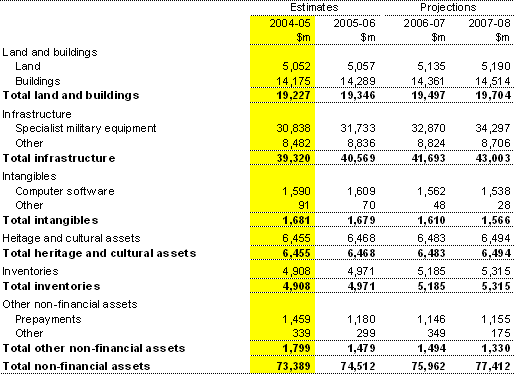
Note 12: Non-financial assets
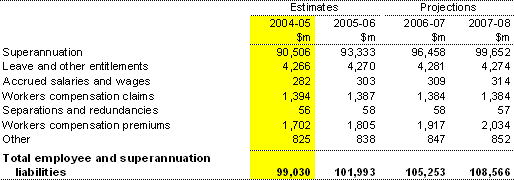
Note 13: Employee and superannuation liabilities
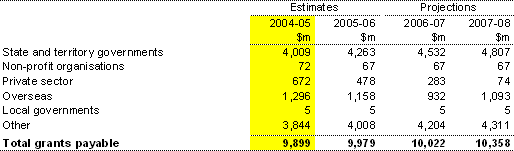
Note 14: Grants payable
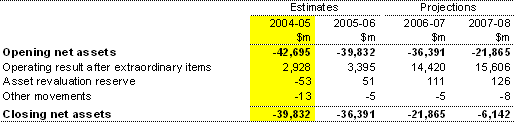
Note 15: Net asset movements
Note 16: Taxation receipts — cash