




Section 3: Budgeted financial statements
The budgeted financial statements will form the basis of the financial statements that will appear in the Australian Bureau of Statistics (ABS) 2004-05 Annual Report, and form the basis for the input into the whole-of-government accounts. The financial statements should be read in conjunction with the accompanying notes.
The budgeted financial statements contain estimates prepared in accordance with the requirements of the Australian Government’s financial budgeting and reporting framework, including the principles of Australian Accounting Standards and Statements of Accounting Concepts, as well as specific guidelines issued by the Department of Finance and Administration.
Analysis of budgeted financial statements
In the Statement of Financial Performance, the ABS is budgeting for a nil result for 2004-05, following a deficit of $1.6 million in 2003-04. Income from the sales of publications and the provision of statistical services is expected to remain steady in the budget year. Departmental appropriations have risen by nearly $18 million as the ABS prepares for the August 2006 Census, which is its largest statistical collection. In line with Census preparations, employee and supplier expenses have risen by $16.2 million. Both appropriations and expenditure will increase over the next two out-years in line with the five yearly census cycle.
Overall, the statement of financial position provides a consistent picture between the budget and previous financial years. The net asset position remains constant around $54.8 million with only minor movements in total assets and total liabilities.
At the beginning of the budget year, a number of new building leases were signed that included rent-free periods. To spread the effects of the rental savings over the term of the leases, other debt will increase in 2004-05 by nearly $1.5 million and a further $1.5 million in 2005-06. This liability will then be gradually reduced over the remaining lease periods.
As the first pay for the budget year fell on 1 July, there will be a significant decrease in employee provisions ($3 million) to account for the reversal of the salary accrual at the end of 2003-04.
The agency cash flow shows that the healthy cash balance in 2003-04 will continue through to the end of the 2004-05 financial year. Increased expenditure is in line with the build up to the 2006 Census, with cash being provided by increases in departmental appropriations.
Agency financial statements
Budgeted agency statement of financial performance
This statement provides a picture of the expected financial results for the ABS by identifying full accrual expenses and revenues, which highlight whether the ABS is operating at a sustainable level.
Budgeted agency statement of financial position
This statement shows the financial position of the ABS. It enables decision-makers to track the management of the ABS’s assets and liabilities.
Budgeted agency statement of cash flows
Budgeted cash flows, as reflected in the statement of cash flows, provides important information on the extent and nature of cash flows by categorising them into expected cash flows from operating activities, investing activities and financing activities.
Agency capital budget statement
Shows all planned agency capital expenditure (capital expenditure on non-financial assets), whether funded either through capital appropriations for additional equity or borrowings, or funds from internal sources.
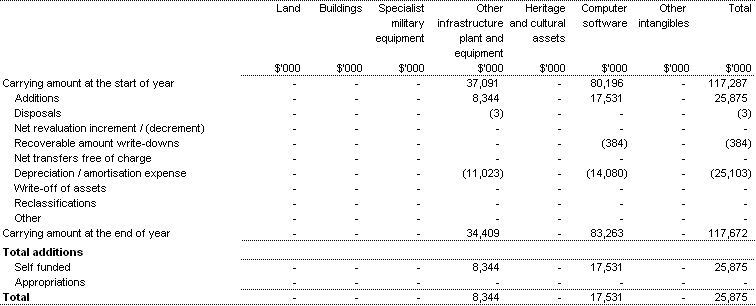
Agency non-financial assets — summary of movement
This statement shows the movement in ABS’s non-financial assets during the budget year.
Table 3.1: Budgeted agency statement of financial
performance
(for the period ended 30 June)
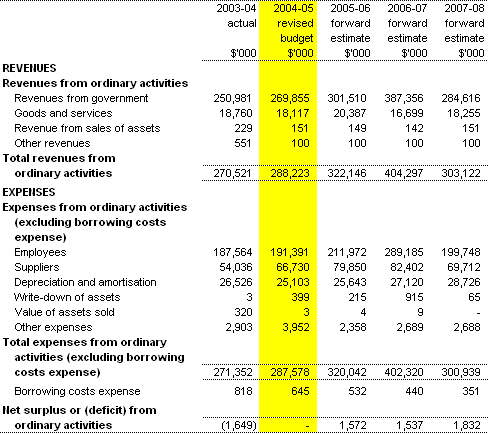
Table 3.2: Budget agency statement of financial
position
(as at 30 June)
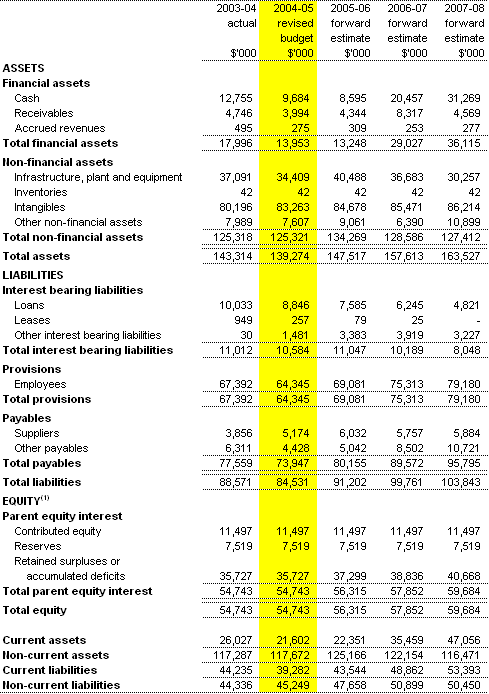
(1) 'Equity' is the residual interest in assets after deduction of liabilities.
Table 3.3: Budgeted agency statement of cash flows
(for the period ended 30 June)
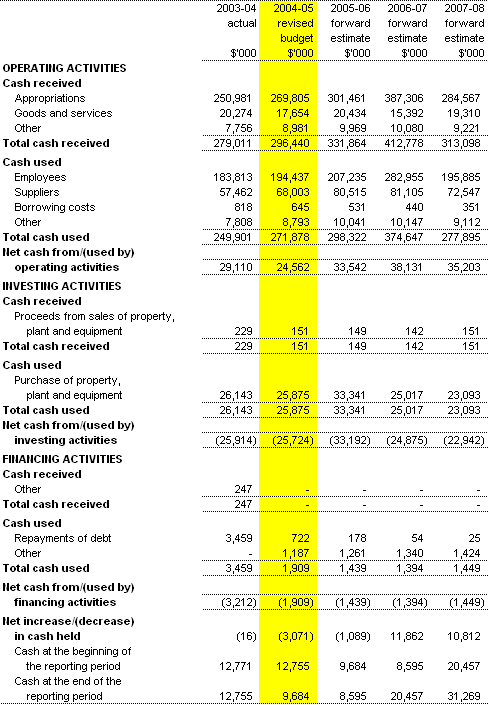
Table 3.4: Agency capital budget statement
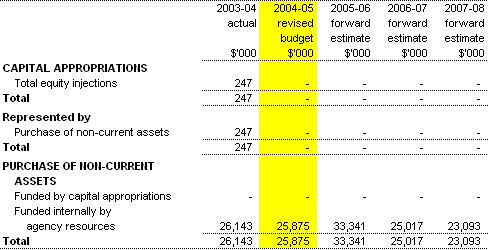
Table 3.5: Agency non-financial assets — Summary of movement (Budget year 2004-05)
Notes to the financial statements
Basis of accounting
The agency budget statements have been prepared on an accrual basis and in accordance with historical cost convention, except for certain assets, which are at valuation.
Budgeted agency financial statements
Under the Australian Government’s accrual budgeting framework, and consistent with Australian Accounting Standards, transactions that agencies control (agency transactions) are budgeted and reported separately from transactions agencies do not have control over (administered transactions). This ensures that agencies are only held fully accountable for the transactions over which they have control.
Agency assets, liabilities, revenues and expenses in relation to an agency are those that are controlled by the agency. Agency expenses include employee and supplier expenses and other administrative costs, which are incurred by the agency in providing its goods and services.
Budgeted agency statement of financial performance
Revenues
Appropriations in the accrual budgeting framework
Under the Australian Government’s accrual budgeting framework, the ABS is appropriated only for the price of its outputs, which represent the Australian Government’s purchase of these agreed outputs.
Revenue from other sources
Revenue is derived from the sale of ABS publications and census data, as well as the provision of user-funded surveys and consultancy work. The amount of revenue earned in any one year is dependent upon the demand for such products and services by government agencies, business and the community.
Other
This category includes resources received free of charge.
Expenses
Employees
This includes wages and salaries, superannuation, provision for annual leave and long service leave, and workers compensation. Employee entitlements are based on leave patterns of ABS employees. Accrued salaries and employer superannuation contributions are based on daily salary expense and the number of days owing at 30 June in each budget year.
Depreciation and amortisation
Depreciable assets are written off over their estimated useful lives. Depreciation is calculated using the straight-line method, which is consistent with the consumption of the service potential of the depreciable assets of the ABS.
Budgeted agency statement of financial position
Non-financial assets
Intangibles
These include software developed in-house.
Inventory
ABS inventory includes publications of statistics both in print and on CD. These levels are expected to remain stable in the out years.
Other
This category includes prepayments.
Debt
Loans
The ABS received a loan of $13.2 million in 2001-02. This loan was used to partially fund the fitout of the ABS’s new national office accommodation. Loan repayments will be made over a ten-year period and are being met by the ABS from within its ongoing operational funding levels.
Leases
These include lease incentives in the form of a rent-free period and/or a contribution to fitout costs. Lease incentives are recognised as a liability, which is reduced by allocating lease rental payments between interest, rental expense and reduction of the liability. Rent-free lease periods are taken up as a liability during the rent-free period and amortised over the remaining term of the lease. The full amount of the lease is therefore allocated evenly over the total term of the lease.
Provisions and payables
Employees
The liability for employee entitlements includes provision for annual leave and long service leave. No provision has been made for sick leave, as all sick leave is non-vesting.
The non-current portion of the liability for long service leave is recognised and measured at the present value of the estimated future cash flows in respect of all employees.
Asset valuation
Australian Government agencies and authorities are required to value property, plant and equipment and other infrastructure assets using the fair value method of valuation. This essentially reflects the current cost the entity would face in replacing that asset.
Capital budget statement
This shows proposed capital expenditure for the ongoing replacement programme of non-financial assets. This asset replacement programme is funded internally.
Purchase of non-financial assets
These include:
- 2004-05 intangibles of $17.5 million, infrastructure, plant and equipment of $8.3 million, which includes fitout to the New South Wales, Queensland and Census offices of $2.5 million;
- 2005-06 intangibles of $15.3 million, infrastructure, plant and equipment of $18.0 million, which includes fitout to the Queensland, Victorian and Census offices of $5.7 million;
- 2006-07 intangibles of $14.8 million, infrastructure, plant and equipment of $10.2 million, which includes fitout to the Australian Capital Territory, South Australian and Tasmanian offices of $4.4 million; and
- 2007-08 intangibles of $15.5 million, infrastructure, plant and equipment of $7.6 million, which includes fitout to the Western Australian office of $0.5 million.