




Section 3: Budgeted financial statements
The budgeted agency and financial statements and related notes for the Australian Securities and Investments Commission (ASIC) are presented in this section. The financial statements should be read in conjunction with the accompanying notes. The Budget estimate and three forward years comprise the following statements.
The budgeted financial statements contain estimates prepared in accordance with the requirements of the Australian Government’s financial budgeting and reporting framework, including the principles of Australian Accounting Standards and Statements of Accounting Concepts, as well as specific guidelines issued by the Department of Finance and Administration.
Analysis of budgeted financial statements
Budgeted agency statement of financial performance
ASIC is budgeting for a break-even operating result for 2004-05 and for the remainder of the forward estimates.
Appropriation for 2004-05 is $205.9 million, which is an increase of $22.6 million on the amount recognised in 2003-04. The rise in appropriation is attributed to the transfer of funding received for the HIH Taskforce from 2003-04 and 2004-05 and the Government’s decision to fund ASIC for enhanced enforcement activities and consumer protection and corporate regulation.
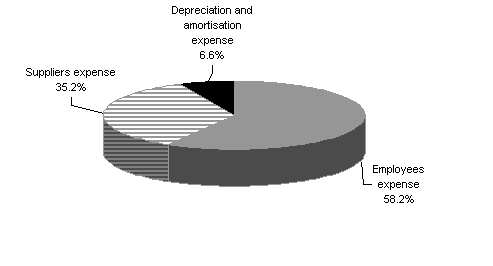
Total expenses including borrowing costs for 2004-05 are estimated to be $214.5 million, an increase of $18.3 million over the prior financial year. The expenditure will be used to fund increased activity levels arising from the increasing demands for ASIC's services including actioning complaints and increased surveillance and enforcement activities.
Budgeted total agency expenses 2004-05
Budgeted agency statement of financial position
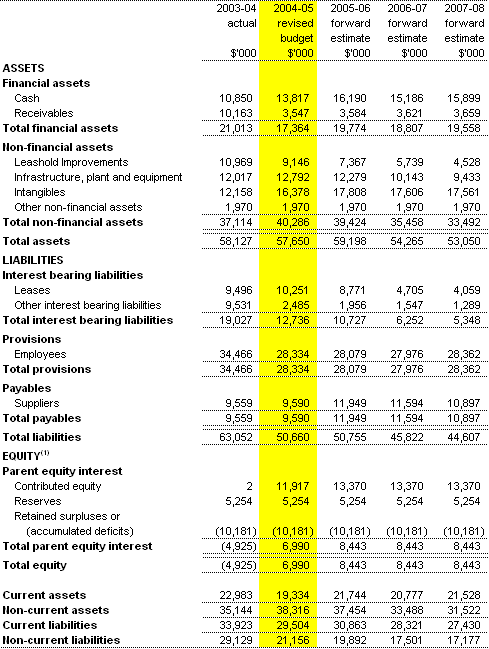
This statement shows the financial position of ASIC. It helps decision-makers to track the management of ASIC’s assets and liabilities.
Equity
ASIC's budgeted equity (or net asset position) for 2004-05 has increased by $11.9 million as a consequence of the Government's decision to provide ASIC with a $11.3 million equity injection to address past year losses, in addition to capital funding of $0.6 million for specific enforcement matters.
This equity injection will place ASIC in a positive equity position and is reflected as an increase in cash and in total equity.
Financial Assets
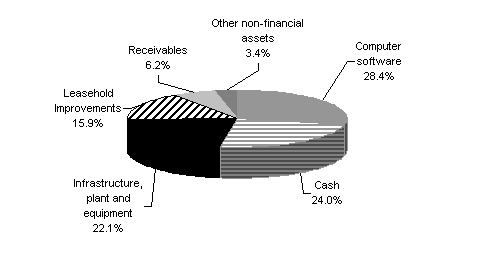
The increase in cash arising from the equity injection of $11.3 million referred to above, has resulted in total financial assets increasing by approximately the same amount. The $0.6 million will be spent on the purchase of capital items.
Non-Financial Assets
A fair value revaluation of plant and equipment is scheduled for 2004-05 in accordance with ASIC's policy to revalue all classes of non-financial assets every three years.
Budgeted total agency assets 2004-05
Liabilities — debt
The principal item under this heading is the estimated amount owing by ASIC in respect of finance leases for computer equipment and peripherals. The forward estimates assume that ASIC will continue to lease all future equipment acquisitions made in accordance with its asset replacement program.
Provisions and payables
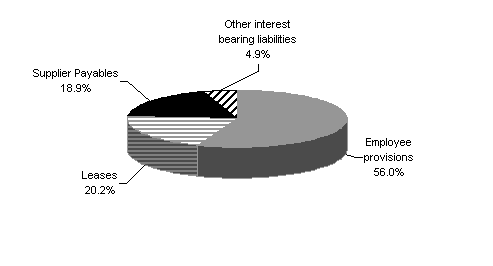
The principal item under this heading is employee leave provisions and accruals. The amount is expected to remain constant as a percentage of total salaries over the period of the forward estimates.
Budgeted total agency liabilities 2004-05
Agency financial statements
Budgeted agency statement of financial performance
This statement provides the expected financial results for ASIC by identifying full accrual expenses and revenues, which highlights whether the agency is operating at a sustainable level.
Budgeted agency statement of financial position
This statement shows the financial position of ASIC. It helps decision-makers to track the management of ASIC’s assets and liabilities.
Budgeted agency statement of cash flows
Budgeted cash flows, as reflected in the statement of cash flows, provide important information on the extent and nature of cash flows by categorising them into expected cash flows from operating activities, investing activities and financing activities.
Agency capital budget statement
This statement shows all proposed capital expenditure funded through the Budget as appropriation or from internal sources.
Agency non-financial assets — summary of movement
This statement shows the movement in ASIC’s non-financial assets during the budget year.
Note of administered activity
Details of transactions administered by ASIC on behalf of the Australian Government are shown in the following notes to the financial statements.
Note of budgeted administered financial performance
The statement of financial performance shows the revenue and expenses associated with the collection of revenue under the Corporations Act 2001, and ASIC's responsibilities in administering unclaimed monies under the Banking Act 1959 and the Life Insurance Act 1995.
Revenues from government include the budgeted amount of appropriation required to pay claimants for unclaimed monies previously transferred to consolidated revenue.
Expenses represent the budget estimated for the payment of unclaimed monies and overpayments referred to above and the budgeted estimate of bad debt expense.
Other revenue represents the amount of fees and charges budgeted to be levied under the Corporations Act 2001. The increase in 2004-05 is the result of an increase in the number of companies being incorporated and an increase in the annual review fee of $12. This is the first increase in the annual review fee since 1997.
Note of budgeted administered financial position
Financial Assets
The amount shown for receivables in 2004-05 and in the forward estimates is the estimated amount of fees and charges under the Corporations Act 2001 remaining unpaid.
Liabilities — payables
The amounts shown in the forward estimates represent the estimated amount of refunds relating to the over payments of annual review and other fees under the Corporations Act 2001.
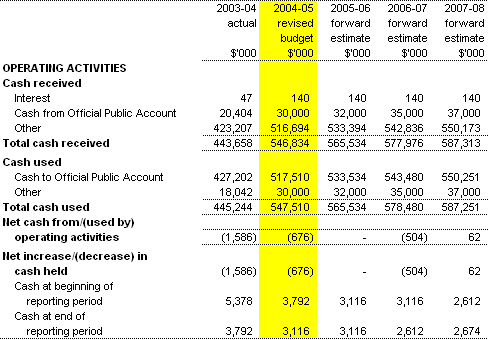
Note of budgeted administered cash flows
Budgeted administered cash flows, provide important information on the extent and nature of cash flows by categorising them into expected cash flows from operating activities, investing activities and financing activities.
Table 3.1: Budgeted agency statement of financial
performance
(for the period ended 30 June)
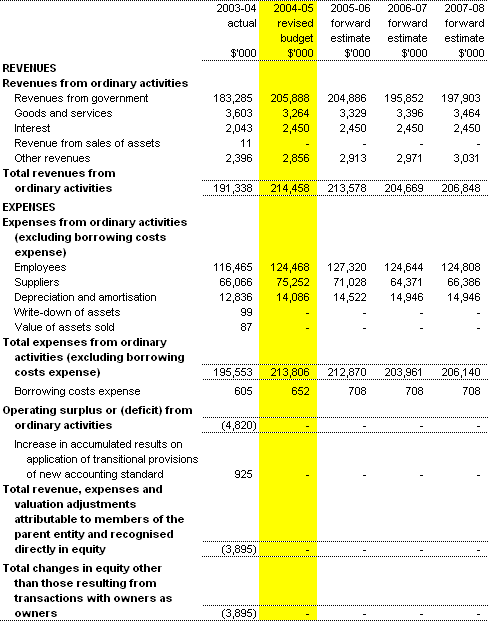
Table 3.2: Budget agency statement of financial
position
(as at 30 June)
(1) ‘Equity’ is the residual interest in assets after deduction of liabilities.
Table 3.3: Budgeted agency statement of cash flows
(for the period ended 30 June)
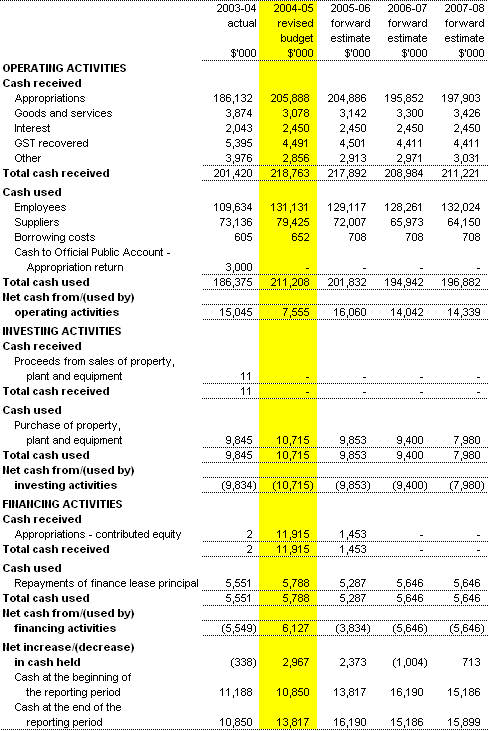
Table 3.4: Agency capital budget statement
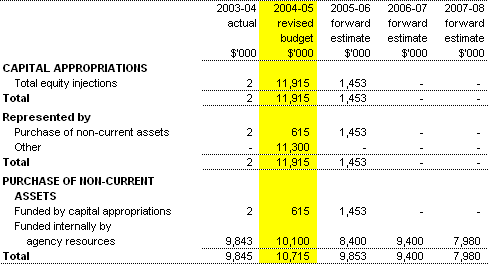
Table 3.5: Agency non-financial assets — Summary of movement (Budget year 2004-05)
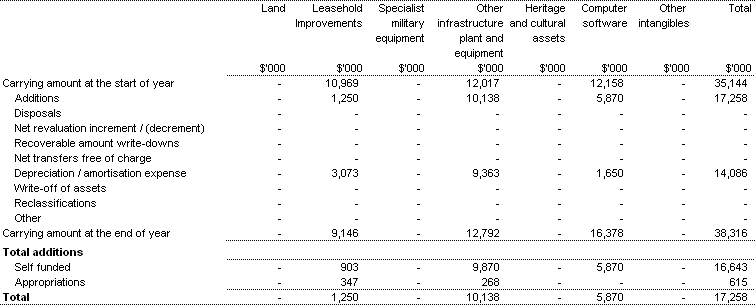
Table 3.6: Note of budgeted financial performance administered on behalf of government (for the period ended 30 June)
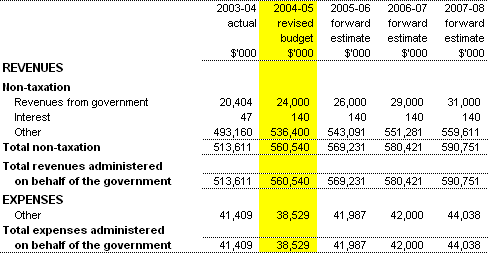
Table 3.7: Note of budgeted financial position administered on behalf of government (as at 30 June)
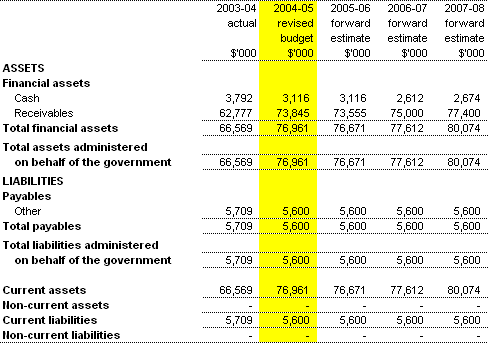
Table 3.8: Note of budgeted administered cash flows
(for the period ended 30 June)
Notes to the financial statements
Basis of accounting
The financial statements have been prepared on an accrual basis and in accordance with the historical cost convention.
Budgeted agency financial statements
Under the Australian Government’s accrual budgeting framework, and consistent with Australian Accounting Standards, transactions that agencies control (departmental transactions) are separately budgeted for and reported on from transactions that agencies do not have control over (administered transactions). This ensures that agencies are only held fully accountable for the transactions over which they have control.
Departmental items are those assets, liabilities, revenues and expenses in relation to an agency or authority that are controlled by the agency. Departmental expenses include employee and supplier expenses and other administrative costs, which are incurred by the agency in providing its goods and services.
Administered items are revenues, expenses, assets and liabilities that are managed by an agency or authority on behalf of the Australian Government according to set government directions. Administered expenses and administered revenues include taxes, fees, fines and expenses that have been earmarked for a specific purpose by government.
Appropriations in the accrual budgeting framework
Under the Australian Government’s accrual budgeting framework, separate annual appropriations are provided for:
- departmental price of outputs appropriations representing the Australian Government’s purchase of outputs from agencies;
- departmental capital appropriations for investments by the Australian Government for either additional equity or loans in agencies;
- administered expense appropriations for the estimated administered expenses relating to an existing outcome or a new outcome; and
- administered capital appropriations for increases in administered equity through funding non-expense administered payments.
Asset valuation
From 1 July 2004, Australian Government agencies and authorities are required to use either the cost basis or the fair value basis to value infrastructure, plant and equipment and leasehold improvements on a three yearly revaluation cycle. ASIC has adopted fair value as a basis for valuing its non-current assets.
Asset recognition threshold
Purchases of property, plant and equipment are recognised initially at cost in the statement of financial position, except for purchases costing less than $2,000, which are expensed in the year of acquisition.
Leases
A distinction is made between finance leases, which effectively transfer from the lessor to the lessee substantially all the risks and benefits incidental to ownership of leased non-current assets, and operating leases under which the lessor effectively retains substantially all such risks and benefits.
Where a non-current asset is acquired by means of a finance lease, the asset is capitalised at the present value of minimum lease payments at the inception of the lease and a liability recognised for the same amount. Leased assets are amortised over the period of the lease. Lease payments are allocated between the principal component and the interest expense.
Operating lease payments are charged to the statement of financial performance on a basis that is representative of the pattern of benefits derived from the lease assets.
Depreciation and amortisation
Depreciable plant and equipment and leased information technology assets are written off to their estimated residual values over their estimated useful lives using in all cases the straight line method of depreciation. Leasehold improvements are amortised on a straight line basis over the lesser of the estimated life of the improvements or the unexpired period of the lease.
Depreciation/amortisation rates (useful lives) are reviewed at each balance date and necessary adjustments are recognised.
Receivables
A provision is raised for any doubtful debts based on a review of the collectability of all outstanding accounts as at year end.
Bad debts are written off during the year in which they are identified.