




Section 3: Budgeted financial statements
The budgeted financial statements will form the basis of the financial statements that will appear in the Australian Bureau of Statistics (ABS) 2003-04 Annual Report, and form the basis for the input into the whole-of-government accounts. The financial statements should be read in conjunction with the accompanying notes.
The budgeted financial statements contain estimates prepared in accordance with the requirements of the Australian Government’s financial budgeting and reporting framework, including the principles of Australian Accounting Standards and Statements of Accounting Concepts, as well as specific guidelines issued by the Department of Finance and Administration.
Analysis of budgeted financial statements
Budgeted agency statement of financial performance
The ABS is budgeting for a nil operating surplus in 2004-05.
Total agency revenue is estimated to be $286.8 million. This is an increase of $16.8 million from the 2003-04 estimated actual.
This rise in revenue is primarily attributed to an increase in appropriations as a result of:
- an increase specifically related to the 2006 Census, as part of the normal Census cycle.
- $4.5 million transfer of funding from 2007-08 to 2004-05.
Total expenses are estimated to be $286.8 million, an increase of $14.8 million from the 2003-04 estimated actual.
This increase in expenses can be attributed directly to the increase in employee and suppliers expenses associated with the preparations for the 2006 Census, as part of the normal Census cycle.
Budgeted agency statement of financial position
In 2004-05 the ABS’s total equity will increase by $0.2 million. This change is related to the capital injection as shown in the 2003-04 Portfolio Additional Estimates Statements relating to the Budget Estimates and Framework Review.
The expected outlook for the ABS indicates that the asset base of the organisation will remain stable, with liabilities for employee provisions expected to increase in the out years. This increase is expected following the increase in staff numbers for the 2006 Census cycle.
The build up of cash in the out years is occurring due to reduced spending on a restructured capital programme. It is expected that the cash build-up will be utilised for additional capital purchases in the long term.
Agency financial statements
Budgeted agency statement of financial performance
This statement provides a picture of the expected financial results for the ABS by identifying full accrual expenses and revenues, which highlight whether the ABS is operating at a sustainable level.
Budgeted agency statement of financial position
This statement shows the financial position of the ABS. It enables decision-makers to track the management of the ABS’s assets and liabilities.
Budgeted agency statement of cash flows
Budgeted cash flows, as reflected in the statement of cash flows, provides important information on the extent and nature of cash flows by categorising them into expected cash flows from operating activities, investing activities and financing activities.
Agency capital budget statement
Shows all planned agency capital expenditure (capital expenditure on non-financial assets), whether funded either through capital appropriations for additional equity or borrowings, or funds from internal sources.
Agency non-financial assets — summary of movement
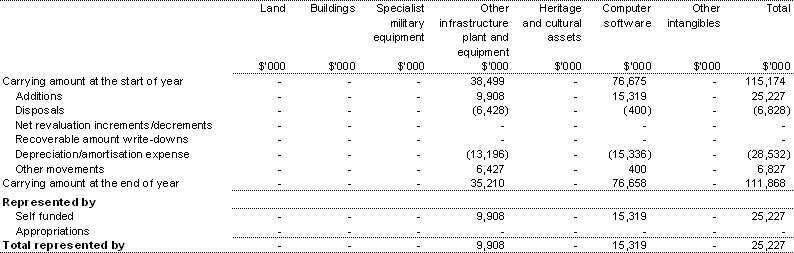
This statement shows the movement in ABS’s non-financial assets during the budget year.
Table 3.1: Budgeted Agency Statement of Financial
Performance
for the period ended 30 June
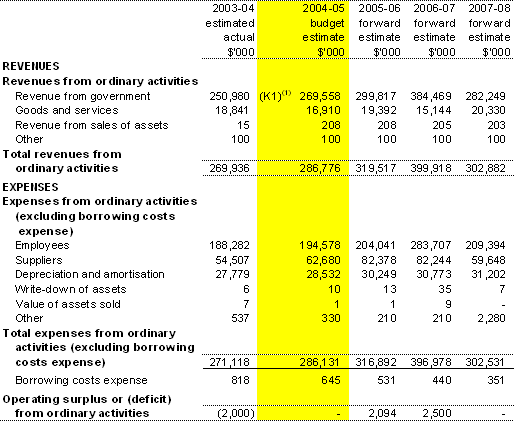
- K1 shows the link back to Table 1.1.
Table 3.2: Budgeted Agency Statement of Financial
Position
as at 30 June
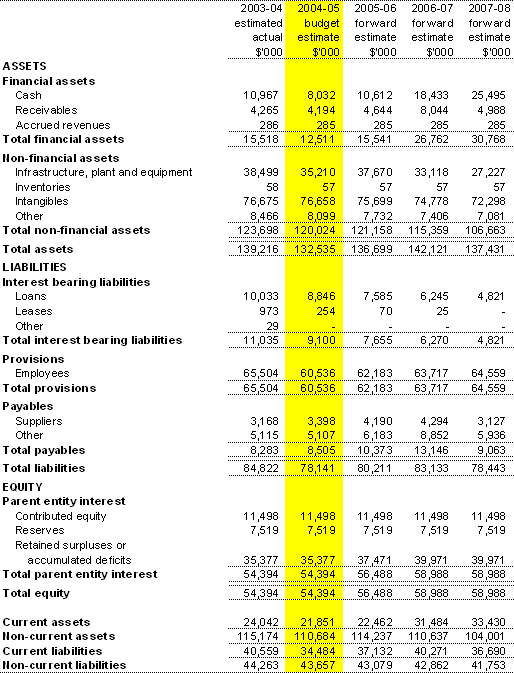
Table 3.3: Budgeted Agency Statement of Cash Flows
for the period ended 30 June
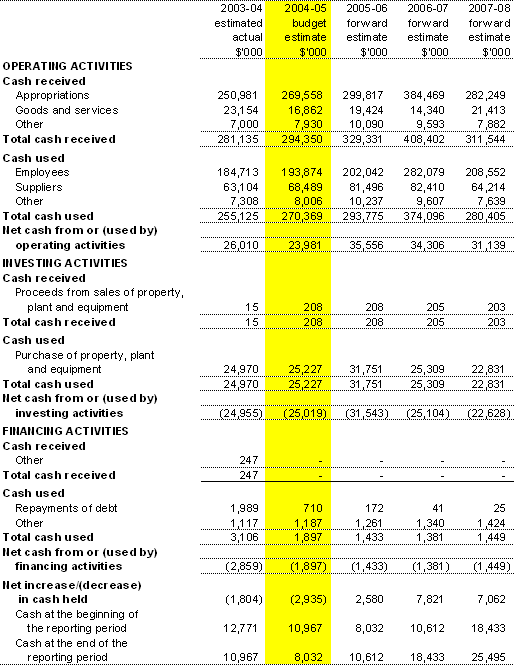
Table 3.4: Agency Capital Budget Statement
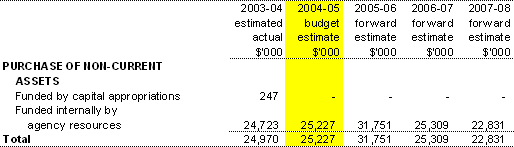
Table 3.5: Agency Non-financial Assets —
Summary of Movement
(Budget year 2004-05)
Notes to the financial statements
Basis of accounting
The agency budget statements have been prepared on an accrual basis and in accordance with historical cost convention, except for certain assets, which are at valuation.
Budgeted agency financial statements
Under the Australian Government’s accrual budgeting framework, and consistent with Australian Accounting Standards, transactions that agencies control (agency transactions) are budgeted and reported separately from transactions agencies do not have control over (administered transactions). This ensures that agencies are only held fully accountable for the transactions over which they have control.
Agency assets, liabilities, revenues and expenses in relation to an agency are those that are controlled by the agency. Agency expenses include employee and supplier expenses and other administrative costs, which are incurred by the agency in providing its goods and services.
Budgeted agency statement of financial performance
Revenues
Appropriations in the accrual budgeting framework
Under the Australian Government’s accrual budgeting framework, the ABS is appropriated only for the price of its outputs, which represent the Australian Government’s purchase of these agreed outputs.
Revenue from other sources
The decrease in revenue from other sources in 2003-04 and 2004-05 is due to the additional revenue associated with the sales of census output during the last financial year.
Other
This category includes resources received free of charge.
Expenses
Employees
This includes wages and salaries, superannuation, provision for annual leave and long service leave, and workers compensation. Employee entitlements are based on leave patterns of ABS employees. Accrued salaries and employer superannuation contributions are based on daily salary expense and the number of days owing at 30 June in each budget year.
Depreciation and amortisation
Depreciable assets are written off over their estimated useful lives. Depreciation is calculated using the straight-line method, which is consistent with the consumption of the service potential of the depreciable assets of the ABS.
Budgeted agency statement of financial position
Non-financial assets
Intangibles
These include software developed in-house.
Inventory
ABS inventory includes publications of statistics both in print and on CD. These levels are expected to remain stable in the out years.
Other
This category includes prepayments.
Debt
Loans
The ABS received a loan of $13.2 million in 2001-02. This loan was used to partially fund the fitout of the ABS’s new national office accommodation. Loan repayments will be made over a ten year period and are being met by the ABS from within its ongoing operational funding levels.
Leases
These include lease incentives in the form of a rent-free period and/or a contribution to fitout costs. Lease incentives are recognised as a liability, which is reduced by allocating lease rental payments between interest, rental expense and reduction of the liability.
Provisions and payables
Employees
The liability for employee entitlements includes provision for annual leave and long service leave. No provision has been made for sick leave as all sick leave is non-vesting.
The non-current portion of the liability for long service leave is recognised and measured at the present value of the estimated future cash flows in respect of all employees.
Asset valuation
Australian Government agencies and authorities are required to value property, plant and equipment and other infrastructure assets using the deprival method of valuation. This essentially reflects the current cost the entity would face in replacing that asset.
Capital budget statement
This shows proposed capital expenditure for the ongoing replacement programme of non-financial assets. This asset replacement programme is funded internally.
Purchase of non-financial assets
These include:
- 2003-04 intangibles of $14.7 million, infrastructure, plant and equipment of $10.3 million, which includes fitout to the Western Australian and South Australian offices of $1.3 million;
- 2004-05 intangibles of $15.3 million, infrastructure, plant and equipment of $9.9 million, which includes fitout to the New South Wales, Queensland and Census offices of $2.7 million;
- 2005-06 intangibles of $14.8 million, infrastructure, plant and equipment of $17.0 million, which includes fitout to the Queensland, Victorian and Census offices of $5.1 million;
- 2006-07 intangibles of $14.9 million, infrastructure, plant and equipment of $10.4 million, which includes fitout to the Australian Capital Territory, South Australian and Tasmanian offices of $4.5 million; and
- 2007-08 intangibles of $14.8 million, infrastructure, plant and equipment of $8.0 million, which includes fitout to the Western Australian and Census offices of $1.4 million.