




Section 3: Budgeted financial statements
The budgeted financial statements will form the basis of the financial statements that will appear in the Australian Competition and Consumer Commission’s (ACCC) 2003-04 Annual Report, and form the basis for the input into the whole-of-government accounts. The financial statements should be read in conjunction with the accompanying abridged notes.
The budgeted financial statements contain estimates prepared in accordance with the requirements of the Australian Government’s financial budgeting and reporting framework, including the principles of Australian Accounting Standards and Statements of Accounting Concepts, as well as specific guidelines issued by the Department of Finance and Administration.
Analysis of budgeted financial statements
An analysis of the ACCC’s budgeted financial statements is provided below.
Statement of Financial Performance
The ACCC is budgeting for a breakeven operating result in 2004-05. The estimated operating result for 2003-04 is an approved operating loss of $8.4 million. The 2003-04 operating loss is attributed to the increasing costs of litigation incurred throughout the year.
Total revenue for 2004-05 is estimated to be $98.3 million, an increase of $23.7 million on the 2003-04 estimated actual revenue. The increase is as a result of:
- additional funding of $23.9 million to maintain existing levels of activity
- less one off funding provided in 2003-04 of $6.8 million to meet additional cost pressures
- additional funding of $6.5 million for the establishment and operational costs of the proposed Australian Energy Regulator.
The trend for agency expenses is shown in the following graph.
Total agency expenses
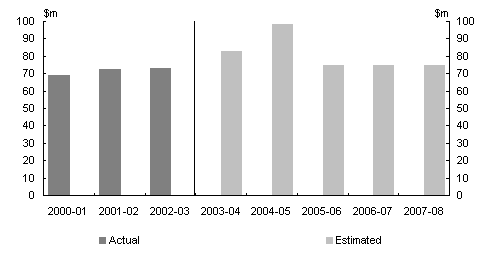
Total expenses for 2004-05 are estimated to be $98.2 million, an increase of $15.2 million. The main increases are as a result of:
- Increased employee expenses of $5.2 million, including wage and superannuation cost increases and salaries for the establishment and operational costs of the proposed Australian Energy Regulator;
- A net increase of $6.5 million from 2003-04 to cover the increasing costs of pursuing litigation; and
- Supplier expenses of $3.5 million for the establishment and operational costs of the proposed Australian Energy Regulator.
Statement of Financial Position
The ACCC’s budgeted 2004-05 net asset position will be $11.1 million, an increase of $23.9 million from 2003-04. This capital funding comprises:
- The amount of $12 million to restore the Commission’s balance sheet position following operating losses over the last two financial years;
- $10 million to restore the Litigation Contingency Fund to its originally intended level, to meet other party costs when required in later years; and
- $1.9 million to cover capital establishment costs for the proposed Australian Energy Regulator.
Administered Revenues and Expenses
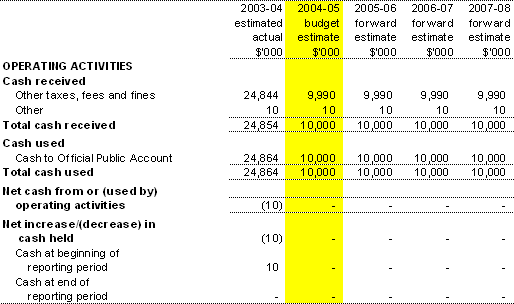
The budget estimate of $10.0 million for administered revenue reflects an estimate of the ongoing level of fines and costs awarded to the ACCC. The 2003-04 estimated actual revenue included one off revenue of $14.6 million from a penalty ordered as part of the ACCC action against a transformer cartel.
Agency financial statements
Budgeted agency statement of financial performance
This statement provides a picture of the expected financial results for the ACCC by identifying full accrual expenses and revenues, which highlights whether the ACCC is operating at a sustainable level.
Budgeted agency statement of financial position
This statement shows the financial position of the ACCC. It enables decision-makers to track the management of the ACCC’s assets and liabilities.
Budgeted agency statement of cash flows
This statement identifies expected cash flows from operating activities, investing activities and financing activities.
Agency capital budget statement
This statement shows all proposed capital expenditure funded through the Budget as appropriation or from internal sources.
Agency non-financial assets — summary of movement
This statement shows the movement in the ACCC’s non-financial assets over the budget year.
Note of administered activity
Details of transactions administered by the agency on behalf of the Australian Government are to be shown in the following notes to the financial statements.
Note of budgeted administered financial performance
This note identifies the main revenues and expenses administered on behalf of the Australian Government. It also discloses administered revenues from government and transfers to the Official Public Account.
Note of budgeted administered financial position
This note shows the assets and liabilities administered on behalf of the Australian Government.
Note of budgeted administered cash flows
This note shows cash flows administered on behalf of the Australian Government.
Table 3.1: Budgeted Agency Statement of Financial
Performance
for the period ended 30 June
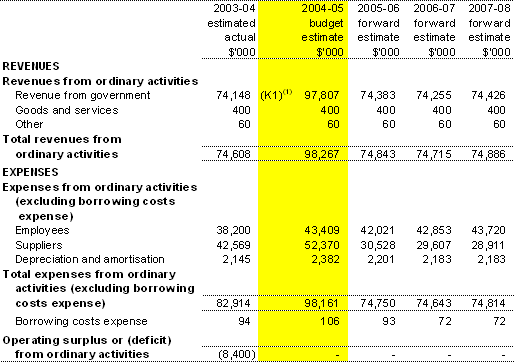
- K1 shows the link back to Table 1.1.
Table 3.2: Budgeted Agency Statement of Financial
Position
as at 30 June
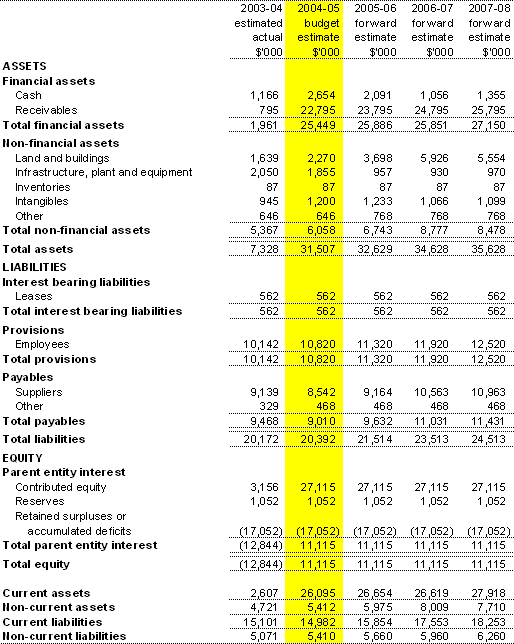
Table 3.3: Budgeted Agency Statement of Cash Flows
for the period ended 30 June
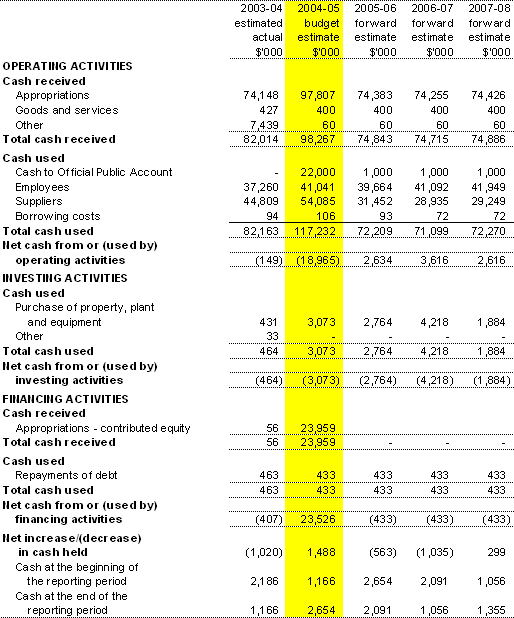
Table 3.4: Agency Capital Budget Statement
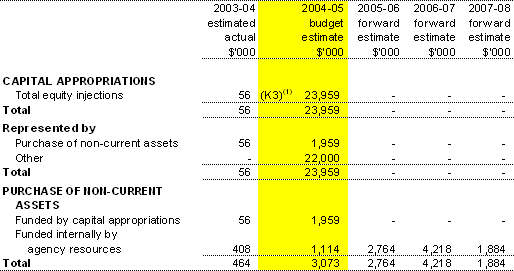
- K3 shows the link back to Table 1.1.
Table 3.5: Agency Non-financial Assets —
Summary of Movement
(Budget year 2004-05)
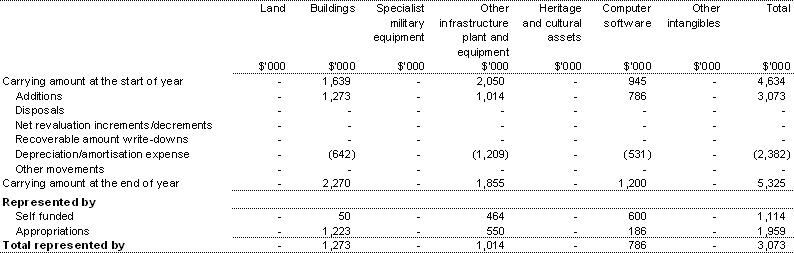
Table 3.6: Note of Budgeted Financial Performance Administered on behalf of Government for the period ended 30 June
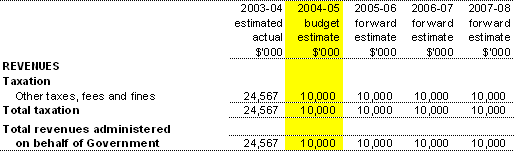
Table 3.7: Note of Budgeted Financial Position Administered on behalf of Government as at 30 June
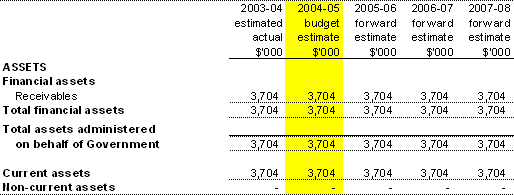
Table 3.8: Note of Budgeted Administered Cash Flows
for the period ended 30 June
Notes to the financial statements
Basis of accounting
The financial statements have been prepared on an accrual basis and in accordance with the historical cost convention, except for certain assets which are at valuation. Except where stated, no allowance is made for the effect of changing prices on the results or the financial position.
Budgeted agency financial statements
Agency assets, liabilities, revenues and expenses are those items that are controlled by the ACCC. They are used by the ACCC in producing its outputs, including:
- computers, plant and equipment used in providing goods and services;
- liabilities for employee entitlements;
- revenues from appropriations or independent sources in payment of outputs; and
- employee, supplier and depreciation expenses incurred in producing the ACCC outputs.
Administered items are those items which are controlled by the Australian Government and managed or oversighted by the ACCC on behalf of the Australian Government. These administered items managed or controlled by the ACCC include authorisation fees, fines and costs.
The purpose of the separation of agency and administered items is to enable the assessment of administrative efficiency of the agency in providing goods and services.
Revenues from government
Revenues from government are revenues relating to the core operating activities of the ACCC. Policies for accounting for revenues from government follow.
Agency appropriations
Since 1 July 1999, the Australian Government Budget has been prepared under an accruals framework.
Appropriations to the ACCC for its agency outputs are recognised as revenue to the extent they have been received into the ACCC’s bank account or are entitled to be received by the ACCC at year end.
Resources received free of charge
Services received free of charge are recognised in the statement of financial performance as revenue when and only when a fair value can be reliably determined and the services would have been purchased if they had not been donated. Use of those resources is recognised as an expense.
Other revenue
Revenue from the sale of goods (that is, seminars/speakers fees, sale of publications, photocopy revenue and sale of non-current assets) is recognised upon the delivery of goods/services to customers. Interest revenue is recognised on a proportional basis taking into account the interest rates applicable to the financial assets.
Administered revenue includes fines and costs, which are recognised as per the court judgement orders. Authorisation fees are recognised when the application is received.
Leases
A distinction is made between finance leases which effectively transfer from the lessor to the lessee substantially all the risks and benefits incidental to ownership of leased non-current assets and operating leases under which the lessor effectively retains substantially all such risks and benefits.
Where a non-current asset is acquired by means of a finance lease, the asset is capitalised at the present value of minimum lease payments at the inception of the lease and a liability recognised for the same amount. Leased assets are amortised over the period of the lease. Lease payments are allocated between the principal component and the interest expense.
Operating lease payments are charged to the statement of operating performance on a basis which is representative of the pattern of benefits derived from the lease assets.
The ACCC entered into a sale and lease back of certain information technology assets on 1 July 1999. This arrangement ceases on 30 June 2004. The sale and lease back of the information technology assets has been specifically treated as a finance lease.
Receivables
Court costs, which are awarded, are not considered as receivables or as creditors, as the case may be, until the costs have been agreed by the concerned parties.
A provision is raised for any doubtful debts based on a review of the collectability of all outstanding accounts as at year end.
Bad debts are written off during the year in which they are identified.
Property, plant and equipment
Asset recognition threshold
Purchases of property, plant and equipment are recognised initially at cost in the statement of financial position, except for purchases costing less than $1,000, which are expensed in the year of acquisition (other than where they form part of a group of similar items which are significant in total).
Revaluations
Property, infrastructure, plant and equipment are carried at valuation. The ACCC revalue all its assets in three year cycles. Revaluations have been undertaken up to 30 June 2002 on a deprival basis. These revaluations being for the cycle which finishes on 30 June 2005.
Future revaluations by the ACCC are to be undertaken at fair value.
Depreciation and amortisation
Depreciable property, plant and equipment assets are written off to their estimated residual values over their estimated useful lives to the ACCC using, in all cases, the straight line method of depreciation. Leasehold improvements are amortised on a straight line basis over the lesser of the estimated life of the improvements or the unexpired period of the lease.
Depreciation/amortisation rates (useful lives) and methods are reviewed at each balance date and necessary adjustments are recognised in the current, or current and future reporting periods, as appropriate. Residual values are re-estimated for a change in prices only when assets are revalued.
Depreciation and amortisation rates that apply to each class of depreciable asset are as follows:
Asset class |
Total useful life |
| Fitout | Lesser of the term of the lease or 10 years |
| Furniture and fittings | 10 years |
| Office equipment | 5 years |
| Computer hardware | 3 years |
| Computer software | 3 to 7 years |