




Section 2: Outcomes and outputs information
Outcomes and output groups
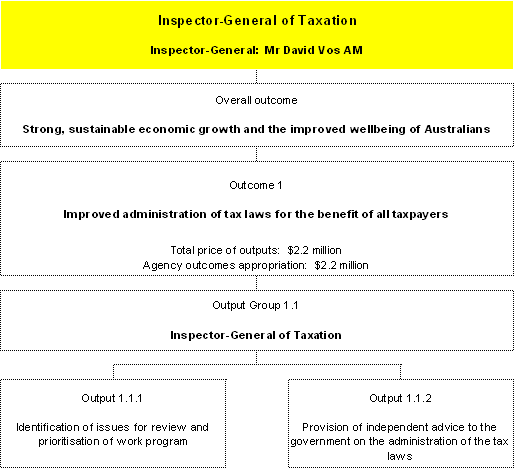
Map 2 shows the relationship between Government outcomes and the contributing outputs for the Inspector-General of Taxation (IGT). Financial detail for Outcome 1 by output appears in Table 2.1 while non-financial information for Outcome 1 appears in Table 2.2.
Map 2: Outcomes and output groups
Outcome 1 — Description
Strong, sustainable economic growth and the improved wellbeing of Australians.
Measures affecting Outcome 1
There are no measures for the IGT in the 2004-05 Budget.
Outcome 1 — Resourcing
Table 2.1 shows how the 2004-05 appropriations translate to total resourcing for Outcome 1, including revenues from government (appropriations), revenue from other sources, and the total price of outputs.
Table 2.1: Total resources for Outcome 1
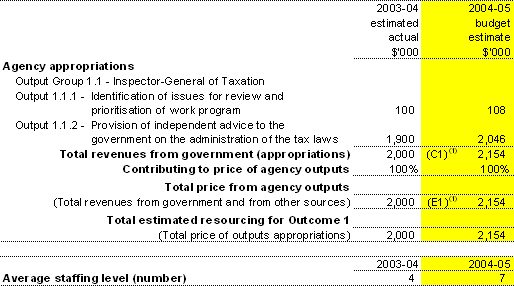
- C1 and E1 show the links back to Table 1.1.
Outcome 1 — Contribution of outputs
The role of the Inspector-General of Taxation is to improve the administration of the tax laws for the benefit of all taxpayers.
This is achieved by reviewing the systems established by the Australian Taxation Office to administer the tax laws and the systems established by tax laws in relation to administrative matters.
The Inspector-General of Taxation’s two outputs derive from the statutory functions. These outputs involve the identification of systemic issues for review and the prioritisation of the work programme and the provision of independent advice to government on the administration of the tax laws.
The scope of the work programme is determined by the identification and prioritisation of a systemic issue by the Inspector-General. However, the Act also provides that the Minister may direct that a matter be included on the work programme, and that the Inspector-General considers requests to conduct reviews from:
- the Minister (separate from the direction provision); or
- the Commissioner of Taxation; or
- a resolution of either House, or both Houses, of the Parliament; or
- a resolution of a Committee of either House, or both Houses, of the Parliament.
Broad-based community involvement in the identification of issues and the opportunity for all stakeholders to provide submissions ensures that reviews undertaken are relevant and timely for all stakeholders. In view of this, the Inspector-General requires the flexibility to vary resourcing allocations so as to allow emerging and important systemic issues to be addressed in a manner that is timely and relevant to government.
The Inspector-General of Taxation has no power to direct the Commissioner of Taxation in the administration of the tax laws. The effectiveness with which Inspector-General’s advice to government contributes to the achievement of the outcome may be difficult to assess. In some instances, the provision of advice to government may lead to legislative change to address an identified systemic issue. However, on other occasions the Commissioner of Taxation may independently address a systemic issue identified by the Inspector-General of Taxation either following the release of a Review Report by the Minister or the publication of an Issues Paper or Work Programme by the Inspector-General.
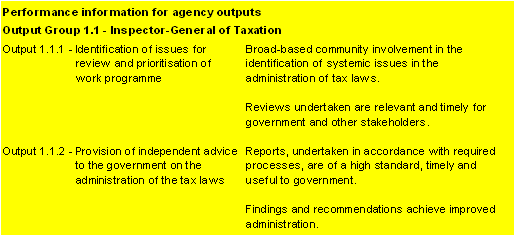
Performance information for Outcome 1
Table 2.2: Performance information for Outcome 1
Evaluations
Internal, informal monitoring of the IGT’s performance and output is undertaken on a continuous basis.
Evaluation of actual levels of achievement will be shown in the Inspector-General of Taxation’s 2003-04 Annual Report.