



Notes to the AAS Financial Statements
Note 1: External reporting standards and accounting policies
The Charter of Budget Honesty Act 1998 requires that the budget be based on external reporting standards and that departures from applicable external reporting standards be identified.
The financial statements included in this statement have been prepared on an accrual basis in accordance with applicable Australian Accounting Standards (AAS), including AAS31 Financial Reporting by Governments (AAS31).
AAS requires governments to prepare accrual based general purpose financial reports. This means that assets, liabilities, revenues and expenses are recorded in financial statements when transactions have an economic impact on the government, rather than when the cash flow associated with these transactions occurs. Consistent with AAS, a statement of financial performance, a statement of financial position and a statement of cash flows have been prepared for the budget year and the three forward years.
AAS will change from 2005-06, with the introduction of Australian Equivalents to International Financial Reporting Standards (AEIFRS). The tables in this Statement are presented on the basis of Australian Accounting Standards as at the date of preparation of the Budget. However, the amounts presented in these financial statements have been adjusted to include the material, reliably estimable impacts from the application of AEIFRS.
The accounting policies in this statement are generally consistent with the requirements of AAS. While the scope for financial reporting recommended in AAS 31 is the whole of government (that is, the Australian Government public sector), in accordance with the Charter of Budget Honesty Act 1998, the presentation covers the general government sector only. This statement includes notes showing disaggregated information.
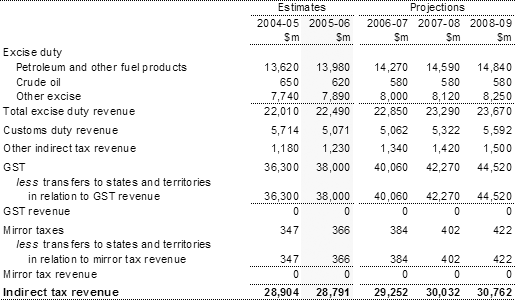
AAS would suggest the gross amount of goods and services tax (GST) be included in the Australian Government’s financial statements. However, under the Intergovernmental Agreement on the Reform of Commonwealth-State Financial Relations, GST is collected by the Australian Taxation Office as an agent for the states and territories (the states), and appropriated to the states. Therefore, accrued GST revenues and associated payments to the states are not recorded in the financial statements.
Note 2: Impacts of Australian Equivalents to International Financial Reporting Standards
The Financial Reporting Council has issued a strategic direction requiring reporting entities in Australia to adopt international accounting standards for reporting periods beginning on or after 1 January 2005. This will involve replacing relevant existing standards with Australian Equivalents to International Financial Reporting Standards (AEIFRS).
The Australian Accounting Standards Board (AASB) has issued the full suite of standards that will apply under AEIFRS including AAS 31 Financial Reporting by Governments.
Material estimated impacts on and movements in these financial statements, as if prepared under AEIFRS, are detailed below.1 The impacts are largely the result of estimating the impact of applying AASB 116 Property, Plant and Equipment, AASB 119 Employee Benefits, AASB 138 Intangible Assets, AASB 139 Financial Instruments: Recognition and Measurement, and AASB 140 Investment Properties.
The estimated impacts on the Statement of Financial Performance arising from the application of AEIFRS suggest positive impacts to the operating result of $435 million in 2005-06, $320 million in 2006-07, $327 million in 2007-08, and $218 million in 2008-09.
The estimated impacts on the Statement of Financial Position arising from the application of AEIFRS to net assets indicate a negative movement in net assets of $2.93 billion in 2005-06, reducing to a negative movement of $2.15 billion by 2008-09.
There are no cash flow impacts arising from the application of AEIFRS.
The material components of the impacts on these statements are disclosed below.
AASB 116 Property, Plant and Equipment requires that the cost of an item of property, plant or equipment include an estimate of the costs of dismantling and removing the asset, and restoring the site on which the asset was situated. AASB 116 requires these costs to be capitalised into the value of the respective assets and an associated provision established.
The yearly impacts on depreciation, borrowing costs and suppliers expenses resulting from applying AASB 116 are a decrease to operating results of $36.1 million in 2005-06, $30.2 million in 2006-07, $26.7 million in 2007-08 and $25.8 million in 2008-09. The cumulative impact on land and buildings, infrastructure, plant and equipment, and provisions result in a negative movement in net assets of $26.2 million in 2005-06, $14.2 million in 2006-07, $13.7 million in 2007-08 and $15.3 million in 2008‑09.
AASB 119 Employee Benefits will require changes in the measurement and recognition of employee annual leave entitlements and superannuation benefits.
The yearly impacts on employee expenses and borrowing costs of applying AASB 119 result in an increase to operating results of $58 million in 2005‑06, $2 million in 2006‑07, $55 million in 2007‑08 and $56 million in 2008‑09. The cumulative impact on employee provisions results in a negative movement in net assets of $1.03 billion in 2005‑06, $1.03 billion in 2006‑07, $0.98 billion in 2007‑08 and $0.92 billion in 2008‑09.
AASB 138 Intangible Assets does not permit intangibles to be measured at valuation unless there is an active market for such an asset. Where intangibles are recorded at valuation, Australian Government entities will derecognise the valuation component of the carrying amount of these assets on adoption of the AEIFRS. These impacts mainly relate to internally developed software.
The yearly impacts on depreciation and amortisation expense of applying AASB 138, result in an increase to operating results of $13 million in 2005‑06, $10 million in 2006‑07, $8 million in 2007‑08 and $7 million in 2008‑09. The cumulative impacts on intangible assets result in a negative movement in net assets of $49 million in 2005‑06, $39 million in 2006‑07, $31 million in 2007‑08 and $23 million in 2008‑09.
AASB 139 Financial Instruments: Recognition and Measurement states that when a financial asset or financial liability is recognised initially, an entity shall measure it at its fair value plus, in the case of a financial asset or financial liability not at fair value through profit or loss, transaction costs that are directly attributable to the acquisition or issue of the financial asset or financial liability.
The yearly impacts on gains of applying AASB 139 increases operating results by $371 million in 2005‑06, $303 million in 2006‑07, $257 million in 2007‑08 and $148 million in 2008‑09. The cumulative impacts on Government securities and payables result in a negative movement in net assets of $2.04 billion in 2005‑06, $1.68 billion in 2006‑07, $1.39 billion in 2007‑08 and $1.22 billion in 2008‑09.
AASB 140 Investment Property requires investment properties to be separately reported, with all movements to the assets fair value recognised in the operating result. Investment properties held at fair value will not be depreciated.
The yearly impacts on gains and depreciation expense of applying AASB 140 increases operating results by $34 million in 2005‑06, $36 million in 2006‑07, $37 million in 2007‑08 and $37 million in 2008‑09. The cumulative impacts on land and buildings and asset reserves result in a negative movement in net assets of $205 million in 2005‑06, $234 million in 2006-07, $263 million in 2007-08 and $293 million in 2008-09.
Note 3: Reconciliation of cash
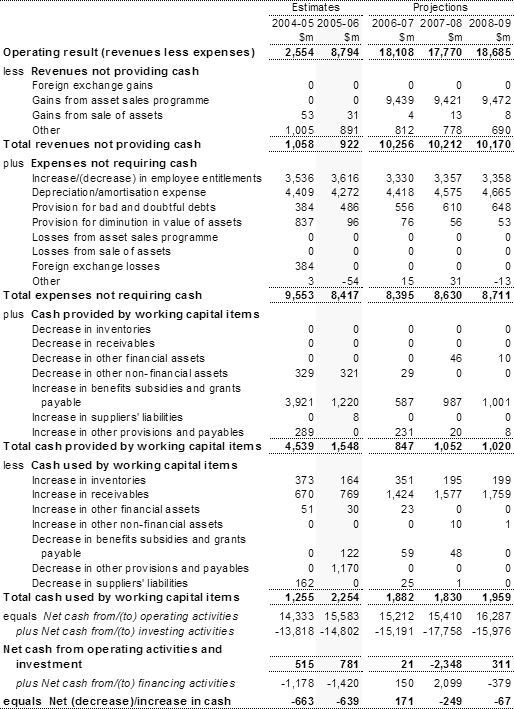
Note 3(a): Consolidated Revenue Fund
The estimated and projected cash balances reflected in the statement of financial position for the Australian Government general government sector (Table 2) include the reported cash balances controlled and administered by Australian Government agencies subject to the Financial Management and Accountability Act 1997 and the reported cash balances controlled and administered by entities, subject to the Commonwealth Authorities and Companies Act 1997 (CAC Act), that implement public policy through the provision of primarily non-market services.
Revenues or monies raised by the Executive Government automatically form part of the Consolidated Revenue Fund by force of section 81 of the Australian Constitution. For practical purposes, total Australian Government general government sector cash, less cash controlled and administered by CAC Act entities, plus special public monies, represents the Consolidated Revenue Fund referred to in section 81 of the Australian Constitution. On this basis, the balance of the Consolidated Revenue Fund is shown below.
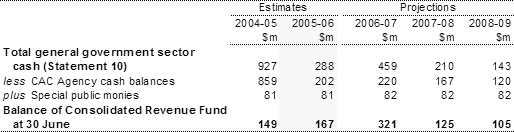
Further information on the Consolidated Revenue Fund is included in Budget Paper No. 4, Agency Resourcing 2005‑06.
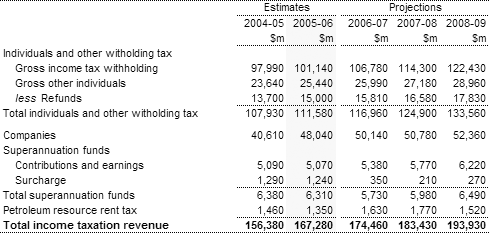
Note 4: Income taxation revenue
Note 5: Indirect taxation revenue
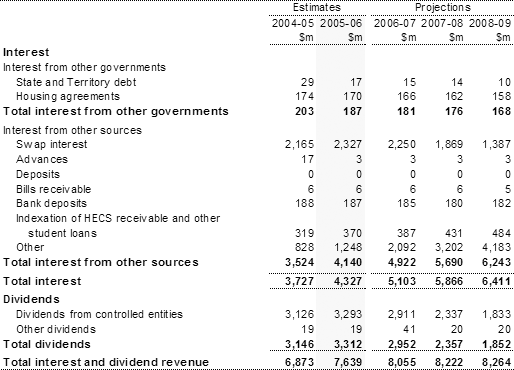
Note 6: Interest and dividend revenue
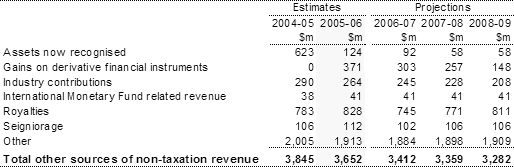
Note 7: Other sources of non-taxation revenue
Note 8: Employee expenses
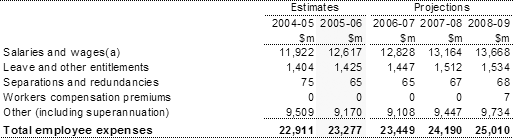
- Salaries and wages do not include superannuation.
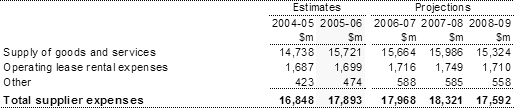
Note 9: Suppliers expenses
1 These impacts do not include those relating to the Department of Defence, as reliable estimates were not available for the preparation of the 2005-06 Budget estimates.