



Variations to the fiscal balance estimates
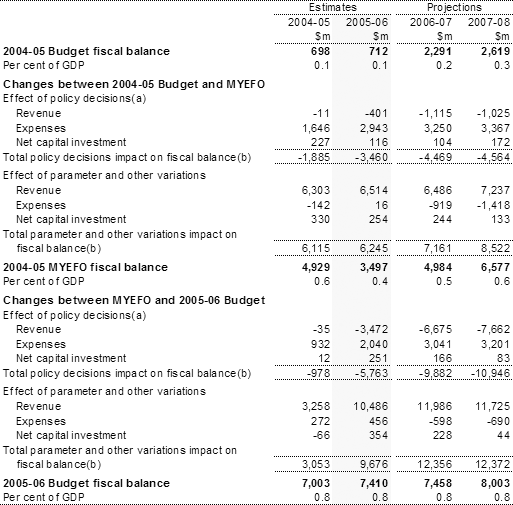
The upward revision of $3.9 billion in the 2005‑06 fiscal surplus since MYEFO largely reflects higher than anticipated revenue from companies, small unincorporated businesses and personal investors. This is partly offset by the impact of personal income tax cuts and the Government’s Welfare to Work package.
Table 2 provides a reconciliation of the fiscal balance estimates between the 2004‑05 Budget, the 2004‑05 MYEFO and the 2005‑06 Budget.
Table 2: Reconciliation of 2004‑05
Budget, 2004‑05 MYEFO and
2005‑06 Budget fiscal balance estimates
- Excludes the public debt net interest effect of policy measures.
- A positive number for revenue indicates an increase in the fiscal balance, while a positive number for expenses and net capital investment indicates a decrease in the fiscal balance.
Variations in revenue estimates
Total revenue for 2005‑06 has been revised up by $7.0 billion since MYEFO, reflecting higher estimated revenue from companies, personal investors and small unincorporated businesses. These upward revisions have been partly offset by the impact of the Government’s decision to provide further personal income tax cuts.
Policy decisions since the 2004‑05 MYEFO are expected to reduce taxation revenue by around $3.5 billion in 2005‑06 and around $26.1 billion over the forward years. The major policy decisions affecting revenue over the four year period 2005‑06 to 2008‑09 are outlined below.
- The personal income tax cuts taking effect from 1 July 2005 and 1 July 2006 will reduce revenue by $3.1 billion in 2005-06, and $21.7 billion over the forward estimates period.
- The abolition of the superannuation contributions and termination payments surcharge for contributions made from 1 July 2005 will reduce revenue by $650 million in 2006‑07 and $2.5 billion over the forward estimates.
- The removal of the 3 per cent tariff applying to business inputs imported under a tariff concession order, effective from 11 May 2005, will reduce revenue by $36 million in 2004-05, $290 million in 2005‑06 and $1.3 billion over the forward estimates.
- The extension of the eligibility criteria for the mature age worker tax offset will reduce revenue by $70 million in 2005‑06 and $295 million over the forward estimates period.
- A four-year income tax exemption for temporary residents for most foreign source income, including capital gains, commencing from July 2006, will reduce revenue by $50 million in 2007‑08 and $105 million over the forward estimates.
- Changes to the capital gains tax treatment of non-resident investors in Australia will reduce revenue by $50 million in 2005‑06 and $230 million over the forward estimates.
- Recognition for tax purposes of certain currently unrecognised business capital expenditures (‘blackhole expenditures’) from 2006‑07 will reduce revenue by $35 million in 2006-07, increasing in later years, to a cost of $205 million over the forward estimates.
- Changes to the capital allowance treatment of film copyright to ensure the application of the effective life depreciation regime, with effect to expenditures after 1 July 2004, will reduce revenue by $15 million in 2005‑06 and $175 million over the forward estimates.
- Abolition of the foreign loss and foreign tax credit quarantining, with effect from the first income year after Royal Assent, will reduce revenue by $25 million in 2007‑08 and in 2008-09.
Parameter and other variations are expected to increase revenue in 2005‑06 by $10.5 billion, relative to the MYEFO forecasts. These upward revisions reflect the flow on effect of a stronger expected revenue base in 2004‑05 and a significant upward revision to nominal GDP growth in 2005-06.
- Relative to MYEFO, nominal GDP growth for 2005‑06 has been revised up by 1¾ percentage points to 7½ per cent — despite a slight downward revision to real GDP growth — reflecting significant increases in estimated growth in the GDP deflator as a result of recent increases in commodity export prices (see Box 3, Statement 3).
- These increases are expected to lift corporate profits significantly in 2005-06, which — due to the timing of company tax collections — will boost revenue in both 2005‑06 and 2006-07. Reflecting this, estimated company income tax revenue for 2005‑06 has been revised up by $4.7 billion since MYEFO, and by a further $3.8 billion in 2006-07.
The Budget estimates also incorporate adjustments to forecasting methodology to align the estimates more closely with recent experience (see Box 1, Statement 5). These adjustments affect the gross other individuals, refunds for individuals and company income tax revenue heads and generally increase estimated revenue from MYEFO for 2005‑06 and the projection years.
Relative to MYEFO, estimated total revenue for 2004‑05 has been revised up by $3.2 billion, largely owing to higher expected revenue from wage and salary earners, personal investors and small unincorporated businesses.
More detail on how the revised outlook for the economy has affected individual revenue heads over the forward estimates period is provided in Statement 5. A full description of all policy measures since MYEFO is provided in Budget Paper No. 2, Budget Measures 2005-06.
Variations in expense estimates
Since MYEFO, estimated expenses for 2005‑06 have increased by $2.5 billion reflecting the impact of new policy decisions of $2.0 billion and parameter and other variations of $0.5 billion.
Major policy decisions since MYEFO that have increased expenses include:
- $430 million in 2005‑06 ($2 billion over the five years from 2004-05) to increase the maximum rate of Family Tax Benefit Part B, as announced in the Extra Assistance for Families election commitment;
- $207 million in 2005‑06 ($797 million over four years) to continue assisting the Solomon Islands Government in the restoration of law and order and broad-ranging economic, governance and public sector reforms;
- $177 million in 2005‑06 ($211 million over four years from 2004-05) for the deployment of additional troops to provide security and training in Southern Iraq;
- $174 million in 2005‑06 ($211 million over three years from 2004-05) to continue the Australian Defence Force contribution to stabilisation and reconstruction activities in Iraq (Operation Catalyst);
- $170 million in 2005‑06 ($3.5 billion over four years) for the Welfare to Work package to increase workforce participation and reduce welfare dependency while retaining a strong safety net for those in need;
- $115 million in 2005‑06 ($500 million over five years from 2004-05) for the grants component of the Australian-Indonesia Partnership for Reconstruction and Development Package to help Indonesia restore health, education and local government services in the worst tsunami affected areas, and improve economic governance and public administration. This is in addition to the $500 million in concessional loans over five years to be directed to reconstruction and rehabilitation of major infrastructure across Indonesia; and
- $112 million in 2005‑06 ($579 million over four years) to continue funding for quarantine border protection programmes delivered by the Australian Quarantine and Inspection Service, the Australian Customs Service and Biosecurity Australia.
Major policy decisions reducing expenses include:
- a $139 million reduction in 2005‑06 ($1 billion over five years from 2004-05) due to changes to listing arrangements for pharmaceuticals which will see a price reduction of at least 12.5 per cent when the first new brand of an already listed medicine is added to the Pharmaceutical Benefits Scheme; and
- an $84 million decrease in 2005‑06 ($335 million over four years) resulting from the withdrawal of the funding offer to state and territory governments to extend concessions to Commonwealth Seniors Health Card holders.
In 2005-06, parameter and other variations have increased forecast expenses by $0.5 billion since MYEFO largely reflecting:
- a $588 million increase in estimated civilian superannuation expenses, largely due to higher nominal interest expense reflecting changes in the estimate of the Consumer Price Index;
- a $398 million increase in Defence expenses reflecting an increase in the estimated non-farm GDP deflator, which is used to index Defence operating expenses;
- a rephasing of $300 million by the Department of Defence of its major capital equipment acquisition programme from beyond the forward estimates period into 2005‑06 to meet current funding requirements, including from expected improvements in performance in the delivery of the Defence Capability Plan;
- a $232 million increase in expenses administered by the Australian Taxation Office resulting from a change in accounting policy which recognises certain payments in the year of accrual rather than the year of payment;
- a $220 million increase in expenses due to a reclassification of Defence Housing Authority expenses following the adoption of the Inventory Accounting Standard which has resulted in expenses being recognised for the purpose of Government Finance Statistics;
- a $200 million increase in Energy Grants Credit Scheme expenses, flowing on from higher than forecast claims activity in 2004‑05 due to expected increases in the mining and road transport sectors; and
- a $70 million increase in Private Health Insurance Rebate expenses, primarily resulting from higher than expected premium increases and levels of insurance coverage.
The above increase in expenses is partially offset by:
- a $439 million reduction in anticipated Newstart Allowance and Youth Allowance expenses, largely due to the stronger labour market reducing the expected number of unemployment benefit recipients;
- a $120 million reduction for Superannuation Guarantee Programme expenses, primarily due to delays in processing claims;
- a $69 million reduction in expenses for the Cleaner Fuels Grant Scheme due to a lower than forecast take-up of bio-diesel production grants;
- the removal of the provision for the implementation of election commitments now reported as policy measures; and
- the regular draw-down of the conservative bias allowance1 reducing estimated expenses by around $1 billion each year from 2005-06.
In 2004-05, estimated expenses have increased by $1.2 billion since MYEFO. This largely reflects new spending of $932 million including $314 million for a one-off lump-sum payment to eligible carers and $212 million towards the Family Tax Benefit Part B package. Parameter and other variations have increased expenses by $272 million and include a $1 billion increase in expenses administered by the Australian Taxation Office resulting from a change in accounting policy, partially offset by other variations including a $140 million underspend associated with the delayed deployment of Australian Federal Police staff to Papua New Guinea.
More detailed information on expenses can be found in Statement 6. A full description of all policy measures since MYEFO can be found in Budget Paper No. 2, Budget Measures 2005-06.
Variations in net capital investment estimates
In 2005-06, forecast net capital investment has increased by $605 million since the 2004‑05 MYEFO. This represents the combined effect of:
- new policy measures of $251 million, including $56 million largely to ensure the Welfare to Work reforms are supported by high quality information technology, $42 million of additional investment in improved security for Australian diplomatic missions, $16 million to continue assisting the Solomon Islands Government in the restoration of law and order and broad ranging economic, governance and public sector reforms, and $11 million for the deployment of additional troops to provide security and training in Southern Iraq; and
- parameter and other variations of $354 million, largely due to a $195 million revision in estimated Defence Housing Authority sales, $101 million in capital investment by the Overseas Property Office and a further $34 million investment for the construction of the Christmas Island Immigration Reception and Processing Centre. These increases are partially offset by sales in the Defence Property Sales programme estimated at $89 million.
In 2004-05, estimated net capital investment has decreased by $54 million since MYEFO, largely reflecting parameter and other variations.
More detailed information on net capital investment can be found in Statement 6. A full description of all policy measures since the MYEFO can be found in Budget Paper No. 2, Budget Measures 2005-06.
1 The forward estimates include an allowance for the established tendency of existing government policy (particularly demand driven programmes) to be higher than estimated in the forward years. To offset this the contingency reserve includes an allowance based on past experience to preserve the overall integrity of forward estimates. This allowance, known as the conservative bias allowance, is progressively reduced so that the budget year conservative bias allowance is zero by budget night.