



Medium-term fiscal outlook
Importance of fiscal sustainability
Delivering sustainable fiscal policy is a key requirement of good government. By not living beyond its means, the Government prevents costly burdens being placed on future generations. Further, when governments are fiscally responsible, they provide a secure investment environment that encourages growth.
By reducing debt to manageable levels, the Government has put its finances in a sound position and generated substantial savings that can be directed to other purposes. However, sustainable fiscal policy is more than just prudent reduction of past debts. It involves managing all elements of the balance sheet — such as the unfunded superannuation liability — and a forward-looking strategy to address the looming fiscal pressures yet to affect Government finances.
The Government recognised the importance of fiscal sustainability by committing to the regular release of the Intergenerational Report, with the first report in 2002 foreshadowing a significant fiscal gap opening over the long term. The Government is committed to managing these fiscal pressures by implementing pro‑growth policies that raise productivity and encourage greater participation in the economy. The Government complements this by taking a long-term view when managing the fiscal outlook. Without making moderate reforms today, more drastic policy solutions will become inevitable in the future.
Medium-term budget pressures
While the current budget position is strong, significant fiscal pressures will emerge beyond the forward estimates period. Demographic change is expected to lead to both lower taxation receipts — due to falls in workforce participation — and higher payments, mainly for pensions and health care. In this budget, the GDP projection in 2008‑09 has been lowered by ¼ per cent, reflecting the initial step of recognising slowing economic growth from the ageing of the population. Medium-term pressures are generated from rising health care costs, relating to increasing demand for health services, technological advances and demographic change.
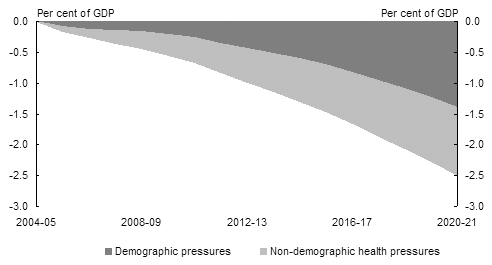
While these fiscal pressures are most evident over the long term, they will have significant effects within the next ten years. The Productivity Commission’s report on the Economic Implications of an Ageing Australia suggests that a fiscal gap of around 1.5 per cent of GDP will emerge by 2015-16; equivalent to $13 billion in today’s terms. A breakdown of the impact of these fiscal pressures is reflected in Chart 1 below.
Chart 1: Medium-term fiscal pressures
Source: Productivity Commission, 2005, Economic Implications of an Ageing Australia.
Improving fiscal sustainability
The Government already has a strong record on fiscal sustainability by reducing net debt by an estimated $90 billion, from 19 per cent of GDP in 1995‑96 to 0.7 per cent of GDP in 2005-06. This has freed up interest savings of around $5.7 billion annually that can be applied to other fiscal pressures. In addition, the Government has released a series of packages designed to lower fiscal pressures over the medium to long term.
The Government’s currently unfunded superannuation liability to employees is the largest liability on the balance sheet at around $91 billion in 2004-05. By establishing the Future Fund, the Government has pre‑committed resources to meet future superannuation payments. As Future Fund earnings are not available for other spending, they are excluded from the underlying cash balance. Funding superannuation now will reduce future pressures on the budget at a time when the Government will need to face the spending challenges of an ageing population.
In addition to establishing the Future Fund, the Government has closed entry to the Public Sector Superannuation Scheme to limit future growth in the liability. Overall, these reforms ensure that superannuation costs are not passed onto future generations at a time when other demographic pressures emerge.
Also in this budget the Government has announced a comprehensive reform package that will improve the outlook for workforce participation and place the welfare system on a more sustainable basis. New obligations to seek part-time work will ensure that those who are able to work do so. The combination of improved payment and income test arrangements, a new compliance regime that encourages people to meet their obligations and funding for a range of new and expanded services will increase participation by moving people out of welfare and into work.
Also, the introduction of the Child Care Tax Rebate and the provision of additional child care places assist parents returning to the workforce after having children. Together, these packages will lead to greater workforce participation that strengthens both the overall economy and the Government’s finances over the medium term.
Healthcare costs currently represent 18 per cent of the Government expenses and will continue to grow strongly in the future. In particular, expenses for the Pharmaceutical Benefits Scheme increased by 11 per cent in 2003-04, reflecting higher general demand for health services — an effect that will be compounded through demographic change. The increase in PBS patient co-payments, the mandatory 12.5 per cent price reduction for generic drugs as well as the raising of the Medicare Safety Net thresholds are directed to returning healthcare to a sustainable footing so that future generations can also enjoy high quality health services.