



Accrual GFS framework
The GFS reporting framework is a specialised financial reporting system designed to support economic analysis of the public sector. It allows comprehensive assessments to be made of the economic impact of government and is consistent with international statistical standards (the System of National Accounts 1993 (SNA93) and the International Monetary Fund’s (IMF) Government Finance Statistics Manual 2001).1
GFS financial statements are contained in Statements 2 and 9.
Nature of the GFS framework
The accrual GFS framework is based on an integrated recording of flows and stocks. Flows reflect the creation, transformation, exchange, transfer or extinction of economic value. They involve changes in the volume, composition or value of a unit’s assets, liabilities and net worth. Stocks refer to a unit’s holdings of assets, liabilities and net worth at a point in time.
The framework distinguishes between two types of flows: transactions and other economic flows.
- Transactions result from mutually agreed interactions between economic entities. Despite their compulsory nature, taxes are transactions deemed to occur by mutual agreement between the government and the taxpayer. Transactions that increase or decrease net worth (assets minus liabilities) are reported as revenue and expenses respectively in the operating statements.2
- Other economic flows represent changes to the value of stocks that do not result from a transaction. Other economic flows arise from price movements (revaluations) and volume changes, including interest and exchange rate movements, and phenomena such as discoveries, depletion and destruction.
The GFS conceptual framework comprises a number of separate statements, each of which draws out analytical aggregates or balances of particular economic significance. Together, these aggregates provide for a thorough understanding of the financial position of the public sector. The GFS statements reported in the Budget are the operating statement, balance sheet, cash flow statement and statement of other economic flows.
Under the accrual GFS framework, flows are recorded in the period in which they occurred. As a result, prior period outcomes may be revised where information arises that could reasonably be expected to have been known in the past, is material in at least one of the affected periods and can be reliably assigned to the relevant period(s).
Operating statement
The operating statement presents details of transactions in GFS revenues, GFS expenses and the net acquisition of non-financial assets (net capital investment) for an accounting period.
GFS revenues arise from transactions that increase net worth and GFS expenses arise from transactions that decrease net worth. GFS revenues less GFS expenses gives the GFS net operating balance. The net operating balance is comparable to the National Accounts concept of government saving plus capital transfers.
The net acquisition of non-financial assets (net capital investment) measures the change in the Australian Government’s stock of non-financial assets due to transactions. As such, it measures the net effect of purchases, sales and consumption (depreciation of fixed assets and use of inventory) of non-financial assets during an accounting period.
Net acquisition of non-financial assets equals gross fixed capital formation, less depreciation, plus changes (investment) in inventories, plus other transactions in non-financial assets.
- Gross fixed capital formation comprises purchases less sales of fixed assets (such as buildings) and net acquisitions of fixed assets under finance leases.
- Depreciation measures consumption of fixed assets, such as through physical deterioration or normal obsolescence, as they are used in production.
- Changes in inventories measures investment in new inventory stocks less use of current inventories.
- Other transactions in non-financial assets comprise mainly (for the Australian Government general government sector) changes in the value of work-in-progress and software assets, and transactions in non-reproducible, intangible assets (such as telecommunications spectrum).
Fiscal balance
The fiscal balance (or GFS net lending/borrowing) is the net operating balance less net capital investment. Thus, the fiscal balance includes the impact of net expenditure (effectively purchases less sales) on non‑financial assets rather than consumption (depreciation) of non-financial assets.3
The fiscal balance measures the Australian Government’s investment-saving balance. It measures in accrual terms the gap between government savings plus net capital transfers, and investment in non-financial assets. As such, it approximates the contribution of the Australian Government general government sector to the balance on the current account in the balance of payments.
A fiscal balance surplus indicates the Australian Government is lending to other sectors. A fiscal balance deficit indicates the Australian Government is using the financial resources of other sectors. Thus, fiscal balance can be viewed as a global indicator of the financial impact of Australian Government operations on the rest of the economy.
Balance sheet
The balance sheet shows stocks of assets, liabilities and GFS net worth. Net debt is also reported in the balance sheet.
Assets represent instruments or entities:
- over which ownership rights are enforced by an economic entity; and
- from which economic benefits may be derived by their owners from holding them or using them over a period of time.
Liabilities represent obligations to provide economic value to other institutional units.
Net debt
Net debt is the sum of selected financial liabilities (deposits held, advances received, government securities, loans and other borrowing) less the sum of selected financial assets (cash and deposits; advances paid; and investments, loans and placements). Net debt does not include superannuation or superannuation related liabilities. Net debt is a common measure of the strength of a government’s financial position. High levels of net debt impose a call on future revenue flows to service that debt.
Net interest payments is a concept related to net debt. Net interest payments is a cash measure defined as interest payments on gross debt less interest received. Net interest payments are affected by the volume of net debt and by interest rates.
Net worth
The net worth of the general government sector is defined as assets less liabilities. Apart from the effect of revaluations and volume changes (recorded in the statement of other economic flows), changes in general government sector net worth reflect the net operating balance. For the public financial corporations and public non-financial corporations sectors, net worth is defined as assets less liabilities less shares and other contributed capital. Net worth is an economic measure of wealth, reflecting the contribution of the Australian Government to the wealth of Australia.
The net worth measure is a more comprehensive indicator of a government’s overall financial position than net debt as it incorporates a government’s non-financial assets, such as land and other fixed assets, as well as certain financial assets and liabilities not captured by the net debt measure, most notably accrued employee superannuation liabilities. For example, a limitation of the net debt measure is that the sale of physical assets decreases net debt, with proceeds from sales increasing financial assets. Net worth recognises this increase in financial assets is funded by a decrease in physical assets. Net worth itself, however, also has limitations. It can be volatile, some non-financial assets can be difficult to measure and changes can reflect circumstances beyond the direct control of the Government.
Cash flow statement
The cash flow statement identifies how cash is generated and applied in a single accounting period. Cash means cash on hand (notes and coins held and deposits held at call with a bank or other financial institution) and cash equivalents (highly liquid investments that are readily convertible to cash on hand at the investor’s option and overdrafts considered integral to the cash management function).
The cash flow statement reflects a cash basis of recording (rather than an accrual basis) where information is derived indirectly from underlying accrual transactions and movements in balances. This, in effect, means that transactions are captured when cash is received or when cash payments are made. Cash transactions are identified specifically because cash management is considered an integral function of accrual budgeting.
Underlying cash balance
The underlying cash balance plus Future Fund earnings (GFS surplus/deficit) is the cash counterpart of the fiscal balance, reflecting the Australian Government’s cash investment-saving balance. This measure is conceptually equivalent under the current accrual framework and the previous cash framework. For the general government sector, the underlying cash balance is calculated as shown below.
Net cash flows from operating activities
plus
Net cash flows from investments in non-financial assets
less
Net acquisitions of assets acquired under finance leases and similar arrangements4
equals
GFS surplus/deficit
less
Future Fund earnings
equals
Underlying cash balance
The Government is reporting the underlying cash balance net of Future Fund earnings from 2005-06 onwards because the earnings will be reinvested to meet future superannuation payments and are therefore not available for current spending. However, Future Fund earnings are included in the fiscal balance because superannuation expenses relating to future cash payments are recorded in the fiscal balance estimates.
Expected Future Fund earnings are separately identified in the Australian Government cash flow statement in Statement 2 Appendix B and the historic tables in Statement 13.
An underlying cash surplus reflects the extent to which cash is not pre-committed to funding the Australian Government’s unfunded superannuation liability and is available to the Australian Government to either increase its financial assets or decrease its liabilities (assuming no revaluations and other changes occur). An underlying cash deficit measures the extent to which the Australian Government requires cash for current period expenditure, either by running down its financial assets or drawing on other sectors’ cash reserves.
Headline cash balance
The headline cash balance is calculated by adding net cash flows from investments in financial assets for policy purposes and Future Fund earnings to the underlying cash balance.
Cash flows from investments in financial assets for policy purposes include equity transactions and net advances.5 Equity transactions include equity injections into controlled businesses and privatisations of government businesses. Net advances include net loans to the states, net loans to students under the Higher Education Contribution Scheme (HECS) and contributions to international organisations that increase the Australian Government’s financial assets.
Statement of other economic flows (reconciliation of net worth)
The statement of other economic flows outlines changes in net worth driven by economic flows other than GFS revenues and GFS expenses. Accordingly, the GFS system includes a fourth financial statement that presents changes in net worth in an accounting period due to other economic flows (the effect of transactions is reported in the operating statement). Other economic flows, GFS revenues and GFS expenses sum to the total change in net worth during a period.6
Other economic flows are changes in the value of assets or liabilities due to price movements or volume changes. Most other economic flows for the Australian Government general government sector arise from price movements in its assets and liabilities, including:
- changes in the value of investments in commercial entities, including through changes in share prices;
- writedowns in asset values, such as through greater allowances for bad and doubtful debts;
- changes in the valuation of superannuation and employee compensation liabilities due to economic and demographic changes; and
- valuation changes due to movements in foreign exchange rates and interest rates.
The Australian Government also has a small number of volume changes, including assets recognised for the first time and changes to assets and liabilities flowing from reclassifications and accounting policy changes.
Sectoral classifications
To assist in analysing the public sector, GFS data are presented by institutional sector. GFS distinguishes between the general government sector, the public non-financial corporations sector and the public financial corporations sector, as shown in Figure 1.
Figure 1: Institutional structure of the public sector
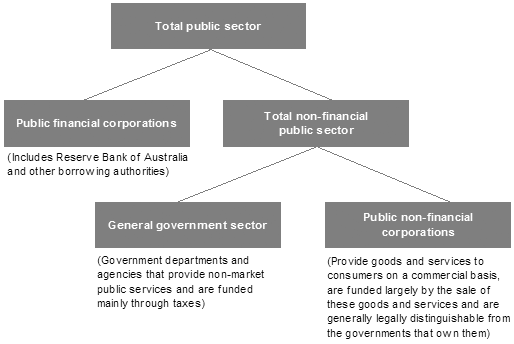
Budget reporting focuses on the general government sector. The general government sector provides public services that are mainly non-market in nature and for the collective consumption of the community, or involve the transfer or redistribution of income. These services are largely financed through taxes and other compulsory levies, although user charging and external funding have increased in recent years. This sector comprises all government departments, offices and some other bodies.
The public non-financial corporations sector comprises bodies that provide goods and services that are mainly market, non-regulatory and non-financial in nature, and are financed predominantly through sales to the consumers of these goods and services. In general, public non-financial corporations are legally distinguishable from the governments that own them. Australian Government public non-financial corporations include Telstra, Australia Post and the Australian Government Solicitor.
Together the general government sector and the public non-financial corporations sector comprise the non‑financial public sector.
The GFS coverage of the public sector also includes public financial corporations. Public financial corporations are public sector bodies that engage in financial intermediation services or auxiliary financial services and are able to incur financial liabilities on their own account (such as taking deposits, issuing securities or providing insurance services). This sector includes the Reserve Bank of Australia, the Export Finance and Insurance Corporation and Medibank Private. Information on public financial corporations is not included in the budget papers as public financial corporations undertake financial intermediation, which is a fundamentally different function from that performed by other public entities. Under the Uniform Presentation Framework, public financial corporations information is only required to be reported in budget outcome statements.
The total public sector comprises all sectors of government — general government, the public non-financial corporations sector and the public financial corporations sector.
1 Additional information on the Australian accrual GFS framework is available in the ABS publication Australian System of Government Finance Statistics: Concepts, Sources and Methods, 2003 (Cat. No. 5514.0.55.001).
2 Not all transactions impact on net worth. For example, transactions in financial assets and liabilities do not impact on net worth as they represent the swapping of assets and liabilities on the balance sheet.
3 The net operating balance includes consumption of non-financial assets because depreciation is a GFS expense. Depreciation also forms part of net capital investment, which (in the calculation of fiscal balance) offsets the inclusion of depreciation in the net operating balance.
4 The underlying cash balance treats the acquisition and disposal of non-financial assets in the same manner regardless of whether they occur by purchase/sale or finance lease — acquisitions reduce the underlying cash balance and disposals increase the underlying cash balance. However, finance leases do not generate cash flows at the time of acquisition or disposal equivalent to the value of the asset. As such, net acquisitions of assets under finance leases are not shown in the body of the cash flow statement but are reported as a supplementary item for the calculation of the underlying cash balance.
5 Cash flows from investments in financial assets for policy purposes were called net advances under the cash budgeting framework.
6 The ABS publication Australian System of Government Finance Statistics: Concepts, Sources and Methods, 2003 (Cat. No. 5514.0.55.001) calls the statement of other economic flows the ‘Statement of Stocks and Flows’.