



Delivering more funding to the states
In 2004-05 and 2005-06, all states will receive a GST windfall over the Guaranteed Minimum Amount (GMA). The states will receive a total gain from tax reform in 2004-05 of approximately $2.2 billion more than the GMA (Table 13). The GMA is an estimate of funding each state would have had available to it had tax reform not been implemented. Components of the GMA comprise estimates of Australian Government Financial Assistance Grants forgone, state taxes abolished by tax reform and other items. Narrow and inefficient state taxes that have been abolished include financial institutions duty, stamp duty on quoted marketable securities and accommodation taxes (bed taxes). Bank account debits tax will be abolished from 1 July 2005 and estimates of the revenue the states would have received from this tax are included in the GMA from 2005-06. Even after the abolition of debits tax, the states will receive a GST windfall of over $1.5 billion in 2005-06 (Table 13).
It is estimated that if further inefficient taxes were not abolished under the Intergovernmental Agreement on the Reform of Commonwealth-State Financial Relations (the IGA), the states’ gain from tax reform would continue to grow over the forward estimates period, with the states receiving a cumulative gain of $17.2 billion from 2004-05 to 2009-10. In light of this, the Australian Government has proposed that the states use a proportion of this GST windfall gain to remove more of the inefficient state taxes as outlined under the IGA.
Under the IGA, the Australian Government guaranteed that in the transitional years after the introduction of The New Tax System in July 2000, each state’s budgetary position would be no worse off than had the reforms to Commonwealth-State financial relations not been implemented. To meet this guarantee, the Australian Government has paid Budget Balancing Assistance (BBA) to any state whose GMA exceeds its GST revenue entitlement. The transitional period ceases on 30 June 2006.
To ensure no financial disadvantage to any state as a result of the Australian Government’s proposed timetable for the elimination of further inefficient taxes, the Australian Government will extend the transitional period to 30 June 2009. This will provide compensation through BBA to any state which has a shortfall between its GST revenue and its GMA after the implementation of further tax reform under the IGA. The Australian Government is not proposing to extend the transitional period unless the states agree to its timetable.
Compensation payments for GST revenue deferred
As part of tax reform, the Australian Government is compensating the states for the deferral of GST revenue as a result of the Australian Government’s decision to allow certain small businesses and non-profit organisations to pay GST annually. As part of these arrangements, $219.4 million has been paid to the states in 2004-05 as an advance from their 2005-06 GST entitlements. Consistent with the requirements of the A New Tax System (Commonwealth‑State Financial Arrangements) Act 1999, the Australian Government will deduct this advance from GST payments to the states in 2005-06. However, the Australian Government will add this $219.4 million to the 2005-06 compensation payments. This will ensure that the full financial impact of allowing annual payment of GST is borne by the Australian Government and there will be no impact on state budgets. Compensation payments for each year will be subject to an ex-post adjustment once final tax return data becomes available and the impact of the measure on GST revenue is known.
As the states are already receiving separate payments to compensate for lower GST revenue due to allowing small businesses and non-profit organisations to pay GST annually, the measure should not also result in states receiving increased BBA. To cater for the possibility that a state may require BBA in the future, it is necessary to put in place a mechanism to ensure that double compensation does not occur. The Australian Government is proposing that the compensation amount paid to each state be included in that state’s GMA (that is, the GMA will be offset by the amount of compensation). This will allow the existing mechanisms to be used to adjust payments as estimated BBA and compensation entitlements change throughout the year. The Australian Government will consult with the states on this matter.
Tables 11 and 12 show the estimated GMA components, GST revenue entitlement and the BBA calculation for each state in 2004-05 and 2005-06. Table 13 shows the estimated GMA, GST revenue entitlement, BBA and gains from tax reform for each state from 2004-05 to 2008-09.
Table 11: Guaranteed Minimum Amount components, GST revenue provision and Budget Balancing Assistance in 2004-05 (estimated)
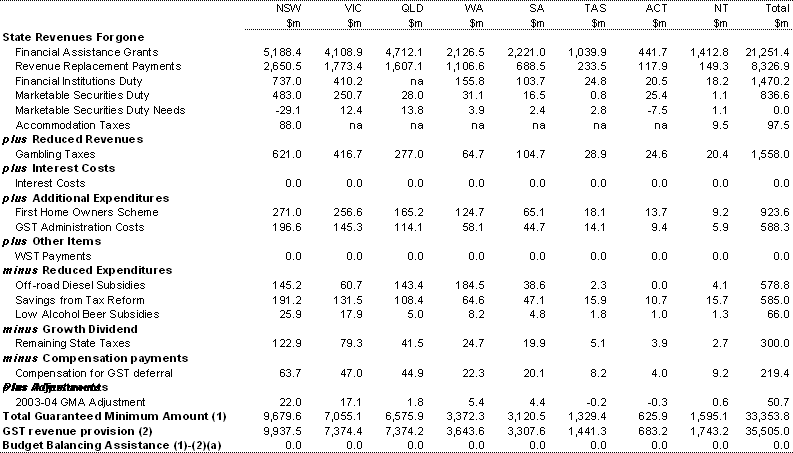
- Where the difference between the GMA and GST revenue is less than zero, the amount is zero.
Table 12: Guaranteed Minimum Amount components, GST revenue provision and Budget Balancing Assistance in 2005-06 (estimated)
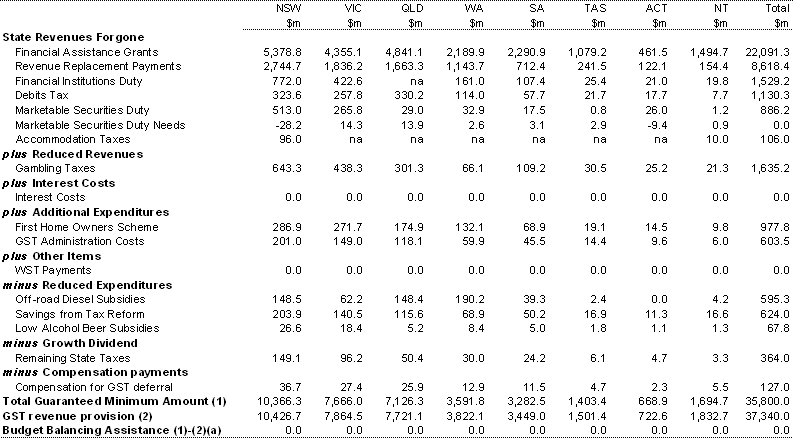
- Where the difference between the GMA and GST revenue is less than zero, the amount is zero.
Table 13: Forward estimates of Budget Balancing Assistance and state and territory gains from tax reform(a)
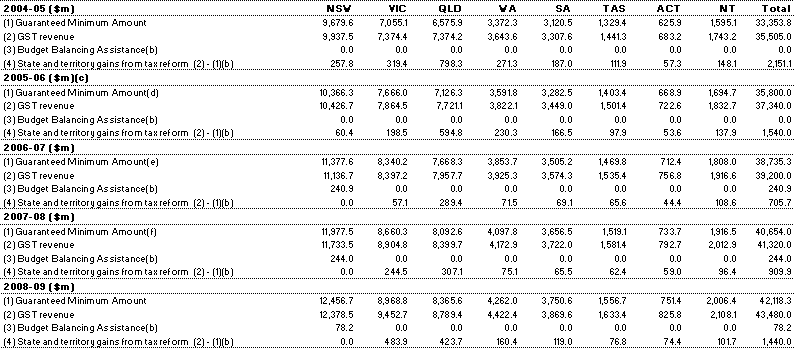
- Projections from 2004-05 will be affected by variations in Guaranteed Minimum Amount (GMA) components and GST revenue. In addition to these factors, projections from 2006-07 will be affected by recommendations by the Commonwealth Grants Commission on the distribution of GST to each of the states.
- Where the difference between the GMA and GST revenue (and vice versa) is less than zero, the amount is zero.
- The transitional period in which the Australian Government guarantees that no state will be worse off due to tax reform expires on 30 June 2006. However, if the states agree to the Australian Government’s proposal to eliminate IGA taxes (see pages 20-21 for details), the Australian Government will extend the transitional period to 30 June 2009.
- As agreed at the 26 March 2004 meeting of the Ministerial Council for Commonwealth-State Financial Relations, bank account debits tax is to be abolished by 1 July 2005. The revenue forgone by the states is included in their GMA from 2005-06 to ensure the states are no worse off. Accordingly, state gains from tax reform decrease in 2005-06 compared to 2004-05.
- Consistent with the Australian Government’s proposal, GMAs from 2006-07 include estimates of revenue forgone from stamp duties on the following: non-quotable marketable securities; leases; mortgages, bonds, debentures and other loan securities; credit arrangements, instalment purchase arrangements and rental arrangements; and cheques, bills of exchange and promissory notes.
- Consistent with the Australian Government’s proposal, GMAs from 2007-08 include estimates of revenue forgone from stamp duty on business conveyances other than real property.
Adjustments in 2004-05
GST revenue provision in 2004-05 has been adjusted to account for the final 2003-04 outcome (Table 1). In 2003-04, the final GST cash collections outcome was $45 million lower than the amount determined by the Commissioner of Taxation in June 2004 and provided to the states in 2003-04 under the terms of the A New Tax System (Commonwealth-State Financial Arrangements) Act 1999 (the Act).
Consistent with the provisions of the Act, the amount of GST revenue determined by the Commissioner and provided to the states in 2004-05 will take account of this variation. The residual adjustment amount for New South Wales for 2004-05 has also been calculated to account for this variation (Table 14).
Residual adjustments
The Australian Government introduced residual adjustments to ensure that all states receive their appropriate payments under the Act as they come off BBA. Residual adjustments will offset any underestimate or overestimate of payments in a previous financial year.
Queensland and the Northern Territory ceased to require BBA in 2002-03. The residual adjustment amounts for 2002-03 reflect an underestimate of payments in 2001-02. Victoria, Western Australia, South Australia, Tasmania and the Australian Capital Territory ceased to require BBA in 2003-04. The residual adjustment amounts for 2003-04 reflect an underestimate of payments in 2002-03 for Victoria, South Australia, Tasmania and the Australian Capital Territory and a minor overestimate of payments in 2002-03 for Western Australia.
Current estimates show that New South Wales will not require BBA in 2004-05. Based on current estimates, New South Wales’ residual adjustment amount for 2004-05 reflects an underestimate of payments in 2003‑04. As final payments for 2004-05 will not be known until the June 2005 determinations, final residual adjustment amounts for 2004-05 will not be known until after that time.
As the Australian Government and the states have not yet agreed, as required by the Act, on the manner in which the determination of each state’s residual adjustment is made, it has not been possible to make the adjustments. A draft methodology for the calculation of residual adjustments has been provided to the states for their consideration. If the states agree to this methodology, it will be used to determine and make residual adjustments to payments to the states.
Table 14 shows estimates of the residual adjustment amounts, based on the draft methodology.
Table 14: Residual adjustment amounts for 2002-03, 2003-04 and 2004-05 (estimated)
