



Specific Purpose Payments
Specific Purpose Payments (SPPs) constitute a significant amount of Australian Government expenditure. In 2005-06, SPPs ‘to’ and ‘through’ the states are estimated to total $26.1 billion. In addition, the Australian Government will provide SPPs direct to local government totalling $439.9 million in 2005-06. In total, SPPs are estimated to represent around 13 per cent of total Australian Government expenditure in 2005-06.
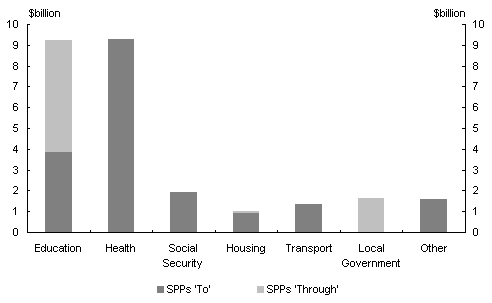
The Australian Government makes SPPs to the states and local government as a financial contribution to important areas of state responsibility in pursuit of its own specified objectives. The Australian Government makes SPPs in a large number of policy areas, including education, health, social security, housing and transport (Chart 3).
In 2005-06, SPPs for health, education and transport are estimated to account for over 75 per cent of SPP expenditure. These categories encompass SPPs for public hospitals, schools, vocational education and training and the development, construction and maintenance of the National Land Transport Network under AusLink.
Chart 3: Composition of Specific Purpose
Payments ‘to’ and ‘through’
the states in 2005-06 (estimated)
More detailed information, including payments on a state-by-state basis for 2004-05 and 2005-06, is in Appendix B.
SPPs can be classified into three groups:
- those paid directly ‘to’ the states — payments direct to state governments, totalling an estimated $19.1 billion in 2005-06;
- those paid ‘through’ the states — payments to state governments to be passed on to local governments (for example, FAGs to local government) and to others (for example, to non-government schools). This category is estimated to total $7.0 billion in 2005-06; and
- those paid direct to local government to help fund local government programmes, such as roads. These payments are estimated to total $439.9 million in 2005-06.
SPP agreements often include agreed national objectives. However, in making these payments, the Australian Government does not seek to take over responsibility for state functions. The majority of SPPs are ‘tied’ meaning that they are subject to conditions designed to ensure that national objectives are achieved. These include:
- general policy conditions (for example, the provision of free public hospital access for Medicare patients in return for funding under the Health Care Agreements);
- requirements that payments be expended for a specific purpose only (for example, SPPs for schools may be spent on teacher salaries and curriculum development);
- state maintenance of effort and matching funding arrangements (whereby states are required to maintain funding levels and/or match the Australian Government’s funding contribution in a specified programme area); and
- reporting of financial and performance information.
SPPs also include some payments that are not subject to conditions. These typically relate to revenue sharing arrangements or compensation (either for the transfer of responsibilities or for other Australian Government action that affects the states). For example, compensation payments are made to the states under the Extension of Fringe Benefits SPP for the extra costs resulting from the liberalisation of access to the Australian Government’s Pensioner Concession Card in 1993. In return, the states agree to provide a core group of concessions to all cardholders.