



Chapter Five: South Asia, Africa,
Middle East and Central Asia
South Asia
| Estimated total ODA to South Asia in 2005–06 | $97.6 million |
South Asia regional development indicators
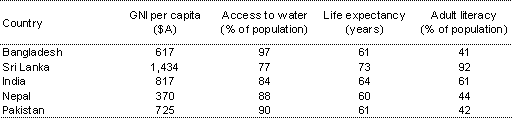
Source: GNI per capita: World Development Indicators, World Bank, 2003; other indicators: Human Development Report, UNDP, 2004.
South Asia has experienced rapid growth in recent years, but is still one of the world’s most disadvantaged regions. More than 40 per cent of the region’s 1.4 billion people live on less than US$1 per day.
Australia is just one of a number of donors working in South Asia. Australia will therefore focus on delivering its program through regional mechanisms and by working with major multilateral partners, other donors, and NGOs to respond flexibly to major regional issues such as HIV/AIDS, governance reform and people trafficking.
On 4 March 2005, the Australian Government signed a partnership agreement with the United Nations Children’s Fund (UNICEF) for a joint South Asia regional program. This program will focus on education (especially primary education) and health at a regional level, with the potential for activities in specific countries to also be considered. Australia is also working with the Joint United Nations Programme on HIV/AIDS to develop an umbrella agreement that will facilitate joint programming of HIV/AIDS activities in South Asia during the period 2005 to 2010.
Australia strongly supports Sri Lanka’s post-conflict peacebuilding and economic recovery efforts. In 2005–06, Australian ODA to Sri Lanka will total $29.1 million, an increase of $6.1 million from 2004–05. Australia is assisting conflict-affected communities in the north and east of the country through the provision of basic rural services such as water and sanitation, trauma counselling, microfinance, and vocational training. Peacebuilding initiatives totalling $3.5 million will include $1 million through the United Nations Development Programme, to help rehabilitate small-scale infrastructure in Trincomalee, Batticaloa and Ampara, and $2.5 million through UNICEF to rehabilitate schools, provide ‘catch-up’ education for conflict-affected children, help young landmine victims, and provide women and children with better access to health nutrition, and water and sanitation services.
Australia will continue to provide significant humanitarian assistance to South Asia, a region vulnerable to crises and natural disasters. Following the December 2004 Indian Ocean disaster, Australia committed $14.5 million in assistance to countries in South Asia including Sri Lanka, the Maldives and the Seychelles. In Bangladesh, Australia’s ODA of $32.3 million in 2005–06 will continue to include substantial contributions to activities of the World Food Programme.
A small number of existing bilateral aid activities will complement the regional and humanitarian initiatives. The aid program will also provide scholarships to a range of South Asian countries.