



Bilateral programs
In 2005–06, ACIAR will support around 200 bilateral projects in developing countries across the Asia–Pacific region. Through close collaboration with partnering research institutions, the projects will promote capacity building, knowledge and technology exchange, and policy initiatives. Increasingly, delivery of benefits to farmers, policy makers and natural resource managers will be achieved by utilising pilot delivery of research outcomes, through research partners and through appropriate NGOs and other dissemination agencies. Estimated bilateral research expenditure in 2005–06 will be $30.3 million.
ACIAR bilateral projects will be developed in line with agreed priorities with partner countries, identified through formal and informal consultations. Priorities will also be informed by the intersection of Australia’s National Research Priorities, announced in December 2002, with Australian development priorities and those of partner countries. In 2005–06, expenditure relating to the National Research Priorities will be $14.85 million. Of these priorities, ACIAR projects will relate to two themes — ‘An environmentally sustainable Australia’, including water, soil loss, salinity and acidity, emissions from transport and energy generation, sustainable use of biodiversity, and responding to climate change; and ‘Safeguarding Australia’, with a focus on protecting Australia from invasive pests and diseases.
All ACIAR project development incorporates an assessment of potential environmental impacts under the Environmental Protection and Biodiversity Conservation Act 1999 guidelines, including, where relevant, the involvement of the Department of Environment and Heritage.
Diagram 10: Estimated ACIAR research expenditure by region 2005–06
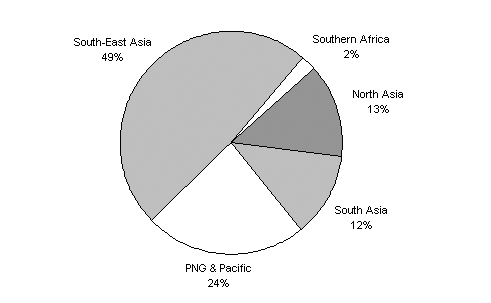
Bilateral projects are expected to be active in 26 countries. Major bilateral partners include PNG, Indonesia, Pacific Island countries, Vietnam, the Philippines, Cambodia, China and India. In 2005–06, projects will address agricultural and natural resource management areas including:
- crop improvement through incorporation of improved germplasm for greater yields, and protecting crops against weeds, pests and diseases;
- animal health including diagnosis and disease control, and increasing productivity through better feeding and breeding options;
- improving management of soil and water resources and their interactions in cropping and other agricultural systems;
- identifying higher-yielding and disease-resistant forest trees, and improving plantation management;
- developing aquaculture systems and improving the sustainable management of wild fish resources;
- improving institutional policy initiatives relating to agriculture and natural resource management; and
- improving the post-harvest handling of agricultural produce.