


Section 3: Budgeted financial statements
The financial statements form the basis of the financial statements that will appear in the Australian Competition and Consumer Commission’s (ACCC) 2005-06 Annual Report, and form the basis for the input into the whole-of-government accounts. The financial statements should be read in conjunction with the accompanying notes.
The financial statements contain estimates prepared in accordance with the requirements of the Australian Government’s financial budgeting and reporting framework, including the principles of Australian Accounting Standards and Statements of Accounting Concepts, as well as specific guidelines issued by the Department of Finance and Administration.
Analysis of budgeted financial statements
An analysis of the ACCC’s budgeted financial statements is provided below.
Departmental financial statements
Budgeted departmental income statement
The ACCC is estimating an accounting operating loss of $7.3 million in 2005-06 as a result of timing of expenditure against funds received in 2004-05. The budgeted operating loss for 2005-06 is due to the following factors:
- Initial funding for the Australian Energy Regulator (AER) was provided in the 2004-05 Budget for only one year due to the uncertainty of the timing of the transfer of functions to the AER. Delays were experienced which resulted in surplus funds of $3.3 million in 2004-05. Since the funds are now expected to be spent in 2005-06 from a previous financial year revenue, a technical accounting operating loss will occur; and
- The Litigation Contingency Fund (LCF) was established in 2001 to fund extraordinary litigation losses. The ACCC has identified a number of potential court losses and anticipate that an estimated $4.0 million will be required from the accumulated surplus to fund these payments.
Operating Revenues
Total revenue for 2005-06 including additional estimates is estimated to be $99.3 million. This is an increase of $13.4 million as a result of the following movements taking place since the 2005-06 Portfolio Budget Statements:
- New funding of $4.1 million for implementing and maintaining an effective and robust competition regulatory regime in relation to the separate retail, wholesale and network business units of Telstra;
- New funding of $0.2 million for the transfer of Treasury functions to the ACCC for safety products and consumer information; and
- Transfer of $9.0 million from the special account to the departmental account to account for undertakings made under Section 87B of the Trade Practices Act 1974 which are now recognised as section 31 receipts and therefore departmental in nature.
Operating expenses
Total expenses are estimated to be $106.5 million. This is an increase of $20.6 million since the 2005-06 Portfolio Budget Statements, arising largely from:
- increased expenditure of $3.3 million relating to the AER especially the expenditure funded in 2004-05 but spent in 2005-06 as explained above;
- increased expenditure of $4.0 million for estimated extraordinary litigation costs;
- increased expenditure of $4.1 million relating to implementing and maintaining an effective and robust competition regulatory regime in relation to the separate retail, wholesale and network business units of Telstra;
- increased expenditure of $0.2 million for the transfer of Treasury functions to the ACCC for safety products and consumer information; and
- expenditure of $9.0 million on a tobacco education programme in accordance with section 87B undertakings from tobacco companies.
Budgeted departmental balance sheet
Equity
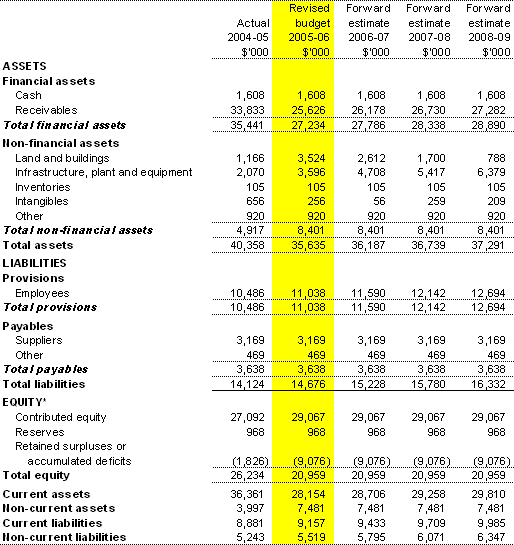
In 2005-06 the ACCC’s equity position will be in surplus in the amount of $21.0 million. This is a decrease of $5.3 million from 2004-05 actuals resulting from the projected operating loss of $7.3 million and a capital equity injection of $2.0 million.
Financial assets
In 2004-05 the ACCC received an amount of $22 million to address accumulated past year losses ($12 million) and to replenish the LCF ($10 million). The LCF was supplemented by funds not required in 2004-05 for extraordinary litigation costs which have not yet eventuated. This amount was transferred to the Official Public Account, and shown as a Receivable, until required.
Non-financial assets
In 2005-06 the ACCC will be maintaining its commitment to long term improvement, investing $6.2 million in capital.
A significant proportion of the ACCC’s capital investment is directed towards the fitout of the Melbourne office, and the purchase of equipment and computer software for the new Measures shown at Table 1.4.
Liabilities
The ACCC’s liabilities are mainly employee entitlements. There is no significant movement in total liabilities from 2004-05.
Budgeted financial statements
Departmental financial statements
Budgeted departmental income statement
This statement provides a picture of the expected financial results for the ACCC by identifying full accrual expenses and revenues, which highlights whether the ACCC is operating at a sustainable level.
Budgeted departmental balance sheet
This statement shows the financial position of the ACCC. It enables decision-makers to track the management of the ACCC’s assets and liabilities.
Budgeted departmental statement of cash flows
This statement identifies expected cash flows from operating activities, investing activities and financing activities.
Departmental statement of changes in equity — summary of movement
This statement shows the movement in equity since the 30 June 2005. It shows the approved operating loss of $7.3 million recognised directly in equity and the appropriated equity injection of $2.0 million for capital purchases.
Departmental capital budget statement
This statement shows all proposed capital expenditure funded from appropriations or from internal sources.
Departmental property, plant, equipment and intangibles — summary of movement
This statement shows the movement in the ACCC’s non-financial assets over the Budget year.
Schedule of administered activity
Details of transactions administered by the agency on behalf of the Australian Government are to be shown in the following schedules of the financial statements.
Schedule of budgeted income and expenses administered on behalf of government
This schedule identifies the main revenues and expenses administered on behalf of the Australian Government. It also discloses administered revenues from government and transfers to the Official Public Account.
Schedule of budgeted assets and liabilities administered on behalf of government
This schedule shows the assets and liabilities administered on behalf of the Australian Government.
Schedule of budgeted administered cash flows
This schedule shows cash flows administered on behalf of the Australian Government.
Table 3.1: Budgeted departmental income statement (for the period ended 30 June)
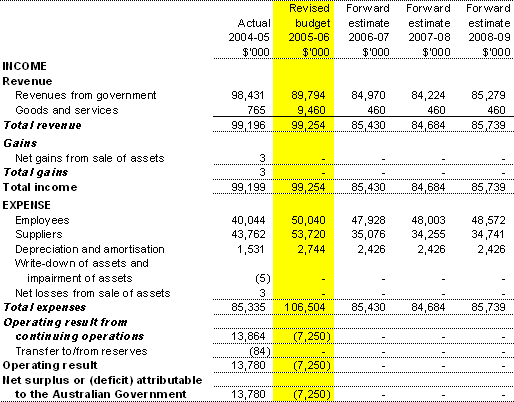
Table 3.2: Budgeted departmental balance sheet (as at 30 June)
* 'Equity' is the residual interest in assets after deduction of liabilities.
Table 3.3: Budgeted departmental statement of cash flows (for the period ended 30 June)
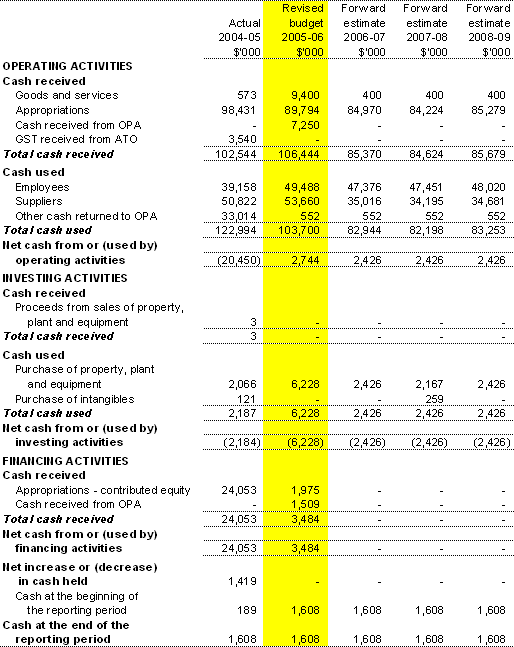
Table 3.4: Departmental statement of changes in equity — summary of movement (Budget year 2005-06)
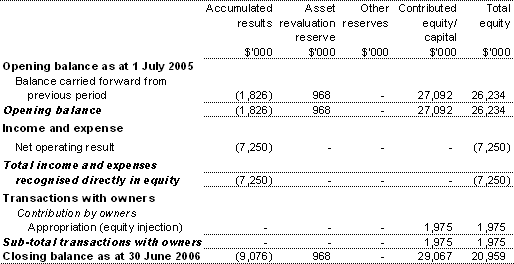
Table 3.5: Departmental capital budget statement
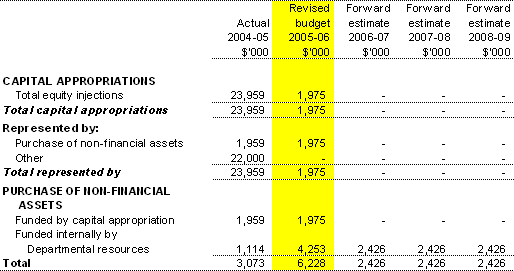
Table 3.6: Departmental property, plant, equipment
and intangibles — summary of movement
(Budget year 2005-06)
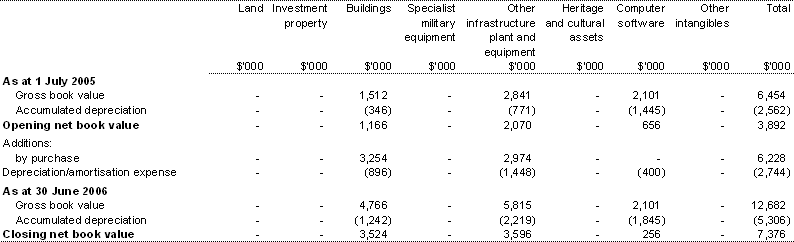
Table 3.7: Schedule of budgeted income and expenses administered on behalf of government (for the period ended 30 June)
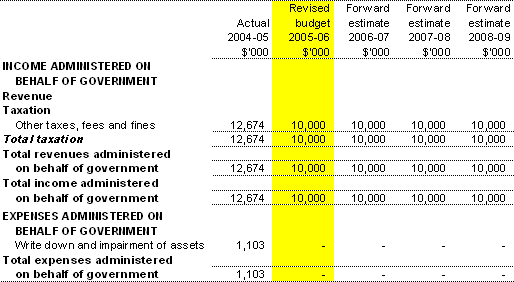
Table 3.8: Schedule of budgeted assets and liabilities administered on behalf of government (as at 30 June)
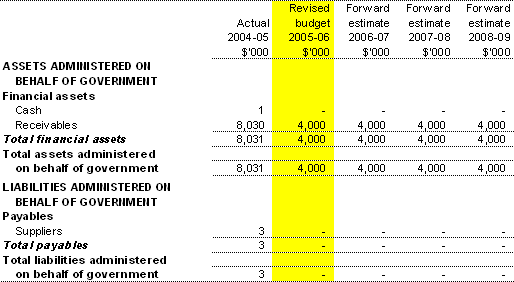
Table 3.9: Schedule of budgeted administered cash flows (for the period ended 30 June)
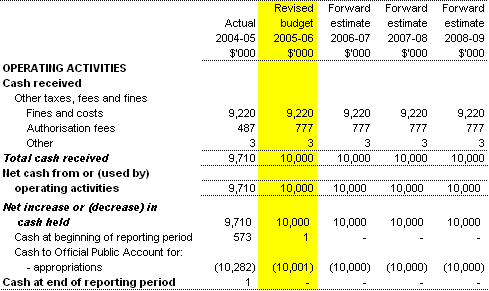
Table 3.10: Schedule of administered capital budget
This table is not applicable to the ACCC.
Table 3.11: Schedule of administered property, plant, equipment and intangibles — summary of movement (Budget year 2005-06)
This table is not applicable to the ACCC.
Notes to the financial statements
Basis of accounting
The financial statements are required by section 49 of the Financial Management and Accountability Act 1997 and are a general purpose financial report.
The statements have been prepared in accordance with:
- Finance Minister’s Orders (or FMOs, being the Financial Management and Accountability Orders (Financial Statements for reporting periods ending on or after 30 June 2004));
- Australian Accounting Standards and Accounting Interpretations issued by the Australian Accounting Standards Board; and
- Consensus Views of the Urgent Issues Group.
The ACCC’s income statement and balance sheet have been prepared on an accrual basis and are in accordance with the historical cost convention, except for certain assets which are at valuation. Except where stated, no allowance is made for the effect of changing prices on the results or the financial position.
Assets and liabilities are recognised in the balance sheet when and only when it is probable that future economic benefit will flow and the amounts of the assets and liabilities can be reliably measured.
Revenue and expenses are recognised in the income statement when and only when the flow or consumption or loss of economic benefits has occurred and can be reliably measured.
Administered revenues, expenses, assets and liabilities and cash flows are accounted for on the same basis and using the same policies as for departmental items except where otherwise stated.
Budgeted agency financial statements
Agency assets, liabilities, revenues and expenses are those items that are controlled by the ACCC. They are used by the ACCC in producing its outputs, including:
- computers, plant and equipment used in providing goods and services;
- liabilities for employee entitlements;
- revenues from appropriations or independent sources in payment of outputs; and
- employee, supplier and depreciation expenses incurred in producing the ACCC outputs.
Administered items are those items which are controlled by the Australian Government and managed or oversighted by the ACCC on behalf of the Australian Government. These administered items managed or controlled by the ACCC include authorisation fees, fines and costs.
The purpose of the separation of agency and administered items is to enable the assessment of administrative efficiency of the agency in providing goods and services.
Revenue
Revenues from government
Amounts appropriated for departmental output appropriations for the year (less any savings and reductions) are recognised as revenue, except for certain amounts which relate to activities that are reciprocal in nature, in which case revenue is recognised only when it has been earned.
Savings are amounts offered up in Portfolio Additional Estimates Statements. Reductions are amounts by which appropriations have been legally reduced by the Finance Minister under Appropriation Act No. 3.
Resources received free of charge
Services received free of charge are recognised as revenue when and only when a fair value can be reliably determined and the services would have been purchased if they had not been donated. Use of those resources is recognised as an expense.
Other revenue
Revenue from the sale of goods (that is, seminars/speakers fees, sale of publications, photocopy revenue, undertakings made from section 87B of the Trade Practices Act 1974 and sale of non-current assets) is recognised upon the delivery of goods/services to customers.
Revenue from rendering of services is recognised by reference to the stage of completion of contracts or other agreements to provide services. The stage of completion is determined according to the proportion that costs incurred to date bear to the estimated total costs of the transaction.
Receivables for goods and services are recognised at the nominal amounts due less any provision for bad or doubtful debts. Collectability of debts is reviewed at balance date. Provisions are made when collectability of the debt is judged to be less rather than more likely.
Revenue from disposal of non-current assets is recognised when control of the asset has passed to the buyer.
Transactions with the government as owner
Equity injections
Amounts appropriated which are designated as ‘equity injections’ for a year (less any savings offered up in Portfolio Additional Estimates Statements) are recognised directly in contributed equity in that year.
Restructuring of administrative arrangements
Net assets received from or relinquished to another Commonwealth agency or authority under a restructuring of administrative arrangements are adjusted at their book value directly against contributed equity.
Employee benefits
Liabilities for services rendered by employees are recognised at the reporting date to the extent that they have not been settled.
Liabilities for wages and salaries (including non-monetary benefits), annual leave and sick leave are measured at their nominal amounts. Other employee benefits expected to be settled within 12 months of the reporting date are also measured at their nominal amounts.
The nominal amount is calculated with regards to the rates expected to be paid on settlement of the liability.
All other employee benefit liabilities are measured as the present value of the estimated future cash outflows to be made in respect of services provided by employees up to the reporting date.
Leave
The liability for employee benefits includes provision for annual leave and long service leave. No provision has been made for sick leave as all sick leave is non-vesting and the average sick leave taken in future years by employees of the ACCC is estimated to be less than the annual entitlement for sick leave.
Leases
A distinction is made between finance leases and operating leases. Finance leases effectively transfer from the lessor to the lessee substantially all the risks and benefits incidental to ownership of leased non-current assets. In operating leases, the lessor effectively retains substantially all such risks and benefits.
Where a non-current asset is acquired by means of a finance lease, the asset is capitalised at the present value of minimum lease payments at the beginning of the lease term and a liability recognised at the same time and for the same amount. The discount rate used is the interest rate implicit in the lease. Leased assets are amortised over the period of the lease. Lease payments are allocated between the principal component and the interest expense.
Lease incentives taking the form of ‘free’ leasehold improvements and rent holidays are recognised as liabilities. These liabilities are reduced by allocating lease payments between rental expense and reduction of the liability.
Receivables
Court costs, which are awarded, are not considered as receivables or as creditors, as the case may be, until the costs have been agreed by the concerned parties.
A provision is raised for any doubtful debts based on a review of the collectability of all outstanding accounts as at year end.
Bad debts are written off during the year in which they are identified.
Acquisition of assets
Assets are recorded at cost of acquisition except as stated below. The cost of acquisition includes the fair value of assets transferred in exchange and liabilities undertaken.
Assets acquired at no cost, or for nominal consideration, are initially recognised as assets and revenues at their fair value at the date of acquisition, unless acquired as a consequence of restructuring of administrative arrangements. In the latter case, assets are initially recognised as contribution by owners at the amounts at which they were recognised in the transferor agency’s accounts immediately prior to the restructuring.
Property, infrastructure, plant and equipment
Asset recognition threshold
Purchases of property, infrastructure, plant and equipment are recognised initially at cost in the balance sheet, except for purchases costing less than $2,000, which are expensed in the year of acquisition (other than where they form part of a group of similar items which are significant in total).
Revaluations
Basis
Property, infrastructure, plant and equipment are carried at valuation. The ACCC has revalued all of its assets at 1 July 2004 and any changes in valuation to 30 June 2005 have been reviewed by the valuers to be nil.
Future revaluations by the ACCC are to be undertaken at fair value. Under fair value, assets which are surplus to requirements are measured at their net realisable value. At 30 June 2005 the ACCC had no assets in this situation.
The ACCC intends to have formal valuations every three years.
Infrastructure, plant and equipment assets were revalued as at 30 June 2004 at deprival value.
All valuations are conducted by an independent qualified valuer.
Depreciation and amortisation
Depreciable property, plant and equipment assets are written off to their estimated residual values over their estimated useful lives to the ACCC using, in all cases, the straight line method of depreciation. Leasehold improvements are amortised on a straight line basis over the lesser of the estimated useful life of the improvements or the unexpired period of the lease.
Depreciation/amortisation rates (useful lives) and methods are reviewed at each reporting date and necessary adjustments are recognised in the current, or current and future reporting periods, as appropriate. Residual values are re-estimated for a change in prices only when assets are revalued.
Depreciation and amortisation rates applying to each class of depreciable asset are based on the useful lives in the table below. These rates apply to each item in that class except where the useful life of the item has been reassessed following revaluation.
Asset class |
Total useful life |
| Fitout | Lesser of the term of the lease or 10 years |
| Furniture and fittings | 10 years |
| Office equipment | 5 years |
| Computer hardware | 3 years |
| Computer software | 3 to 7 years |
Impairment of non-current assets
Non-current assets carried at up-to-date fair value at the reporting date are not subject to impairment testing.
Non-current assets carried at cost or deprival value and held to generate net cash inflows are required to have their recoverable amounts tested at the reporting date. The test compares the carrying amounts against the net present value of future net cash inflows. ACCC has no assets in this category.
The non-current assets carried at cost or deprival value, which are not held to generate net cash inflows, have been assessed for indications of impairment. Where indications of impairment exist, the carrying amount of the asset is compared to the higher of its net selling price and depreciated replacement cost and is written down to that value if greater. No assets were identified as impaired as at 30 June 2004.
Intangibles
Intangibles comprise software that has been externally acquired for internal use. These assets are carried at cost.
Software is amortised on a straight-line basis over its anticipated useful life. The useful life of the ACCC’s software is three to seven years.
All software assets were assessed for impairment as at 30 June 2004.
Inventories
Inventories (publications) held for resale are valued at cost, unless they are no longer required, in which case they are valued at net realisable value.