


Section 3: Budgeted financial statements
Budgeted agency and administered financial statements and related notes for the Australian Office of Financial Management (AOFM) are presented in this section. The financial statements are produced for 2004-05 (actual results), 2005-06 (revised Budget estimate) and three forward years. The financial statements should be read in conjunction with the accompanying notes.
Analysis of budgeted financial statements
There have been no significant changes to the analysis of AOFM’s budgeted financial statements since the 2005-06 Portfolio Budget Statements.
Budgeted financial statements
Departmental financial statements
Budgeted departmental income statement
This statement provides a picture of the expected financial results for the AOFM by identifying full accrual expenses and revenues.
Budgeted departmental balance sheet
This statement shows the financial position of the AOFM. It enables decision-makers to track the management of the agency’s assets and liabilities.
Budgeted departmental statement of cash flows
This statement provides information on the amount and nature of budgeted cash flows, categorised into expected cash flows from operating activities, investing activities and financing activities.
Departmental statement of changes in equity — summary of movement
This statement provides information on changes in the amount and nature of equity for the Budget year 2005-06.
Departmental capital budget statement
This statement shows all proposed capital expenditure on non-financial assets, whether funded through capital appropriations (equity or borrowings) or from internally sourced funds.
Departmental property, plant, equipment and intangibles — summary of movement
This statement shows the budgeted movement in the AOFM’s non-financial assets during the Budget year 2005-06.
Schedule of administered activity
Details of transactions administered by the AOFM on behalf of the Australian Government are shown in the following schedules to the financial statements.
Schedule of budgeted income and expenses administered on behalf of government
This schedule identifies the revenues and expenses administered by the AOFM on behalf of the Australian Government.
Schedule of budgeted assets and liabilities administered on behalf of government
This schedule shows the assets and liabilities administered by the AOFM on behalf of the Australian Government.
Schedule of budgeted administered cash flows
This schedule shows cash flows administered by the AOFM on behalf of the Australian Government, categorised into expected cash flows from operating activities, investing activities and financing activities.
Schedule of administered capital budget
This schedule shows all proposed capital expenditure on net debt management activities sourced from special appropriations.
Table 3.1: Budgeted departmental income statement (for the period ended 30 June)
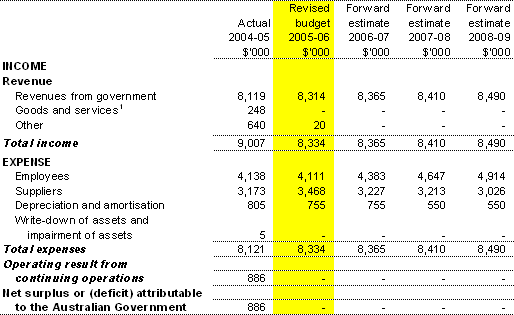
1 For 2004-05, the amount comprises services received free of charge from the Australian National Audit Office.
Table 3.2: Budgeted departmental balance sheet (as at 30 June)
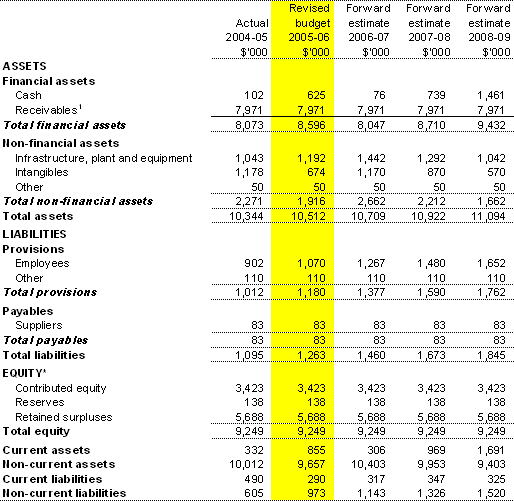
1 Receivables balance includes $7.8 million of undrawn appropriations held in the Official Public Account.
* 'Equity' is the residual interest in assets after deduction of liabilities.
Table 3.3: Budgeted departmental statement of cash flows (for the period ended 30 June)
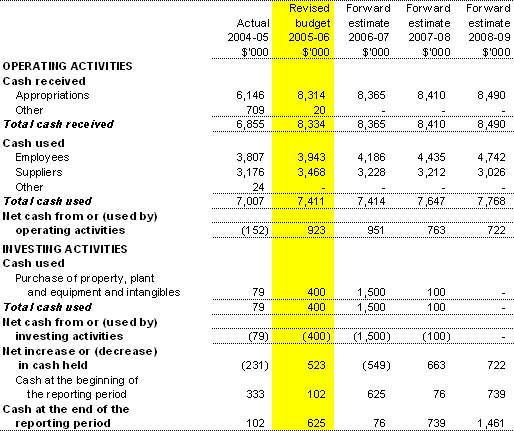
Table 3.4: Departmental statement of changes in equity — summary of movement (Budget year 2005-06)
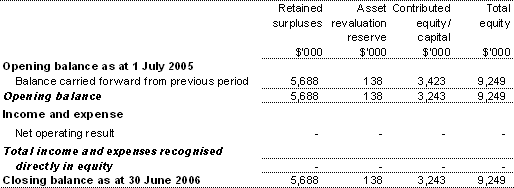
Table 3.5: Departmental capital budget statement
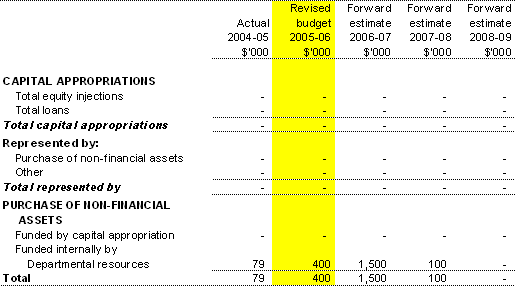
Table 3.6: Departmental property, plant, equipment
and intangibles — summary of movement
(Budget year 2005-06)
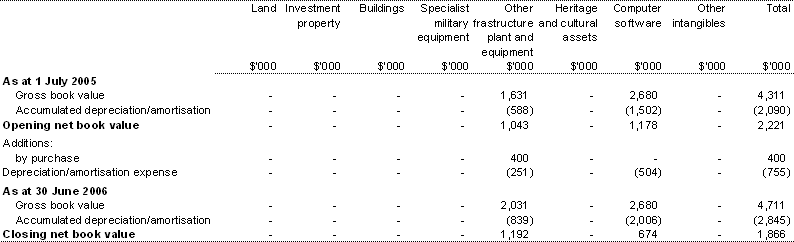
Table 3.7: Schedule of budgeted income and expenses administered on behalf of government (for the period ended 30 June)
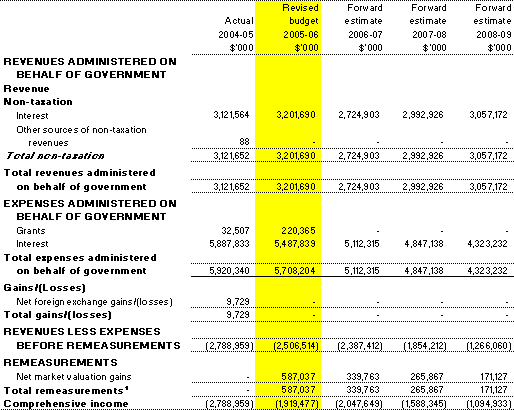
1 Since 1 July 2005 the AOFM's administered financial statements have been prepared on a fair value basis. Prior to that the financial statements were prepared in accordance with the historical cost convention. Under fair value accounting, changes in the valuation of financial assets and financial liabilities due to changes in interest rates are reflected through the schedule of income and expenses (net market valuation gains).
Table 3.8: Schedule of budgeted assets and liabilities administered on behalf of government (as at 30 June)1
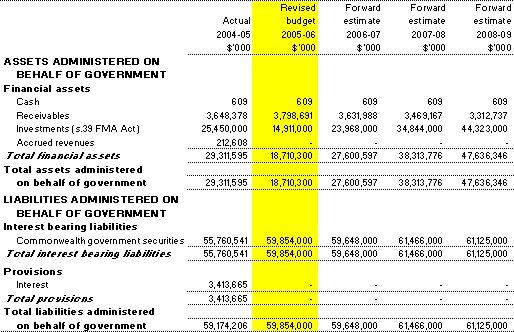
1 Under fair value accounting (adopted since 1 July 2005) the aggregate value of a financial asset or financial liability is recorded against a single financial statement class. Under historical cost accounting the value of a financial asset or financial liability was disaggregated and recorded against several financial statement classes.
Table 3.9: Schedule of budgeted administered cash flows for the period ended 30 June)
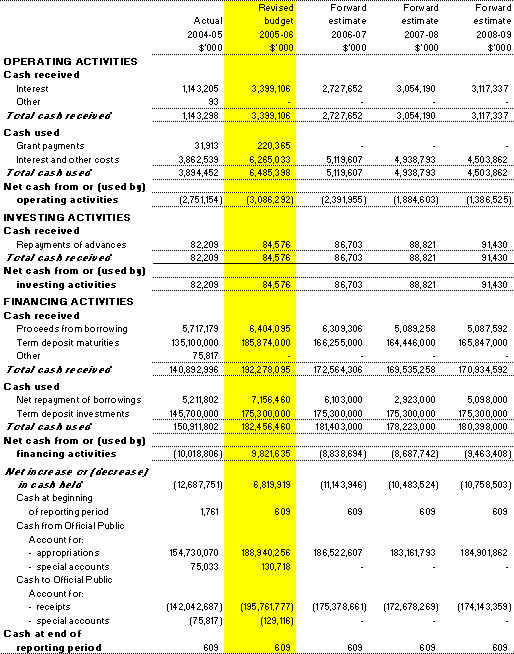
Table 3.10: Schedule of administered capital budget
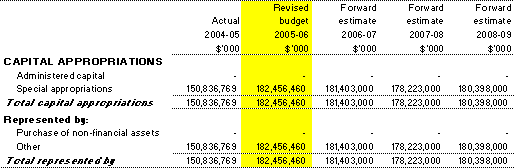
Table 3.11: Schedule of administered property, plant, equipment and intangibles — summary of movement (Budget year 2005-06)
This table is not applicable to AOFM.
Notes to the financial statements
Basis of accounting
The departmental financial statements have been prepared on an accrual basis and are in accordance with the historical cost convention, except for infrastructure, plant and equipment assets and employee entitlements. Infrastructure, plant and equipment assets are revalued every three years using a fair value methodology. Employee entitlements are measured at the present value of estimated future cash flows based on periodic actuarial assessment.
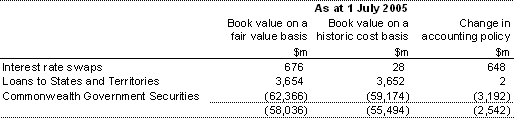
Since 1 July 2005, the administered financial statements have been prepared on a fair value basis in accordance with Australian Equivalents to International Financial Reporting Standards. Prior to 1 July 2005 the administered financial statements were prepared on an accrual basis in accordance with the historical cost convention. A one-off adjustment of $2,542 million (unfavourable) for the change in accounting treatment was made as at 1 July 2005. The adjustment relates to the following financial assets and financial liabilities:
Fair value is synonymous with market value and represents the estimated exchange equivalent price using relevant inputs from reference markets and valuation techniques. Fair value is determined on the presumption of normal market conditions and the reporting entity is not undertaking transactions on adverse terms.
On behalf of the Department of Communications, Information Technology and the Arts (DCITA), the AOFM currently oversees the investments made by the newly created Communications Fund. These are currently being held as deposits with the Reserve Bank of Australia. These investments and their earnings are reported by DCITA and not the AOFM.
Budgeted departmental and administered financial statements
The budgeted financial statements contain estimates prepared in accordance with the requirements of the Australian Government’s financial budgeting and reporting framework, including the principles of Australian Accounting Standards and Statements of Accounting Concepts, as well as specific guidelines issued by the Department of Finance and Administration.
Under the Australian Government’s accrual budgeting framework, transactions that agencies control (departmental transactions) are separately budgeted for and reported from transactions agencies do not have control over (administered transactions). This ensures that agencies are only held fully accountable for the transactions over which they have control.
- Departmental assets, liabilities, revenues and expenses are those which are controlled by the agency. Agency expenses include employee and supplier expenses and other administrative costs, which are incurred by the agency in providing its goods and services to government.
- Administered assets, liabilities, revenues and expenses are those which are managed on behalf of the Australian Government according to set government directions. Administered expenses include interest incurred on Commonwealth Government Securities. Administered revenues include interest earned on housing agreement loans, interest on investments and interest from swaps.
Administered internal transactions
Administered transactions between the AOFM and other agencies within the general government (administered internal transactions) are not reported in the schedule of budgeted administered income and expenses or the schedule of budgeted administered assets and liabilities.
However, for the purposes of disclosing all cash flows through AOFM’s administered bank accounts, cash flows in the schedule of budgeted administered cash flows are reported inclusive of administered internal transactions.
Goods and services tax (GST)
All supplies provided by the AOFM are input taxed under A New Tax System (Goods and Services Tax) Act 1999.
Appropriations in the accrual budgeting framework
Under the Australian Government’s accrual budgeting framework, separate annual appropriations are provided to the AOFM for:
- departmental price of outputs appropriations: representing the Australian Government’s purchase of outputs from the AOFM; and
- administered expense appropriations: for the repayment of interest on lapsed coupons not supported by special appropriation.
Special appropriations continue under the accrual budgeting framework and fund the majority of administered payments made by the AOFM, including debt redemption, interest payments and financial investment activity.
Budgeted departmental income statement
Appropriations
Price of outputs appropriation estimates are not based on market price indicators. The agreed price of outputs appropriation is based on Budget Process Operational Rules, whereby the AOFM’s output appropriation is adjusted for wage cost indexation less efficiency dividend.
For financial years from 2005-06 to 2007-08 (inclusive), the government has imposed an additional 0.25 per cent efficiency dividend on agencies, bringing the efficiency dividend to 1.25 per cent for these financial years. The government is expecting to review the efficiency dividend arrangements in the 2008-09 Budget.
Budgeted departmental balance sheet
Cash and undrawn appropriations
The estimated cash reserves and undrawn appropriations will be maintained to ensure that the AOFM is well placed to:
- settle employee liabilities as they fall due;
- make asset replacements; and
- repay liabilities.
Budgeted financial statements have been prepared on the assumption that unspent monies will not be withdrawn by the Department of Finance and Administration.
Administered schedule of budgeted income and expenses
Non-taxation revenue — interest
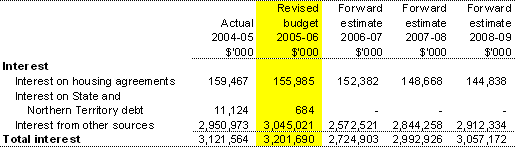
Interest from other sources includes interest from swaps and investments.
Expenses – grants
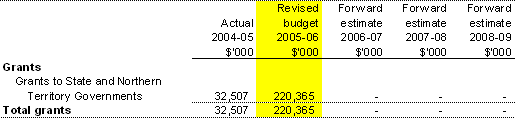
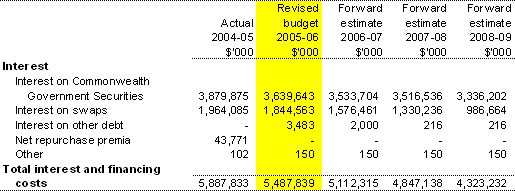
Expenses – interest and financing costs
Net market valuation gains
Net market valuation gains represents the estimated unrealised fair value gains on the net debt portfolio. This valuation gain represents the change in financial exposures due to changes in market conditions and the passage of time.
In a passive ‘issue and hold to maturity’ strategy, such as that relating to the AOFM’s debt issuance and management activities, the revaluation effect will net to zero over the life of a financial instrument.
Administered schedule of budgeted assets and liabilities
Financial assets – receivables
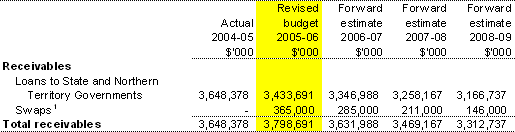
1 For 2004-05 swaps are included in ‘Accrued revenues’.
Financial assets — investments
The AOFM, on behalf of the Australian Government, holds surplus funds as term deposits with the Reserve Bank of Australia. Estimates of the fair value of these asset holdings are disclosed as administered investments. The asset holdings of the Future Fund and other government agencies are not included in these estimates.
Interest bearing liabilities — Commonwealth Government Securities
Commonwealth Government Securities represent the fair value of government securities on issue.