



Fiscal strategy
The Government's medium-term fiscal strategy is an integral part of the economic management framework designed to deliver sustainable economic growth, rising employment and higher living standards.
A medium-term approach to fiscal policy
The primary objective of the medium-term fiscal strategy is to maintain budget balance, on average, over the course of the economic cycle. This helps deliver macroeconomic stability, encourages private investment in a low interest rate environment, entrenches low public debt and ensures that, over time, the current account continues to reflect private, profit-driven, saving and investment decisions.
The Government's medium-term fiscal strategy has a number of supplementary objectives, including: maintaining budget surpluses over the forward estimates period while growth prospects are sound; not increasing the overall tax burden from 1996-97 levels; and improving the Australian Government's net worth position over the medium to longer term. The supplementary objective of no increase in the overall tax burden means that the Government achieves budget balance over the cycle through a disciplined approach to spending and not by recourse to increased taxation.
Consistent with the Government's fiscal strategy, this budget delivers a surplus in 2007-08 and surpluses over the forward estimates period. This will help contain inflationary pressures in the economy and will add to national savings. The fiscal strategy is complemented by a monetary policy framework which will continue to foster sustainable economic growth with low inflation and low interest rates into the future.
Sound macroeconomic policy has seen the Australian economy continuously expand over 16 years — while also keeping inflation well contained. Since this Government came to office in 1996, Australia's real GDP growth has averaged around 3½ per cent per annum, while inflation has averaged around 2½ per cent per annum.
This period of solid economic growth, coupled with prudent fiscal management, has enabled the Government to eliminate net debt, with Australia one of only a few countries among the OECD to have done so (Chart 2). In addition, the Government has established the Future Fund to meet outstanding Australian Government superannuation liabilities by 2020.
Chart 2: General government net debt levels in selected countries
(1998 to 2008)
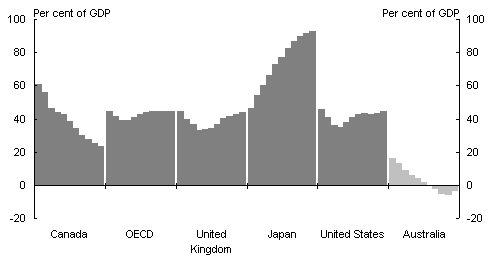
Source: International data are sourced from OECD Economic Outlook 80, December 2006. Australian data are sourced from Statement 12. All data are for the total general government sector.
The maintenance of budget surpluses while economic growth remains sound represents a prudent response to an uncertain future. In the current environment, this gives some insurance against adverse external risks, while also securing our finances to meet future challenges flowing from the ageing of the population.