



Estimates of revenue
Total revenue
Total revenue for 2007-08 is expected to increase by $11.2 billion, 4.8 per cent higher than estimated revenue for 2006-07. Of this, taxation revenue is expected to increase by 4.8 per cent ($10.6 billion) and non-taxation revenue is expected to increase by 4.1 per cent ($619 million).
The increase has resulted primarily from higher estimated revenue from companies ($6.3 billion) and individuals ($2.2 billion).
The revenue estimates for 2006-07 and 2007-08 are constructed using the outcomes for 2005-06, information on revenue collections in the year to date and the revised economic forecasts for 2006-07 and 2007-08. Revenue estimates for the projection years — 2008-09 to 2010-11 — are based mainly on underlying trends in economic parameters and take no account of cyclical influences on economic activity. As at the 2005-06 and 2006-07 Budgets, key commodity prices are assumed to return to their long-run average level over the first two projection years. For a discussion of this technical assumption see Budget Paper No. 1, Budget Strategy and Outlook 2006‑07, page 3-31.
The revenue estimates for 2006-07 and 2007-08 are provided in Table 4. Descriptions of the revenue heads are provided in Appendix D.
Table 4: Australian Government general government revenue
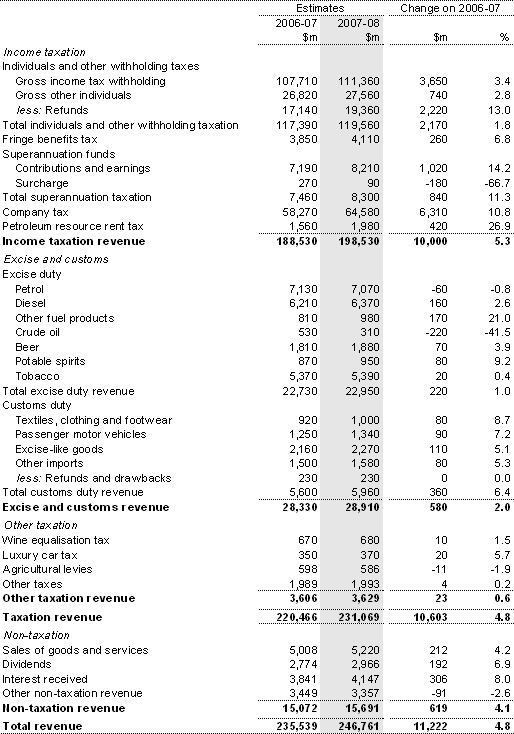
Revenue estimates by revenue head
Income taxation revenue
Individuals and other withholding taxation
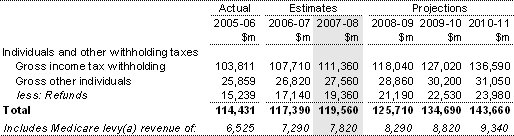
Estimated revenue from individuals for 2006-07, 2007-08 and the projection years is provided in Table 5. Estimated revenue from individuals in 2007-08 is expected to increase by $2.2 billion (1.8 per cent), reflecting solid growth in most forms of income, including wages, personal investment income (see Box 5.1) and unincorporated business income. The Government's decision to provide additional personal tax relief has partially offset the upward revisions.
Table 5: Individuals and other withholding taxation revenue
- Medicare levy for 2005-06 is an estimate.
Gross income tax withholding
Gross income tax withholding revenue is expected to increase by $3.7 billion (3.4 per cent) in 2007-08, reflecting solid growth in average wages and moderating growth in employment, partially offset by additional personal income tax relief.
Gross other individuals
Gross revenue from other individuals is expected to increase by $740 million (2.8 per cent) in 2007-08. This reflects strong growth in capital gains and moderate growth in unincorporated business income, partly offset by the impact of the additional personal income tax relief announced in the 2006-07 and 2007-08 Budgets.
Income tax refunds for individuals
Refunds for individuals are expected to increase by $2.2 billion (13.0 per cent) in 2007-08. Refunds are generally related to movements in revenue from gross income tax withholding and gross other individuals in the previous year. Strength in labour market outcomes throughout 2006-07 will increase refunds in 2007-08 as part-year employees will tend to have more tax withheld than they are required to pay on assessment. In addition, the estimate for 2007-08 incorporates the effects of changes to the low income tax offset announced in the 2006‑07 Budget.
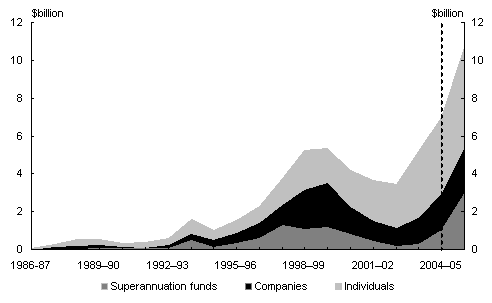
Box 5.1: Capital gains tax Capital gains tax (CGT) is not a separate revenue head. It is a large, increasingly important and volatile component of gross other individuals, refunds, companies and superannuation funds heads of revenue. Net CGT payable has grown from $43 million in 1986-87 to $7.0 billion (0.8 per cent of GDP) in 2004-05. Partial data from 2005-06 tax returns indicate that the recent strong growth has continued, with net CGT estimated to exceed $10 billion. Chart 1: Tax payable on net capital gains subject to tax by entity type(a) Income-year basis
(a) Tax payable on net capital gains is estimated (based on entity type and tax rates). Source: ATO Taxation Statistics, Commissioner of Taxation annual reports and Treasury estimates. Generally, capital gains from disposals of pre-CGT assets (assets acquired before 20 September 1985) are exempt from tax. Since its introduction, the tax base, generated by the transfer and consequent ungrandfathering of pre-CGT assets and the creation of new assets, has been expanding. This contributed to strong growth in CGT for the first half of the series and may still be having a small influence. From 1985 to 1999, capital gains were taxed at the individual taxpayer's full marginal rate on gains above an indexed cost base. For individuals the maximum rate was 48.5 per cent in 1999. From 1999 the Government introduced a discount of 50 per cent on nominal gains for individuals where assets were held for longer than a year, meaning that the marginal tax rate effectively halved. This meant for individuals, the maximum rate fell to 24.25 per cent and to 23.25 per cent from 1 July 2006. For superannuation funds, the 1999 reforms resulted in the effective rate falling from 15 per cent to 10 per cent. In broad terms, capital gains arise from the difference between the sale price and cost of assets. Consequently, movements in capital gains have a natural sensitivity to movements in prices. The growth in CGT during the late 1990s was underpinned by strong growth in share prices. From 2000-01 to 2002-03 growth in share prices slowed while house prices increased markedly. In recent years, strong growth in share prices has again led to strong growth in CGT. The rate at which assets are transferred is also an important determinant of CGT as the tax is levied on realised gains. This feature allows taxpayers some greater choice over when to incur CGT compared with many other taxes. An increase in the rate of asset turnover leads to an increase in the level of realised capital gains (increased turnover effectively brings forward the recognition of accrued gains). |
Medicare levy
Revenue from the Medicare levy is expected to increase by $530 million in 2007-08. Movements in revenue from the Medicare levy are generally consistent with growth in personal taxable income.
Fringe benefits tax
Estimated revenue from fringe benefits tax for 2006-07, 2007-08 and the projection years is provided in Table 6.
Table 6: Fringe benefits tax revenue

Revenue from fringe benefits tax is expected to increase by $260 million (6.8 per cent) in 2007-08, reflecting solid labour market expectations.
Superannuation funds
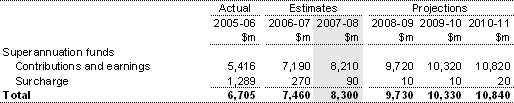
Estimated revenue from superannuation funds for 2006-07, 2007-08 and the projection years is provided in Table 7.
Table 7: Superannuation funds revenue
Superannuation funds taxation
Taxation revenue from superannuation funds is expected to increase by $1.0 billion (14.2 per cent) in 2007-08, underpinned by solid labour market expectations and earnings growth. Superannuation funds earnings growth is expected to be stronger than previously estimated, largely because of higher than anticipated capital gains following continued strength in the share market.
Superannuation surcharge
Revenue from the superannuation surcharge is expected to decrease by $180 million in 2007-08. While the abolition of the surcharge extinguishes future liabilities from accruing, allowance has been made in relation to the identification of liabilities which accrued prior to 1 July 2005.
Company and other related income taxation
Estimated revenue from companies for 2006-07, 2007-08 and the projection years is provided in Table 8.
Table 8: Company and other related income taxation revenue

Company income taxation
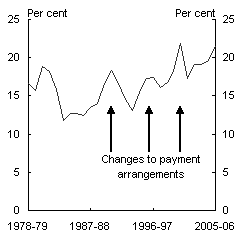
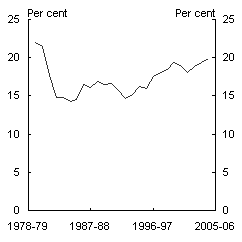
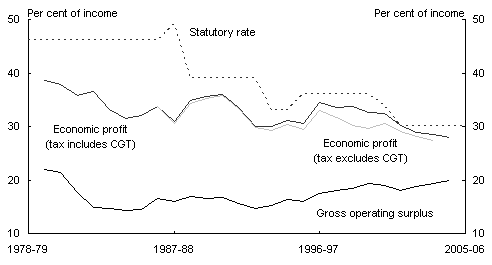
Company income taxation revenue is expected to increase by $6.3 billion (10.8 per cent) in 2007-08. The increase largely reflects ongoing strength in company profits, in particular in the mining and finance sectors.
Company income taxation revenue over the projection years, 2008-09 to 2010-11, incorporates a technical assumption that the prices of key non-rural commodities will return to long-run average levels over the first two years of the projection period. This is broadly consistent with aggregate non-rural commodity prices retracing around 60 per cent of their recent gains by the end of the projection period.
Petroleum resource rent tax
Estimated revenue from the petroleum resource rent tax is expected to increase by $420 million (26.9 per cent) in 2007-08, reflecting higher expected profitability of offshore petroleum projects from higher oil prices (measured in Australian dollars).
Excise and customs revenue
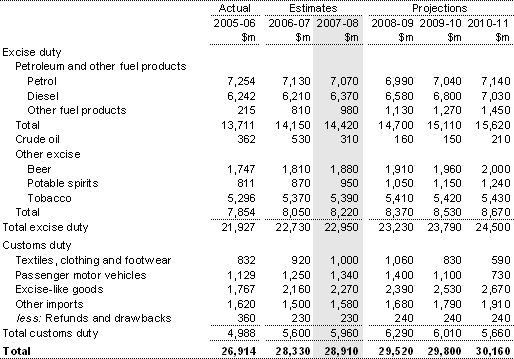
Estimates for 2006-07, 2007-08 and the projection years are provided in Table 9 for excise and customs revenue.
Table 9: Excise and customs revenue
Excise duty
In 2007-08, revenue from excise duty on refined petroleum products is expected to increase by $270 million (1.9 per cent), with excise on other fuel products expected to account for $170 million of that increase (a growth rate of 21.0 per cent for those products). This reflects moderate growth in overall demand for fuels as well as continuing substitution from petroleum and diesel to other blended fuel products (such as petrol/ethanol and diesel/biodiesel blends).
Revenue from crude oil excise duty is expected to decrease by $220 million (-41.5 per cent) in 2007-08, largely reflecting lower expected production in the relevant fields.
Other excise revenue is expected to increase by $170 million (2.1 per cent) in 2007-08. Beer excise revenue is estimated to increase by $70 million (3.9 per cent) reflecting growth in the market for premium beers, which are generally full strength. Excise revenue from other excisable beverages is expected to increase by $80 million (9.2 per cent) with consumption of ready to drink products continuing to grow strongly. Estimated revenue from both tobacco and other spirits excise is expected to remain largely unchanged from 2006-07 levels.
Customs duty
Customs duty revenue is expected to increase by $360 million in 2007-08, underpinned by growth in imports.
Other taxation revenue
Revenue estimates for 2006-07, 2007-08 and the projection years are provided in Table 10 for the wine equalisation tax, the luxury car tax, agricultural levies and other taxes.
Table 10: Other taxation revenue
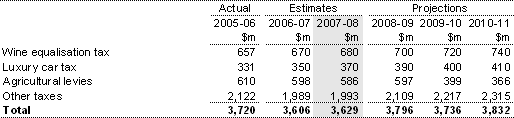
Total other taxation revenue is estimated to increase by $23 million in 2007-08.
Revenue from the wine equalisation tax and the luxury car tax is expected to increase by $10 million and $20 million respectively in 2007-08.
Revenue from agricultural levies and other taxes in 2007-08 is expected to be largely unchanged from 2006-07 levels.
Non-taxation revenue
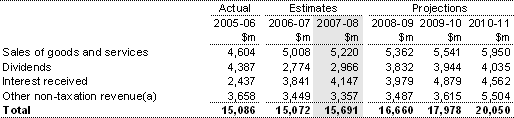
Revenue estimates for 2006-07, 2007-08 and the forward years are provided in Table 11 for the various categories of non-taxation revenue. Item descriptions are in Appendix D.
Table 11: Non-taxation revenue
- Includes all other non-taxation revenue collected by the Australian Government agencies.
Non-taxation revenue is expected to increase by $619 million (4.1 per cent) in 2007-08 largely reflecting an increase in sales of goods and services primarily by the Department of Defence to other governments.
Interest and dividends revenue received are also forecast to increase due largely to the earnings of the Future Fund.