



Statement 7: Asset and Liability Management
The Australian Government balance sheet provides information on the Government's assets and liabilities and provides an indication of the sustainability of government finances. Maintaining a strong balance sheet provides governments with the capacity and flexibility to deal with longer term fiscal pressures.
The balance sheet presents the Government's assets and liabilities which contribute to the calculation of net debt and net worth. A detailed balance sheet for the Australian Government general government sector is provided in Appendix B of Statement 2 (Table B2).
Net debt and net worth
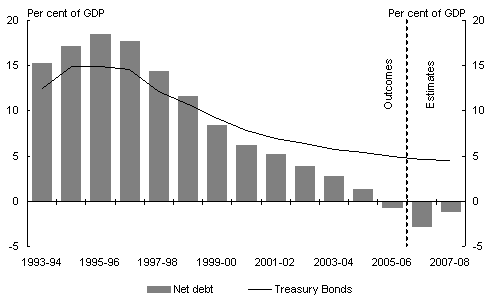
Net debt was eliminated in 2005-06 after falling from a peak of 18.5 per cent of GDP ($95.8 billion) in 1995-96. Due to continuing strong economic and fiscal management net debt is expected to remain below zero in 2007-08 and over the forward years. Financial assets included in net debt reduce temporarily in 2007-08 (Chart 1). The change in the 2007-08 estimate is largely explained by the Future Fund progressively moving its assets out of cash and fixed interest securities, which are included in the calculation of net debt, into equities, which are excluded. Despite the low levels of net debt, the Government is committed to issuing sufficient Treasury Bonds to support the Treasury Bond futures market.
Chart 1: Australian Government general government sector
net debt and Treasury Bonds on issue
Source: Data are from ABS cat. no. 5501.0, Australian Government Final Budget Outcomes and Treasury estimates.
Australia's net debt position compares favourably to other industrialised countries and is among the lowest in the OECD. The average net debt to GDP ratio in the OECD is around 45 per cent while for Australia it is below zero (see Chart 2 in Statement 1).
Net debt is a sub-set of the Government's broader financial portfolio. It includes financial liabilities such as government securities and other loans and borrowing, and financial assets such as cash and deposits. Net debt is a common measure of the strength of a government's fiscal position and performance.
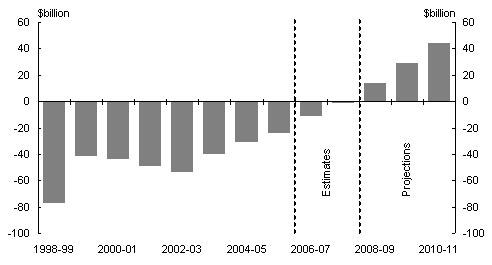
Net worth is a broader measure of the Government's overall financial position which incorporates the Government's non-financial assets, such as land and other fixed assets, as well as certain financial assets and liabilities not included in net debt, most notably accrued employee superannuation liabilities. Australian Government general government sector net worth is projected to be positive by 2008-09 (Chart 2).
Chart 2: Australian Government general government net worth
Source: Data are from ABS cat. no. 5501.0, Australian Government Final Budget Outcomes and Treasury estimates.
The present and projected improvement in net worth is primarily driven by budget surpluses and returns on investments in the Future Fund. The Government has projected surpluses over the forward estimates reflecting the current strength of the economy, while Future Fund earnings are expected to grow at a faster rate than other investments.
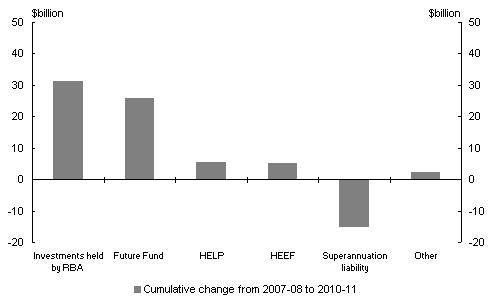
This increase in net worth is reflected in the balance sheet as higher term deposits at the Reserve Bank of Australia (RBA) from accumulated budget surpluses, an increase in Future Fund assets resulting from transfers to the Fund and earnings, the creation of the Higher Education Endowment Fund (HEEF), and growth in the Higher Education Loans Programme (HELP). These increases in assets significantly outweigh growth in the Government's liabilities over this period, which include the unfunded superannuation liabilities (Chart 3).
Chart 3: Changes in the composition of net worth over the forward estimates
Source: Treasury estimates.
The positive outlook for net worth and net debt means the Government is well placed to deal with future emerging fiscal pressures.