Overview of the Aid Program
Development context
Remarkable economic growth in East Asia over the last twenty years has seen over 500 million people lifted above an income of US$1 a day. According to World Bank estimates, in 1981 some 58 per cent of people in East Asia lived on less than US$1 a day, while in 2001 the proportion fell to less than 15 per cent. In South Asia over the same period, the proportion fell from 52 per cent to 31 per cent. Yet vast numbers of people remain in poverty in the region. East Asia, the Pacific, and South Asia are home to almost 700 million people living on less than US$1 a day, two thirds of the global total and more than twice the number living in poverty in sub-Saharan Africa.
Within Australia's region, significant disparities exist and progress on reducing poverty looks likely to continue at different rates. Per capita economic growth in much of the Pacific has stalled, and even some areas of Asia are missing many of the economic and development opportunities offered by the strong economic growth elsewhere in the region.
Many people who continue to live in poverty are in areas where growth has not reached. They are vulnerable to many potential shocks. Security, stability and improved governance are among the most important preconditions for sustained growth and poverty reduction, but are lacking in some weaker states in the region. Corruption is also a major challenge which damages development prospects in many countries. It can stifle economic growth and undermine efforts to lift poor citizens out of poverty.
Other obstacles are blocking the poor, especially the rural poor, from accessing the potential and benefits of growth. Chief among these are infrastructure constraints to growth. Poor transport networks separate many rural areas of the Asia-Pacific region from urban markets and greater productivity. Demography compounds these challenges as young and rapidly growing populations place extra strain on public services like education and health. For example, recent population growth rates in Papua New Guinea, Solomon Islands and Vanuatu have been 2.5 per cent a year and higher, and over 40 per cent of the population of Solomon Islands is under 15 years old.
Health services are further strained by the vulnerability of the region to infectious disease. HIV/AIDS threatens development gains across the region, with Papua New Guinea a particular concern. Avian and pandemic influenza also have the potential to cause widespread disruption. The natural environment is also under increasing pressure from rapid economic and population growth. Competition for resources, including water and energy, is growing and will need to be managed. Adaptation to the potential impacts of climate change is a further challenge.
Strategic framework
The Prime Minister announced in September 2005 the Government's intention to double the aid budget to about $4 billion by 2010. The announcement was subject to three critical conditions: the demonstrated effectiveness of the application of additional resources, reduced corruption, and improved governance in partner countries. Following on from this announcement, the White Paper Australian Aid:Promoting Growth and Stability was launched in 2006, providing the strategic framework to guide the direction and delivery of the aid program over the next 10 years. It provides a comprehensive account of how the Government will approach the doubling of the aid budget to about $4 billion annually by 2010.
The strategic framework provided by the White Paper builds on the lessons learnt from decades of Australian and international experience of aid delivery. Central lessons from this experience are: the primacy of growth for poverty reduction; the need for robust institutions for growth; and the importance of basic service delivery — health, education and local infrastructure — for providing opportunities to participate in development.
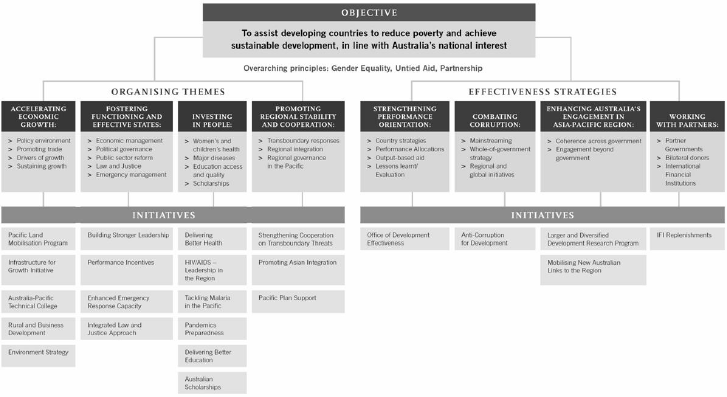
The White Paper framework centres on the objective of Australia's aid program: To assist developing countries to reduce poverty and achieve sustainable development, in line with Australia's national interest.
In order to achieve this objective, the aid program is organised around the themes of:
- accelerating economic growth
- fostering functioning and effective states
- investing in people, and
- promoting regional stability and cooperation.
The Prime Minister was unequivocal that the doubling of Australian aid by 2010 must be subject to assurances of its effectiveness. To this end, the White Paper framework provides strategies to improve the aid program's effectiveness by:
- strengthening the performance orientation of the aid program
- combating corruption
- enhancing Australia's engagement with the Asia-Pacific region, and
- working in partnership with regional governments and other donors.
The White Paper framework is reinforced by promoting greater gender equality in development, and through untying Australian aid to improve efficiency and competitiveness.
A key initiative of the White Paper was the creation of an Office of Development Effectiveness (ODE), which has a mandate to improve the effectiveness of aid policies and programs, including through the publication of an Annual Review of Development Effectiveness (ARDE). This review will draw on the breadth of the ODE's work, including quality process reviews, evaluations and the experiences of all Australian agencies delivering official development assistance. The ARDE will be integrated into the budget cycle and provide a practical link between aid allocations and aid effectiveness. The first ARDE will be released in late 2007.
The White Paper strategic framework is summarised in Diagram 1 overleaf.
Diagram 1: Strategic framework for Australia's overseas aid program
Aid Budget
The Government will provide an estimated $3,155.3 million in official development assistance (ODA) in 2007-08, of which $2,731.6 million will be managed by AusAID. The ratio of Australia's ODA to gross national income (ODA/GNI ratio) is estimated at 0.30 per cent for 2007-08. In calendar year 2006, Australia provided a total of $2,825 million in overseas aid, representing a 0.30 per cent ODA/GNI ratio. This is equal to the preliminary 2006 weighted average ODA/GNI ratio for the Organisation for Economic Cooperation and Development (OECD) donor community as a whole. This Budget maintains Australia's ODA/GNI ratio at 0.30 per cent.
Table 1 shows the composition of Australian ODA, including ODA managed by AusAID.
Table 1: Composition of Australian ODA
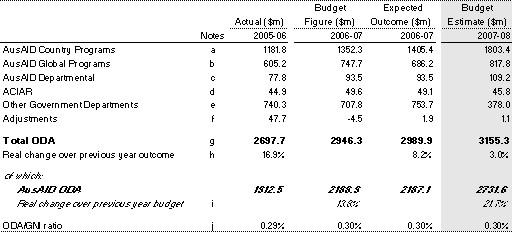
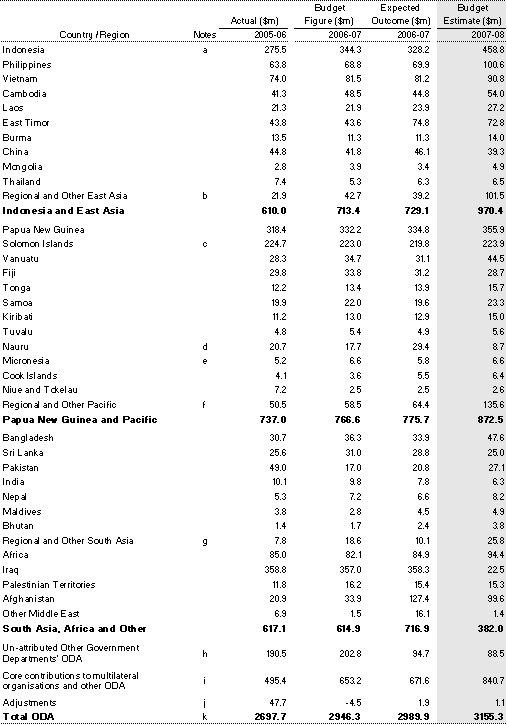
Table 2 shows total Australian ODA from all agencies and programs to each partner country.
Table 2: Australian ODA by partner country
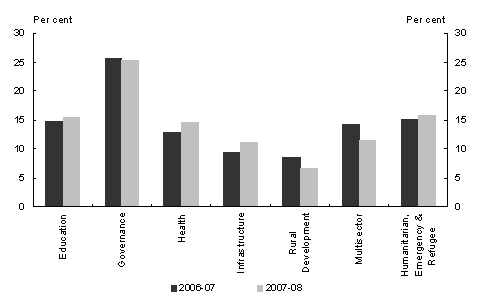
Australia's aid is delivered across a range of sectors, including education, governance, health, infrastructure, rural development and humanitarian assistance. Diagram 2 illustrates the estimated sectoral breakdown for 2006-07 and 2007-08 according to the sector classification defined by the OECD's Development Assistance Committee (DAC). Further breakdowns are provided for governance (page 18), health (page 22) and education (page 27) sectors.
Diagram 2: Estimated breakdown of Australian ODA by DAC sector