


Supporting apprentices and technical colleges
The Government is committed to assisting apprentices to invest in their future. Skills for the Future committed $837 million to support skill creation. Realising Our Potential builds on this and will attract new apprentices with wage and fee support and shorter apprenticeships while increasing the status and availability of quality technical training. These measures are part of the Government’s plan to restore the true value of technical and vocational training.
The Government is providing additional assistance of $549 million over four years to Australian Apprentices in skill shortage trades.
From 1 July 2007 eligible Australian Apprentices under the age of 30 will receive an additional tax exempt payment of $1,000 per year as a wage top‑up to be paid in six-monthly instalments during the first and second years of the apprenticeship. Around 228,000 apprentices will benefit over four years.
Eligible Australian Apprentices will also receive a voucher to reimburse the course fees payable to their Registered Training Organisation by up to $500 per year. This voucher will also be available to Australian Apprentices in both the first and second year of their Australian Apprenticeship in a skill shortage trade. Around 252,000 apprentices will benefit over four years.
Included in the Realising Our Potential package are a further three Australian Technical Colleges in the Brisbane, Sydney and Perth areas at a cost of $84 million over five years. This will build on the Government’s existing commitment of $468 million to support 25 Australian Technical Colleges.
The Government will also provide funding of $59 million over four years to Registered Training Organisations to partner with industry and local employers to develop and implement fast-track apprenticeships with competency-based, rather than time-based, progression.
Registered Training Organisations will be able to apply for up to $50,000 to work with industry partners to develop innovative training arrangements that allow apprentices to complete their training much more quickly than the current four-year periods.
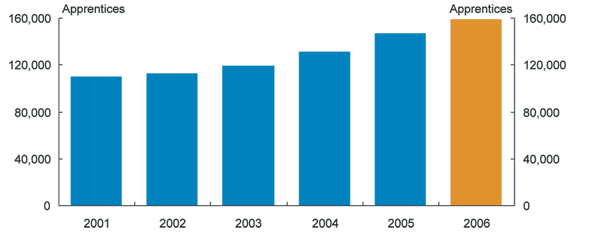
Traditional apprentice numbers continue to grow (NCVER 2007)
Realising Our Potential 9