


National standards and choice
Clear, comparable and accessible information can better inform parents' choices, as well as the decisions of school authorities and schools themselves. The Government has a key role to play in developing high-level national standards and facilitating national reporting on both student outcomes and the performance of schools.
Standards
The next schools funding agreement will include:
- national standards for core curriculum in key areas
- national standards for assessment of Year 12 results, including externally-moderated exams
- timely, accurate reporting for parents on literacy and numeracy attainment, with school, state and national comparisons.
Realising Our Potential includes funding of $13 million over two years to work with the States and Territories to develop core standards in English, Maths, Science and Australian History in Years 10, 11 and 12. Core standards for Australian History will build on the outcomes of the Australian History Summit in August 2006.
The Government will also provide $15 million over three years to promote the use of student aptitude tests by universities as a supplementary mechanism for assessing Year 12 students seeking entrance to a tertiary course.
Choice
Choice is often restricted within the government school sector, leaving parents with little option other than to move their children into the non-government sector. Parents and students have been voting with their feet since the 1970s.
The number of students in government schools peaked in 1978 at 2.4 million. Today there are fewer full-time students in government schools than there were in 1974. Growth in total student numbers of around 500,000 since 1974 has occurred entirely in non-government schools.
As part of the next schools funding agreement, the Australian Government will encourage greater choice within the government school sector, including the establishment of more selective high schools.
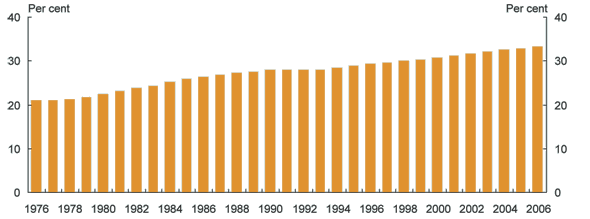
Proportion of full-time students enrolled in non-government schools, 1976-2006
Realising Our Potential 13