



Section 4: Other reporting requirements
4.1 Purchaser-provider arrangements
Cross agency overview
The Australian Bureau of Statistics’ (ABS) goods and services are purchased by several Australian Government agencies including:
- Australian Agency for International Development;
- Australian Institute of Health and Welfare;
- Department of Agriculture, Fisheries and Forestry;
- Department of Education, Science and Training;
- Department of Communications, Information Technology and the Arts;
- Department of Employment and Workplace Relations;
- Department of Families, Community Services and Indigenous Affairs;
- Department of Health and Ageing; and
- Department of Transport and Regional Services.
4.2 Cost recovery arrangements
Cost recovery arrangements (in accordance with Australian Government Cost Recovery Guidelines, July 2005, and the Australian Government Competitive Neutrality Guidelines for Managers, February 2004) have been developed in relation to the various goods and services paid for by clients, amounting to $21.0 million in 2007-08.
Summary of cost recovery impact statement
The ABS is the central statistical authority for the Australian Government and the largest provider of statistical information in Australia. The ABS produces and disseminates a wide range of statistical products and services. Some of these products and services are provided free of charge as part of the Basic Information Set (BIS) and others are provided on a cost recovery basis within the Additional Information Set (AIS).
Cost recovery activities are as follows:
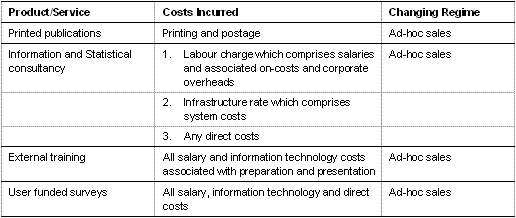
The legislative authority for imposing these charges is section 12, subsection 3 of the Census and Statistics Act 1905 which states ‘The Statistician may make charges for results and abstracts published and disseminated under this section.’
Costs recovered for marginally costed products and services include:
- labour (including labour on-costs); and
- systems development and maintenance, where such systems are exclusively devoted to the production and dissemination of marginally costed products.
These costs are also recovered for incrementally priced products and services, along with any capital and overhead costs arising from their provision.
ABS uses the Fully Distributed Costing model to allocate costs. Under this model, overhead costs are allocated on a pro rata basis to the product or service (that is, all costs are recovered from the sum of all sales of the product or service). In addition, ABS allocates information technology costs using the Activity Based Costing method (that is, total system costs are distributed according to usage).
ABS established efficient costs by comparison with markets where similar systems exist. ABS assesses itself on an ongoing basis against external benchmarks. Examples of this include:
- use of Gartner Service for benchmarking IT costs;
- review of ABS staffs’ professional and technical qualifications;
- as evidence of cost efficiency in the delivery of information consultancy services;
- hours devoted to individual consultancies are monitored;
- quotes authorised and monitored by senior staff;
- inter- office benchmarking is undertaken; and
- international benchmarking is undertaken.
The total revenue forecast to be recovered in this current financial year is $17.4 million. However, when receipts from inter- and intra‑government agencies, including universities, and from commercial activities are removed the total revenue in scope is estimated to be $1.7 million in 2006-07.
The ABS recently reviewed and updated its pricing policy in response to the Commonwealth Government Cost Recovery Guidelines. The outcomes of this review were released on the ABS web site on 8 February 2006, in the form of a Discussion Paper titled ABS Pricing Policy Review Outcomes — Public Consultation (cat. no. 1399.0). The paper provided ABS clients with the opportunity to comment on the proposed application of Government Guidelines to ABS pricing policy.
In addition to the invitation to respond in the Discussion Paper on the web site:
- ABS Regional Offices were asked to contact client members of their State Statistical Coordination Committees for feedback;
- ABS Outposted Officers were asked to promote the Paper to their agencies and to seek comment; and
- the views of the Australian Statistics Advisory Council were sought and reflected in the final policy.
Eight responses were received, mainly from other government agencies. The responses were generally accepting of the changes to pricing policy. Some respondents requested clarification of which Information Set the particular products of interest to them (including Information and Statistical consultancies, customised data and training services) would fall into.
ABS costs and prices are reviewed annually to ensure that revenue recovers appropriate costs. However, the Commonwealth Cost Recovery Guidelines require a wider periodic review of existing cost recovery arrangements which address the appropriateness of cost recovery, the design of cost recovery charges and the adequacy of monitoring arrangements. It is intended that a regular review of cost recovery arrangements, as instructed by these Guidelines, will be undertaken every five years from 2006.
4.3 Australian Government Indigenous Expenditure
Table 4.1: Australian Government Indigenous Expenditure
The ABS does not deliver any programmes for indigenous Australians. However, in meeting it’s objective to provide a high quality, objective and responsive national statistical service the ABS undertakes a range of indigenous statistical collections which are estimated to cost in the order of $15 million in 2007-08.