



Section 2: Resources for 2007-08
2.1 Appropriations and other resources
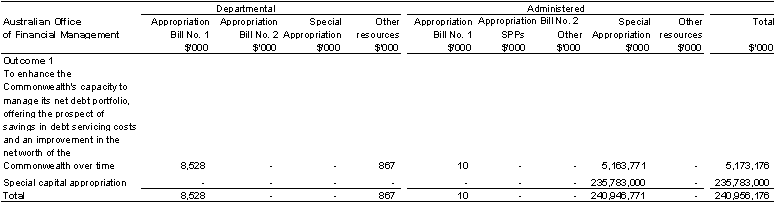
The total resourcing for the Australian Office of Financial Management (AOFM) in the 2007-08 Budget is $240,956.2 million, represented by departmental appropriation of $8.5 million, administered appropriation of $240,946.8 million and departmental revenues of $0.9 million. The administered appropriation comprises two components, appropriation for expenses of $5,163.8 million and debt redemption and financial investment activity of $235,783.0 million.
Table 2.1 shows the total resources from all origins for 2007-08, including appropriations. The table summarises how revenue will be applied by outcome and by administered and departmental classification.
Table 2.1: Appropriations and other resources 2007-08
2.2 2007-08 Budget measures
The AOFM does not have any 2007-08 Budget measures.
2.3 Other resources available to be used
The following table provides details of estimated administered and departmental revenues from sources other than appropriations for the AOFM for 2006-07 (estimated actual) and 2007-08 (budget estimate). Departmental revenues are eligible items under the AOFM’s net appropriation agreement under section 31 of the Financial Management and Accountability Act 1997, and as a result can be applied to the AOFM’s departmental activities. The AOFM’s administered revenues are not available to meet financial commitments of the AOFM and are returned to the Official Public Account.
Table 2.3: Other revenues
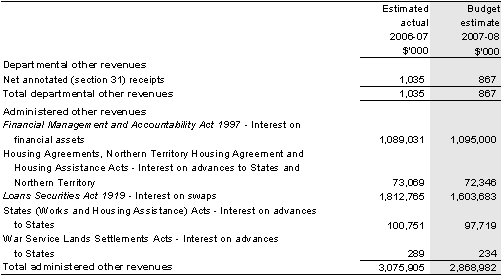
Departmental revenues comprise cost recovery arrangements from the States for security registry services incurred by the AOFM for managing debt on allocation to the States, recovery of expenses from salary packaging arrangements and revenue from staff secondments, including from the Australian Agency for International Development (AusAID) to reimburse costs associated with overseas deployments and other support for debt management in the region.
Administered revenues include interest revenue on swap transactions and financial investments, interest on advances made to the States and the Northern Territory under Commonwealth-State financing arrangements.
2.4 Movement of administered funds
Table 2.4: Movement of administered funds between years
The AOFM does not have any movement of administered funds.
2.5 Special appropriations
Table 2.5: Estimates of expenses from special appropriations
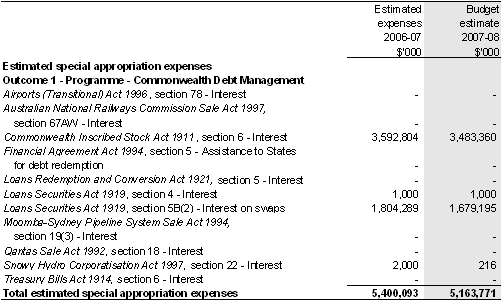
The commentary below summarises the key legislative mechanisms that establish the Australian Government’s borrowing capacity.
The Commonwealth Inscribed Stock Act 1911 and associated regulations provide for the creation and issuance of domestic stock prescribed under the Act, including Treasury Fixed Coupon Bonds, Treasury Indexed Bonds and Treasury Notes.
The Financial Agreement Act 1994 formalises revised debt redemption arrangements applying since 1 July 1990 between the Australian Government and the States and the Northern Territory. The Act prescribes the contributions to be made by the Australian Government, the States and the Northern Territory to meet the volume of maturing State and Northern Territory debt. The Act also establishes compensation payments by the Australian Government to the States and the Northern Territory as a result of the new arrangements.
The Loans Securities Act 1919 provides the Australian Government with additional borrowing in overseas borrowings, swaps and other financial arrangements.
The Loans Redemption and Conversion Act 1921 gives the Treasurer the power to borrow money necessary for the purpose of paying off, repurchasing or redeeming loans.
Section 39(2) of the Financial Management and Accountability Act 1997 gives the Treasurer the power to invest public money in authorised investments for the purposes of managing the public debt of the Australian Government. Section 39(9) appropriates funds for this purpose.
2.6 Movements in special accounts
Special accounts provide a means to set aside and record amounts used for specified purposes. The following table shows the expected additions (credits) and reductions (debits) for each account used by the AOFM.
Table 2.6: Estimates of special account cash flows and balances
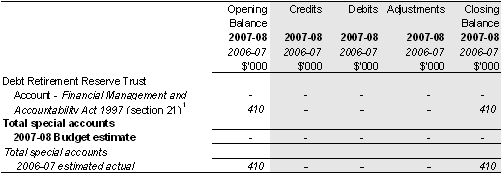
- This special account is administered in nature and is governed by the Financial Agreement Act 1994
Until July 1990, the Australian Government borrowed on behalf of the State and Territory governments and allocated a portion of its Treasury Bond raisings to those governments to fund the redemption of previous allocations of bond raisings. Until 1986, the Australian Government also borrowed on behalf of the State and Territory governments to raise new borrowings. In addition there are outstanding balances of various loans raised by the State Governments.
The annual funding of the redemption of the State and Territory allocated debt is governed by the Financial Agreement Act 1994 which requires the Australian Government to establish and maintain the Debt Retirement Reserve Trust Account (DRRTA), a special account, for the States and the Northern Territory. Monies standing to the credit of a State or the Northern Territory are applied by the Australian Government in connection with the repurchase and repayment of the debt of that State or the Northern Territory.
The Act prescribes the contributions to be made by the Australian Government and by the States and the Northern Territory to the DRRTA.
Approximately $10 million of perpetual debt with no fixed maturity date remains outstanding under arrangements governed by the Financial Agreement Act 1994. All other debt has been redeemed. Redemption of the perpetual debt is at the discretion of the relevant States, the timing of which was not fixed at the time of preparation of the Budget. Accordingly, there are no projected cash flows through this special account.