Section 5: Budgeted financial statements
Budgeted agency and administered financial statements and related notes for the Australian Office of Financial Management (AOFM) are presented in this section. The financial statements are produced for 2006-07 (estimated actual results), 2007‑08 (Budget) and three forward years. The financial statements should be read in conjunction with the accompanying notes.
5.1 Analysis of budgeted financial statements
Departmental
Budgeted Income Statement
Since its establishment as a separate agency in July 1999, the AOFM has been developing its resource base and functionality. Continuous improvements are being made in policy, systems and methodology in the areas of financial market operations and risk management. The budget and forward years reflect periods when revenue and operating expenses are expected to be relatively stable.
Budgeted Balance Sheet
The AOFM’s net asset (or equity) position is forecast to remain constant over the Budget and forward years, reflecting that current funding levels are expected to be adequate to support the AOFM’s current operations during this period.
The AOFM forecasts that during the forward estimates period it will need to make renewed capital investment in agency infrastructure. Some further capital expenditure, in the forward estimates period, particularly in relation to systems, both for development and replacement, is expected. Sufficient funding has been provided for this future capital investment from accumulated unspent outputs appropriations (depreciation funding) and equity injections.
Administered
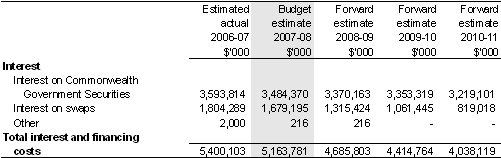
Following the Government’s decision, announced in the 2003-04 Budget, to maintain the market in Commonwealth Government Securities (CGS), the AOFM issues Treasury Bonds with tenors chosen to support the requirements of the Treasury Bond futures market. The Administered Budget and forward estimates reflect this decision.
The AOFM executes interest rate swap transactions to manage the cost and risk of its net debt portfolio. The Administered Budget and forward estimates incorporate the interest rate swap programme.
The Australian Government holds surplus funds as term deposits with the Reserve Bank of Australia. Estimates of these asset holdings have been included in the Administered Budget and forward estimates. The Future Fund is managed by the Future Fund Management Agency in the Finance and Administration Portfolio, and its asset holdings are not included in the AOFM’s administered budget and forward estimates.
5.2 Budgeted financial statements tables
Table 5.1: Budgeted departmental income statement
(for the period ended 30 June)
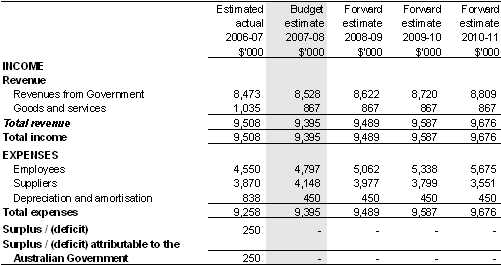
Table 5.2: Budgeted departmental balance sheet (as at 30 June)
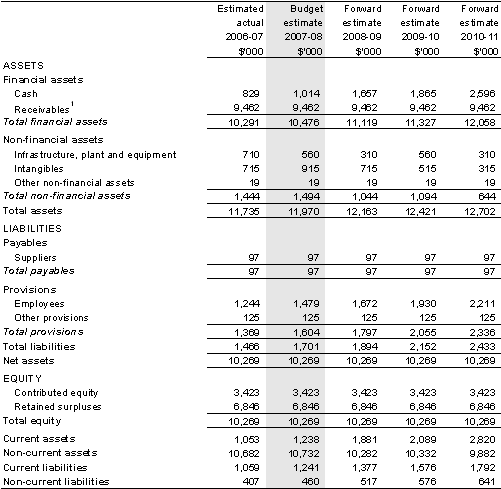
- Receivables balance includes $9.3 million of undrawn appropriations held in the Official Public Account.
Table 5.3: Budgeted departmental statement of cash flows
(for the period ended 30 June)
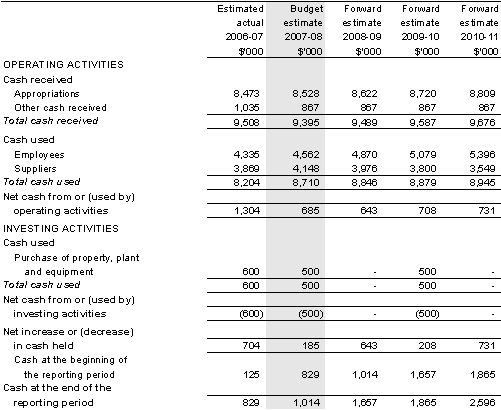
Table 5.4: Departmental statement of changes in equity — summary of movement
(Budget year 2007-08)
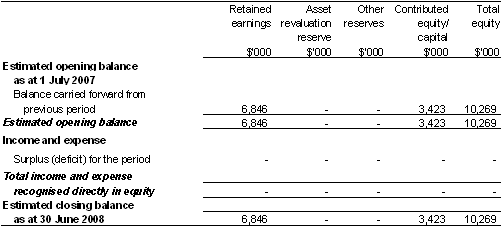
Table 5.5: Departmental capital budget statement
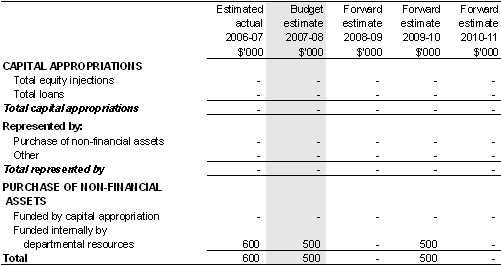
Table 5.6: Departmental property, plant, equipment and intangibles — summary of movement (Budget year 2007-08)
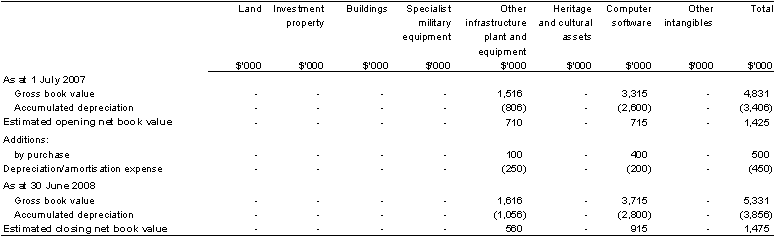
Table 5.7: Schedule of budgeted income and expenses administered on behalf
of government (for the period ended 30 June)
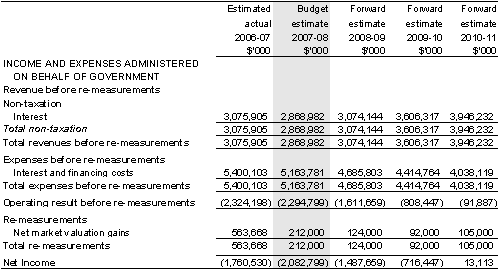
Table 5.8: Schedule of budgeted assets and liabilities administered on behalf
of government (as at 30 June)
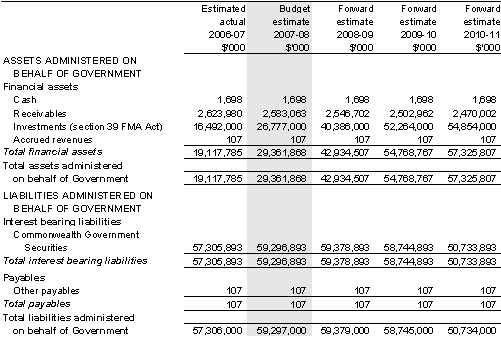
Table 5.9: Schedule of budgeted administered cash flows
(for the period ended 30 June)
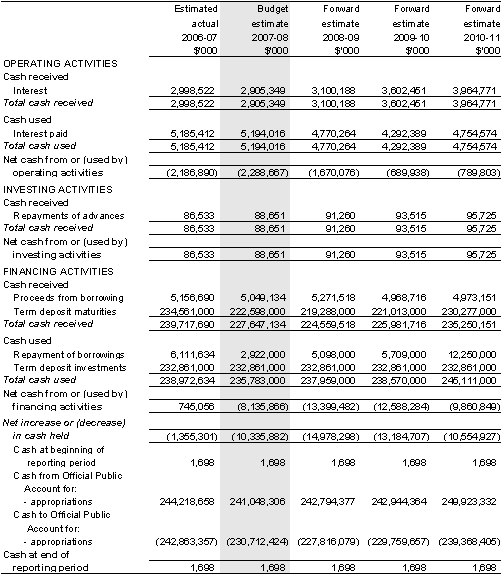
Table 5.10: Schedule of administered capital budget
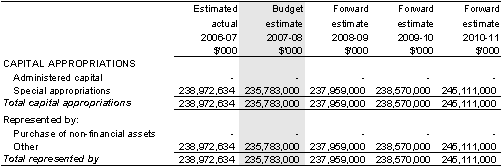
Table 5.11: Schedule of administered property, plant, equipment and intangibles — summary of movement
(Budget year 2007-08)
The AOFM does not have any administered property, plant, equipment and intangibles.
5.3 Notes to the financial statements
Basis of accounting
The departmental financial statements have been prepared on an accrual basis and are in accordance with the historical cost convention, except for infrastructure, plant and equipment assets and employee entitlements. Infrastructure, plant and equipment assets are revalued every three years using a fair value methodology. Employee entitlements are measured at the present value of estimated future cash flows based on periodic actuarial assessment.
Since 1 July 2005, the administered financial statements have been prepared on a fair value basis in accordance with Australian equivalents to international financial reporting standards. As a result of subsequent amendments to AASB 139 Financial Instruments: Recognition and Measurement, the AOFM has revised its accounting policies. The impact of this revision is that the AOFM will continue to measure all significant financial assets and financial liabilities at fair value through profit or loss, with the exception of housing loans to the States and Northern Territory. From 2006-07, these loans are now measured on an amortised cost basis, after initial recognition at fair value, under the requirements of the revised AASB 139.
Fair value is synonymous with market value and represents the estimated exchange equivalent price using relevant inputs from reference markets and valuation techniques. Fair value is determined on the presumption of normal market conditions and that the reporting entity is not undertaking transactions on adverse terms.
On behalf of the Department of Communications, Information Technology and the Arts (DCITA), the AOFM currently manages the investments made by the Communications Fund. These investments and their earnings are reported by DCITA and not the AOFM.
Budgeted departmental and administered financial statements
The budgeted financial statements contain estimates prepared in accordance with the requirements of the Australian Government’s financial budgeting and reporting framework, including the principles of Australian Accounting Standards and Statements of Accounting Concepts, as well as specific guidelines issued by the Department of Finance and Administration.
Under the Australian Government’s accrual budgeting framework, transactions that agencies control (agency transactions) are separately budgeted for and reported from transactions agencies do not have control over (administered transactions). This ensures that agencies are only held fully accountable for the transactions over which they have control.
- Agency assets, liabilities, revenues and expenses are those which are controlled by the agency. Agency expenses include employee and supplier expenses and other administrative costs, which are incurred by the agency in providing its goods and services to government.
- Administered assets, liabilities, revenues and expenses are those which are managed on behalf of the Australian Government according to set government directions. Administered expenses include interest incurred on Commonwealth Government Securities. Administered revenues include interest earned on housing agreement loans, interest on investments and interest from swaps.
Administered internal transactions
Administered transactions between the AOFM and other agencies within the General Government Sector (administered internal transactions) are not reported in the schedule of budgeted administered income and expenses or the schedule of budgeted administered assets and liabilities.
However, for the purposes of disclosing all cash flows through AOFM’s administered bank accounts, cash flows in the schedule of budgeted administered cash flows are reported inclusive of administered internal transactions.
Goods and services tax (GST)
All supplies provided by the AOFM are input taxed under A New Tax System (Goods and Services Tax) Act 1999.
Appropriations in the accrual budgeting framework
Under the Australian Government’s accrual budgeting framework, separate annual appropriations are provided to the AOFM for:
- agency price of outputs appropriations: representing the Australian Government’s purchase of outputs from the AOFM; and
- administered expense appropriations: for the repayment of interest on lapsed coupons not supported by special appropriation.
Special appropriations fund the majority of administered expenses and payments made by the AOFM, including debt redemption, interest payments and financial investment activity.
Budgeted departmental income statement
Appropriations
Price of outputs appropriation estimates are not based on market price indicators. The agreed price of outputs appropriation is generally adjusted for wage cost indexation less an efficiency dividend.
For financial years from 2005-06 to 2007-08 (inclusive), the Government has imposed an additional 0.25 per cent efficiency dividend on agencies, bringing the efficiency dividend to 1.25 per cent for these financial years.
Budgeted departmental balance sheet
Cash and undrawn appropriations
The estimated cash reserves and undrawn appropriations will be maintained to ensure that the AOFM is well placed to:
- settle employee liabilities as they fall due;
- make asset replacements; and
- repay liabilities.
Budgeted financial statements have been prepared on the assumption that unspent monies will not be withdrawn by the Department of Finance and Administration.
Administered schedule of budgeted income and expenses
Non-taxation revenue — interest
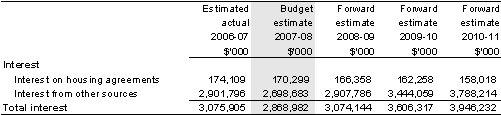
Interest from other sources includes interest from swaps and investments.
Expenses — interest and financing costs
Net market valuation gains
Net market valuation gains represents the estimated unrealised fair value gains on the net debt portfolio. This valuation gain represents the change in financial exposures due to changes in market conditions and the passage of time.
In a passive ‘issue and hold to maturity’ strategy, such as that relating to the AOFM’s debt issuance and management activities, the revaluation effect will net to zero over the life of a financial instrument.
Administered schedule of budgeted assets and liabilities
Financial assets — receivables
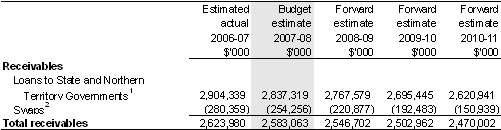
- At amortised cost from 1 July 2006.
- At fair value.
Financial assets — investments
The AOFM, on behalf of the Australian Government, holds surplus funds as term deposits with the Reserve Bank of Australia. Estimates of the fair value of these asset holdings are disclosed as administered investments. The asset holdings of the Future Fund and other government agencies are not included in these estimates.
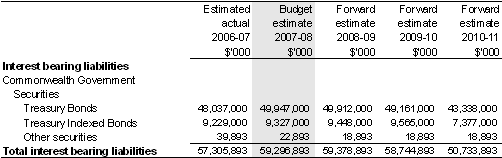
Interest bearing liabilities — Commonwealth Government Securities
Commonwealth Government Securities represent the fair value of government securities on issue, including Treasury Bonds and Treasury Indexed Bonds.