



Section 3: Outcomes
General government sector (GGS) agencies are required to plan, budget and report under an outcomes structure. GGS agencies produce outputs (departmental items) and also administer items on behalf of the Government (administered items).
This section explains how the resources identified in Section 2 will be used to deliver outputs and administered items to contribute to the outcome for the Australian Prudential Regulation Authority (APRA).
3.1 Summary of outcomes and contribution to outcomes
The relationship between activities of APRA and its outcome is summarised in the following figure.
Figure 2: Contributions to outcomes
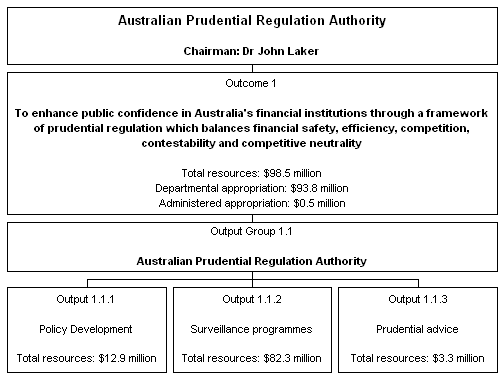
APRA determines the relative contribution of its three outputs to the agency outcome using a time management system. Direct labour costs are captured by the system while costs associated with support and overhead activities are allocated across the three outputs in the ratio of each of the direct output costs to total direct output cost.
3.2 Outcome resources and performance information
3.2.1 Outcome 1 resourcing
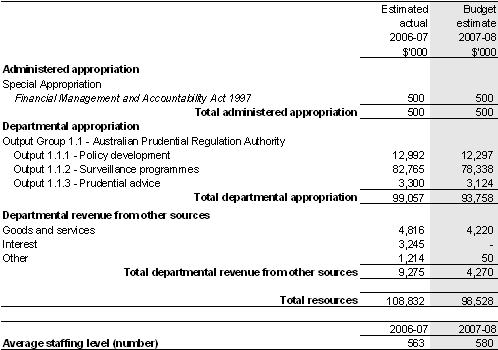
The following table shows how the 2007-08 Budget appropriations translate to total resourcing for the Outcome, including departmental appropriations and revenue from other sources.
Table 3.1: Total resources for Outcome 1
3.2.2 Measures affecting Outcome 1
The Budget measures for APRA appear in Table 2.2. Details of these measures are included in Budget Paper No. 2, Budget Measures 2007-08.
3.2.3 Contributions to achievement of Outcome 1
The outputs of APRA aim to enhance public confidence in Australia’s financial institutions through a framework of prudential regulation, which balances financial safety and efficiency, competition, contestability and competitive neutrality.
The outputs involve formulation and promulgation of prudential policy and practice to be observed by regulated institutions; effective surveillance and compliance programmes and, where relevant, remediation and enforcement measures, to give effect to the laws administered by APRA and to standards issued under those laws; and advice to government on the development of regulation and legislation affecting regulated institutions and the financial markets in which they operate.
Departmental outputs
APRA has three outputs contributing to Outcome 1:
Policy development comprises the issuance of prudential standards and guidelines to assist regulated industries manage risk, industry consultation in development of new prudential policies, cooperation with national and international agencies in the harmonisation of prudential standards and informing the public to enhance understanding of the role of APRA.
Surveillance programmes aim to minimise financial loss by depositors, policy holders and fund members which may result from the failure of regulated institutions to adequately manage risk; facilitate early identification of emerging prudential risks and supervision of necessary remedial actions through inspections and off-site surveillance of regulated entities; and exercise enforcement powers as appropriate to protect the interests of depositors, policy holders, superannuation funds members and the public interest generally.
Prudential advice to Government on prudential regulation policy development; advice to Government comprise advice on amendments to legislation and regulations administered by APRA; liaison with Treasury and appropriate Ministers at regular intervals; and briefing of Government on matters emerging in international forums which may impact on prudential policy.
3.2.4 Performance information for Outcome 1
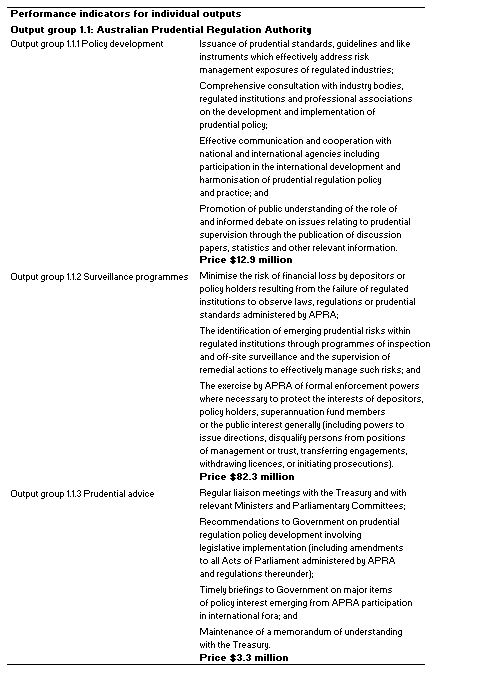
Performance information for administered items, individual outputs and output groups relating to APRA is summarised in Table 3.2.
Table 3.2: Performance information for Outcome 1
The primary business outcome of APRA is to protect beneficiaries of regulated financial institutions and to enhance public confidence in Australia’s financial institutions through a framework of prudential regulation which balances the objectives of financial safety and efficiency, competition, contestability and competitive neutrality. Key strategies have been identified that will achieve this business outcome in a cost effective manner. The three strategies that align with the APRA output are: supervision, enforcement and rehabilitation; policies, standards and guidelines for prudential supervision; and prudential advice covering relations with Government, Parliament and other interested parties.
The estimated percentage distribution of APRA’s operating expenditure across these three elements of the APRA outcome in 2007‑08 is 84 per cent for supervision, rehabilitation and enforcement, 13 per cent for development of prudential policies and standards and 3 per cent for prudential advice.
APRA has developed measures that provide a general quantitative indicator of its supervisory performance. Two such measures are the Performing Entity Ratio (PER), which is the number of APRA-regulated institutions which meet their commitments to beneficiaries in a given year, divided by the total number of APRA-regulated institutions and the Money Protected Ratio (MPR), which is the dollar value of liabilities to beneficiaries in Australia that remained safe in a given year, divided by the total dollar value of liabilities to beneficiaries in Australia in APRA-regulated institutions.
3.2.5 Evaluations for Outcome 1
Performance will be measured on a quarterly basis through an integrated programme of business planning, measurement and reporting. The business plan is expressed through seven strategic objectives: maintaining and enhancing the quality and intensity of supervision; consolidating the prudential framework; investing in efficiency; building and sustaining staff; improving communications; ensuring APRA’s readiness to respond to unexpected external events; and strengthening APRA’s management and internal processes.
Feedback will be sought from key stakeholders on a regular basis on the development of policy and prudential advice.
The performance of surveillance programmes is evaluated through the measurement processes, through KPIs reported to and considered by the Executive on a quarterly basis.