



Section 3: Outcomes
General government sector (GGS) agencies are required to plan, budget and report under an outcomes structure. GGS agencies produce outputs (departmental items) and also administer items on behalf of the Government (administered items).
This section explains how the resources identified in Section 2 will be used to contribute to the four outcomes for the Treasury. Key performance measures and performance evaluation activities are specified for each outcome.
3.1 Summary of outcomes and contribution to outcomes
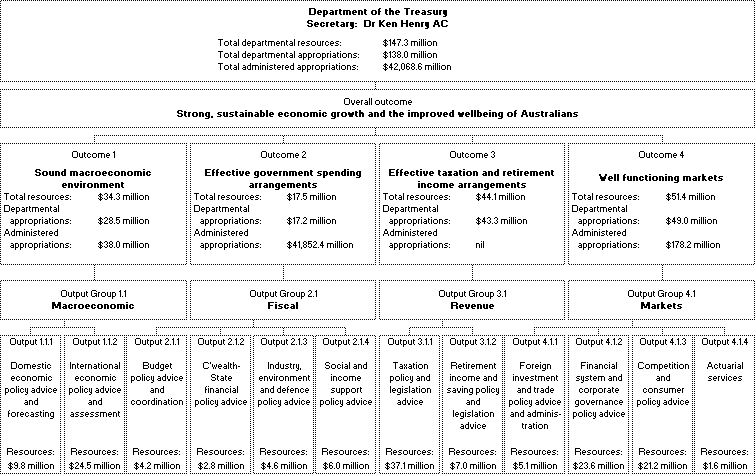
The relationship between outputs of the Treasury and the four outcomes is summarised on the next page in Figure 2.
Figure 2: Contributions to outcomes
3.2 Outcome resources and performance information
Outcome 1 — Sound macroeconomic environment
A sound macroeconomic environment is an essential foundation for strong sustainable economic growth and the improved wellbeing of Australians. It is characterised by stable prices, low interest rates, healthy employment growth, and a sustainable external position.
As many influences on macroeconomic outcomes are beyond the control of the Australian Government, policy aims to improve the prospects for the Australian economy rather than to target specific outcomes or major economic indicators. Success is judged more by medium to long-term performance relative to Australia’s past and to other countries, rather than by particular results in any year.
3.2.1 Outcome 1 resourcing
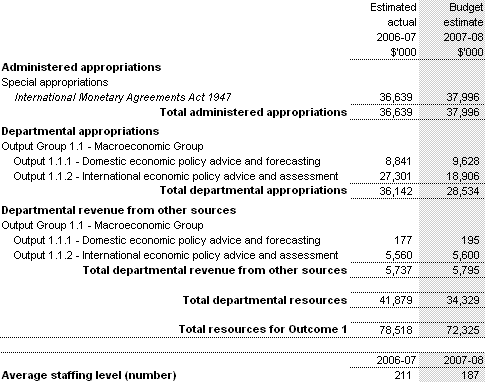
The following table shows how the 2007-08 Budget appropriations translate to total resourcing for Outcome 1, including administered appropriations, departmental appropriations and departmental revenue from other sources.
Table 3.1: Total resources for Outcome 1
3.2.2 Measures affecting Outcome 1
A list of measures appears in Table 2.2. Details of measures are included in Budget Paper No. 2, Budget Measures 2007-08.
3.2.3 Contributions to achievement of Outcome 1
The Treasury contributes to a sound macroeconomic environment by providing high-quality macroeconomic policy advice to the Treasurer, based on careful monitoring and analysis of economic conditions in Australia and overseas.
More specifically, in the coming year Treasury will provide advice on:
- domestic and international developments affecting the Australian economy and forecast the direction of the Australian and international economies;
- the setting of sound macroeconomic policies; and
- identifying policies likely to improve Australia’s economic growth potential and wellbeing, including improved understanding of the impact of changes in workforce participation and productivity on future growth and fiscal pressures.
The Treasury also provides advice to the Government on a range of international policy challenges, including strengthening multilateral regimes underpinning open trade and capital flows, supporting the development aspirations of developing countries, and shaping the evolution of the regional economic architecture.
In 2007-08, the Treasury will devote significant resources to:
- working with others to reform, strengthen and modernise key international forums (including the World Bank, International Monetary Fund, Organisation for Economic Cooperation and Development and Asian Development Bank);
- maintaining Treasury’s leading role in shaping the Group of Twenty (G-20), the Asia Pacific Economic Cooperation (APEC) forum, and the East Asia Summit process;
- building on already close links with policy makers in key East Asian countries, including Japan, China and Indonesia;
- working closely with counterparts in the Indonesian Government in support of their reform efforts under the $50 million Government Partnerships Fund (GPF), a key component of the $1 billion Australia-Indonesia Partnership for Reconstruction and Development (AIPRD);
- playing a role in Government initiatives to improve economic governance in the Pacific, particularly, in Papua New Guinea, Solomon Islands and Nauru, and the Pacific Islands Forum Economic Ministers’ Meeting; and
- providing high quality, strategic policy support to selected countries in the Asia-Pacific region.
Following on from 2006-07, an important focus for the Treasury in the coming year will be preparation for the APEC Finance Ministers’ Meeting in 2007, the Economic Committee meetings and associated workshops.
These key international meetings provide the opportunity to lead the international economic and financial agenda and the global debate on measures to strengthen the foundations for economic development, growth and stability.
- Treasury is working to develop effective, relevant and achievable policy outcomes and work programmes for APEC.
- Treasury’s priority following the hosting of the G-20 in 2006 is to sustain efforts to promote it as the most effective global forum for dealing with major global economic and financial challenges, including through participation on the management troika in 2007 (comprising the current, past and future hosts of the G-20, currently South Africa, Australia and Brazil respectively).
The effectiveness of the Treasury’s contribution to a sound macroeconomic environment is judged primarily by feedback from Treasury Portfolio Ministers on the quality and relevance of Treasury’s advice.
3.2.4 Performance information for Outcome 1
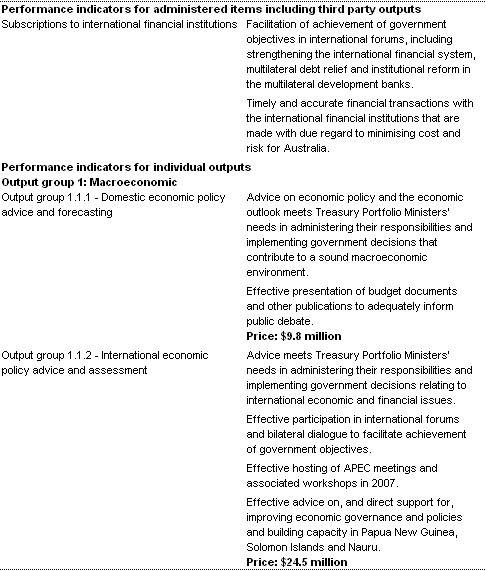
Performance information for administered items, individual outputs and output groups relating to Outcome 1 are summarised in Table 3.2.
Table 3.2: Performance information for Outcome 1
3.2.5 Evaluations for Outcome 1
Feedback will be sought from key clients and stakeholders on a regular basis on the effectiveness of the Treasury’s policy advice and international engagement. Results of evaluations will be presented, as appropriate, in The Treasury Annual Report 2007-08.
Outcome 2 — Effective government spending arrangements
Effective government spending arrangements contribute to the overall fiscal outcome, influence strong sustainable economic growth and improve the wellbeing of Australians.
Effective spending measures should meet their stated objectives, minimise behavioural distortions and deliver significant economic and other benefits compared with costs, so as to contribute to the wellbeing of Australians.
Treasury provides policy advice to portfolio Ministers in order to promote Government decisions that further these objectives.
Outcome 2 resourcing
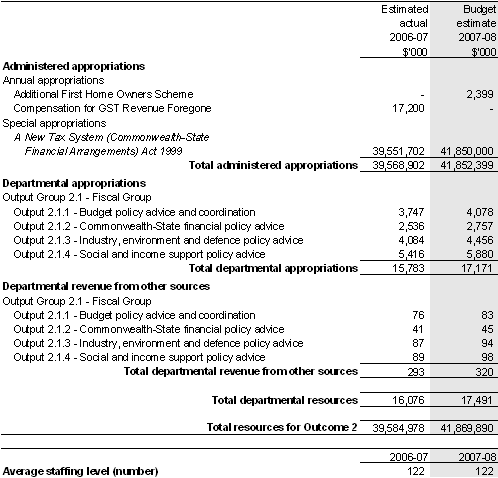
The following table shows how the 2007-08 Budget appropriations translate to total resourcing for Outcome 2, including administered appropriations, departmental appropriations and departmental revenue from other sources.
Table 3.1.2: Total resources for Outcome 2
Measures affecting Outcome 2
A list of measures appears in Table 2.2. Details of measures are included in Budget Paper No. 2, Budget Measures 2007-08.
Contributions to achievement of Outcome 2
Effective government spending arrangements are crucial to achieving the Australian Government’s objectives for the economy and hence the wellbeing of Australians. Ongoing advice to the portfolio Ministers from the Treasury assists in formulating, implementing and explaining government spending decisions.
More specifically, in the coming year the Treasury will provide advice on:
- budget policies, including arrangements for the distribution of resources between the Australian Government and other levels of government, which are consistent with sustainable public finances and macroeconomic objectives;
- Commonwealth-State financial policy, including implementing the Intergovernmental Agreement on the Reform of Commonwealth-State Financial Relations, and on the fiscal and economic positions of the State and Territory governments, particularly in relation to the effectiveness of federally funded activities;
- government expenditure programmes, with a focus on those programmes with significant economic, social or budgetary implications;
- policies relating to the Australian Government’s debt portfolio and the management of the portfolio; and
- policies to promote the efficient and sustainable use of resources and to improve workforce participation and the competitiveness and productivity of Australian industries, thereby promoting higher levels of sustainable economic growth.
In 2007-08, the Treasury will devote significant resources to:
- developing budget policy advice and coordination, including:
- production of the 2006-07 Final Budget Outcome, 2007-08 Mid Year Economic and Fiscal Outlook, 2008-09 Budget, and the Pre-election Economic and Fiscal Outlook.
- developing Commonwealth-State financial policy advice, including on:
- interrelationships with other levels of government;
- the fiscal and economic positions of the State and Territories, including the effectiveness of federally funded activities; and
- implementing the Intergovernmental Agreement on the Reform of Commonwealth-State Financial Relations.
- developing industry, environment and defence policy advice, including advising on:
- significant environmental policy issues including climate change, water reform and natural resource management;
- regional and rural policies;
- defence and national security issues;
- energy policy; and
- industry policy issues including innovation.
- developing social and income support policy advice, including advising on:
- building human capital in areas such as health, early childhood development and education and improved workforce participation and productivity, including through the Council of Australian Governments (COAG) National Reform Agenda;
- health policies;
- labour market and work and family policies; and
- policy frameworks in relation to Indigenous Australians.
The effectiveness of the contribution of these outputs to the outcome will be judged primarily by feedback from Treasury Portfolio Ministers as to whether policy advice meets their needs in formulating, implementing and explaining government spending decisions.
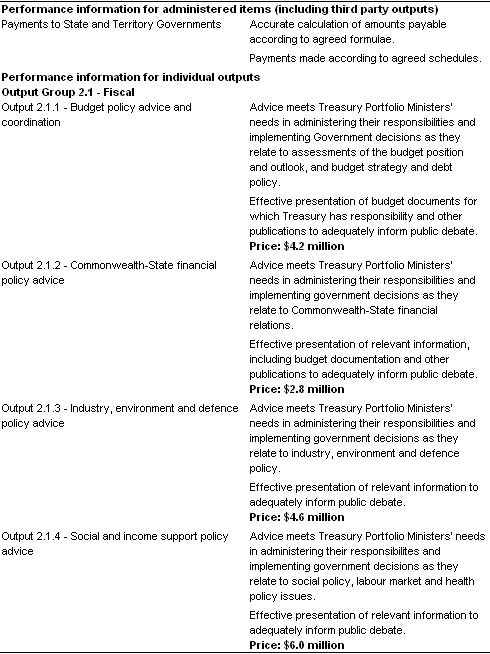
Performance information for Outcome 2
Table 3.2.2: Performance Information for Outcome 2
Evaluations for Outcome 2
Feedback will be sought from key clients on a regular basis on the effectiveness of policy advice and payments to State and Territory Governments. Results of evaluations will be presented, as appropriate, in The Treasury Annual Report 2007-08.
Outcome 3 — Effective taxation and retirement income arrangements
Effective taxation and retirement income arrangements contribute to the overall fiscal outcome and influence strong sustainable economic growth and the improved wellbeing of Australians.
Taxation measures should meet revenue objectives (or other public policy objectives) and have regard to the principles of economic efficiency, horizontal and vertical equity and transparency whilst minimising compliance and administrative costs. By meeting these objectives, taxation measures contribute to wellbeing, either directly or by providing the revenue base to finance Government services.
Treasury provides policy advice to Portfolio Ministers in order to promote Government decisions that further these objectives.
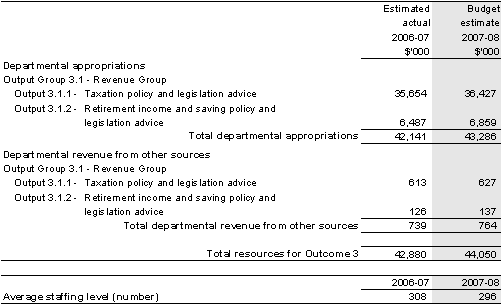
Outcome 3 resourcing
The following table shows how the 2007-08 Budget appropriations translate to total resourcing for Outcome 3, including departmental appropriations and departmental revenue from other sources.
Table 3.1.3: Total resources for Outcome 3
Measures affecting Outcome 3
A list of measures appears in Table 2.2. Details of measures are included in Budget Paper No. 2, Budget Measures 2007-08.
Contributions to achievement of Outcome 3
Effective taxation and retirement income arrangements are crucial to achieving the Australian Government’s objectives for the wellbeing of Australians. Ongoing advice to the Portfolio Ministers from the Treasury assists in formulating, implementing and explaining Government decisions on taxation and retirement income arrangements.
More specifically, in the coming year Treasury will provide advice on:
- taxation policies and legislative design proposals which contribute to the reform of the Australian taxation system in term of efficiency, equity and transparency whilst minimising compliance and administrative costs; and
- retirement income and saving issues, including superannuation, and other income support arrangements intended to improve the wellbeing of Australians.
In 2007-08, the Treasury will devote significant resources to:
- providing advice on those issues identified by the Government as its key strategic priorities;
- continuing to develop quantitative modelling to identify labour force participation effects of Government policy proposals, including tax and income support changes;
- meeting its obligations under the Charter of Budget Honesty Act 1998;
- continuing to implement decisions arising from the Australian Government’s Review of Aspects of Income Tax Self Assessment;
- progress the review and renegotiation of tax treaties with key investment partners, pursue tax information exchange agreements with offshore financial centres, contribute to the tax policy work of the OECD and continue the programme of reform of Australia’s international tax arrangements;
- final stages of implementation of the Australian Government’s Simpler Superannuation measures; and
- continuing to improve processes and outputs in the development of advice on taxation and retirement income policies (including consultations processes and design of legislation).
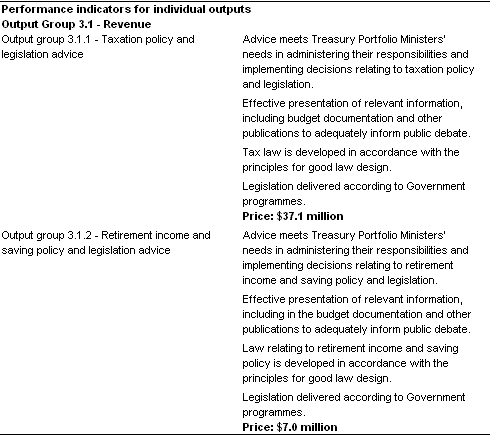
Performance information for Outcome 3
Table 3.2.3: Performance Information for Outcome 3
Evaluations for Outcome 3
Feedback will be sought from key clients on a regular basis on the effectiveness of policy advice. Results of evaluations will be presented, as appropriate, in The Treasury Annual Report 2007-08.
Outcome 4 — Well functioning markets
Well functioning markets contribute to strong sustainable economic and employment growth and the improved wellbeing of Australians, by enabling resources to flow to those parts of the economy where they can be used most productively.
Well functioning markets operate where investors and consumers have confidence and certainty about the regulatory framework, and are able to make decisions that are informed and free of market distortions and impediments.
Treasury provides advice on policy processes and reforms that promote a secure financial system and sound corporate practices, remove impediments to competition in both product and services markets, and safeguard the public interest in areas such as consumer protection and foreign investment and trade.
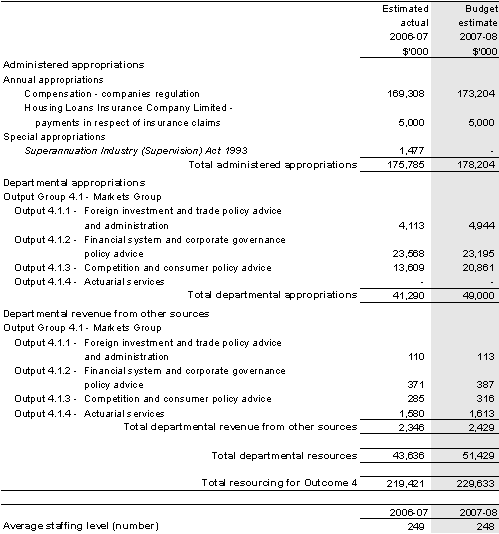
Outcome 4 resourcing
The following table shows how the 2007-08 Budget appropriations translate to total resourcing for Outcome 4, including administered appropriations, departmental appropriations and departmental revenue from other sources.
Table 3.1.4: Total resources for Outcome 4
Measures affecting Outcome 4
A list of measures appears in Table 2.2. Details of measures are included in Budget Paper No. 2, Budget Measures 2007-08.
Contributions to achievement of Outcome 4
Treasury provides advice to portfolio Ministers to assist them to carry out their responsibilities in formulating, implementing, and explaining the policies needed to achieve well functioning markets — markets that are competitive, efficient, informed, fair and transparent.
More specifically, in the coming year Treasury will provide advice on:
- policies relating to general foreign investment and trade, including foreign investment proposals;
- policies relating to the financial system, corporations, and the financial services sector;
- policies relating to a sound and efficient prudential framework;
- policies relating to issues emerging in the general insurance sector;
- policies relating to a range of initiatives to improve the frameworks for corporate insolvency and corporate groups;
- policies relating to structural reform in key sectors of the economy, including energy and transport and communications, in conjunction with other government departments and agencies; and
- policies relating to competition and consumer policy matters, including legislative amendments to the Trade Practices Act 1974.
In 2007‑08, Treasury will devote significant resources to:
- implementing trade and investment policy priorities in relation to the Government’s commitment to negotiate six free trade agreements — China, Japan, Association of South East Asian Nations (ASEAN), Malaysia, Japan, Chile and the Gulf Cooperation Council — to review the single economic market concept under the Closer Economic Relations Agreement (CER) with New Zealand as well as input into trade and investment issues in Asia-Pacific Economic Cooperation (APEC), G‑20 and World Trade Organization (WTO);
- monitoring international and local compliance with foreign investment and trade policies, including by processing foreign investment applications, and further examining reform options with a focus on reducing compliance and administrative costs;
- progressing a range of international cooperation issues, particularly with the United States and New Zealand, as well as enhancing international engagement with Indonesia;
- representing Australia’s interest in forums such as the Organisation for Economic Co-operation and Development (OECD) and the Australia Pacific Economic Co-operation (APEC);
- progressing a dialogue with other APEC economies on financial sector reform, with a view to strengthening policy makers’ understanding of issues, challenges and policy options for advancing the development of financial sectors and, in particular, private capital markets, in the region;
- international cooperation in financial system regulation, corporate governance, financial reporting, auditing, and corporate insolvency including the development of ways to further integrate the Australian and United States (US) financial services sectors, with a focus on regulatory recognition, including through the Financial Services Committee established under the Australia—US Free Trade Agreement, and further work on developing a single economic market with New Zealand in relation to corporate regulatory frameworks and financial services;
- improving the regulatory framework for corporations and financial services, including by implementing wide ranging reforms to simplify and reduce the regulatory burden on business, progressing reforms relating to corporate insolvency and corporate groups, financial reporting, financial services and financial markets, and, implementing reforms to the Insurance Contracts Act 1984;
- enhancing the arrangements and tools available to government to deal with distressed financial institutions;
- improving regulation and competition in the financial sector by facilitating well functioning and competitive financial markets, particularly by addressing banking competition and insurance market issues and improving the effectiveness of regulation, developing a single economic market with New Zealand in banking services, and monitoring market supervision issues;
- developing and implementing the reform agenda for competition policy, including the competition and regulation streams of COAG’s National Reform Agenda and advancing microeconomic reforms in key infrastructure markets including energy, transport and communications;
- implementing reforms relating to the competition and consumer provisions of the Trade Practices Act — including changes to legislation as a result of the Government response to the Senate small business report and the introduction of criminal sanctions for cartels — and contributing to the review of the Australian consumer policy framework;
- developing and delivering a range of financial literacy initiatives that will build the capacity of Australians to better manage their money and to take advantage of significant reforms to the finance sector;
- providing support for Ministers in considering a range of appointments to statutory and non statutory bodies such as the Productivity Commission, the Australian Competition and Consumer Commission, and the Australian Securities and Investments Commission;
- providing secretariat services to the Financial Reporting Council, Foreign Investment Review Board, Financial Sector Advisory Committee, the Ministerial Council for Consumer Affairs, the Commonwealth Consumer Affairs Advisory Council; and
- maintaining successful operations of the Australian Government Actuary, Royal Australian Mint, Financial Reporting Panel, and the Takeovers Panel.
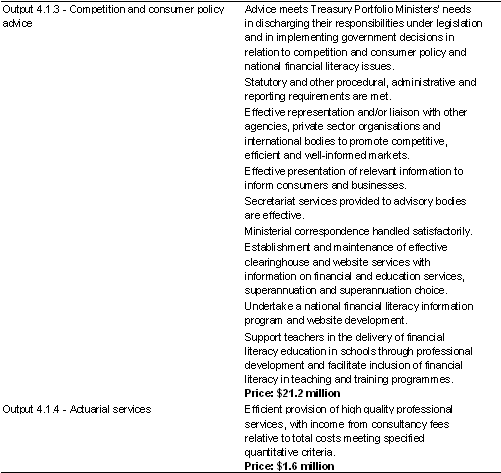
Performance information for Outcome 4
Table 3.2.4: Performance Information for Outcome 4
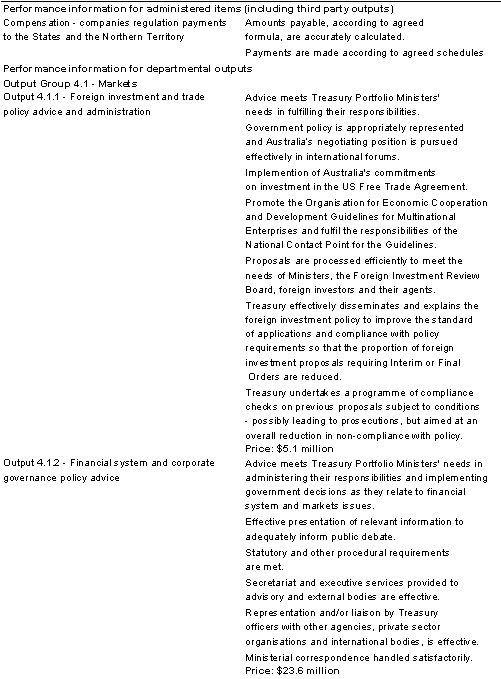
Table 3.2.4: Performance Information for Outcome 4 (continued)
Evaluations for Outcome 4
Feedback will be sought from key clients on a regular basis on the effectiveness of policy advice. Results of evaluations will be presented, as appropriate, in The Treasury Annual Report 2007-08.