




Economic outlook
Consumer price inflation has intensified over recent years, reaching 4.2 per cent through the year to March 2008. Powerful countervailing forces are confronting the Australian economy. As a result of slower growth in advanced economies and tighter credit conditions, economic growth is forecast to moderate to 2 per cent in 2008‑09. This, combined with higher interest rates, is expected to lead to a moderation in employment growth and gradually ease price pressures.
Counteracting this, robust growth in emerging economies is expected to lead to further large rises in Australia's terms of trade, which are already at levels not seen since the early 1950s. Strong rises in the terms of trade will boost income and increase upward pressure on prices. As a result, nominal GDP growth is expected to accelerate to 9 per cent in 2008‑09, notwithstanding the slowing in real activity. If realised, this would be the fastest rate of growth since the late 1980s. Consumer price inflation is forecast to be 4 per cent through the year to June 2008 and 3 per cent through the year to June 2009.
The major economic parameters used in preparing the Budget are contained in Table 1.
Table 1: Major economic parameters(a)
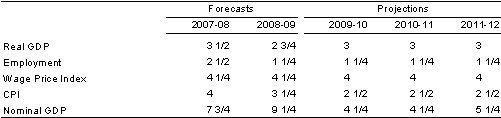
- All parameters except the CPI are year average percentage changes. The CPI is through the year growth to the June quarter. As in previous budgets, projections assume a two‑year step down in non‑rural commodity prices.
Source: Treasury.
If www.budget.gov.au responds slowly or you are having trouble downloading a document, try one of the Budget Website Mirrors
Note: Where possible, Budget documents are available in HTML and for downloading in Portable Document Format(PDF). If you require further information on any of the tables or charts on this website, please contact Treasury.