




The outlook for the international economy
The outlook for the global economy has deteriorated significantly since last year, as the crisis in the global financial system has deepened and started to hamper economic activity. Complicating the outlook, global inflationary pressures are building, reflecting capacity constraints in some areas and rising energy and food prices.
The global economy is expected to expand by 4 per cent in 2008 and 2009 (Chart 1 and Table 2). Financial market difficulties have been most acute in the US (Box 1), where a severe housing contraction was already slowing growth. In contrast, emerging economies have experienced little impact to date. The contrasting exposure to credit market difficulties is expected to result in a continued large divergence between growth in advanced and emerging economies. The collapse of securitised lending, the increase in borrowing costs, tightening credit standards, and an associated impact on confidence, are expected to significantly constrain advanced economy growth (Box 2), with the US expected to experience a mild recession. Any further escalation in financial market turbulence would represent a significant downside risk to global growth.
Chart 1: Global growth(a)
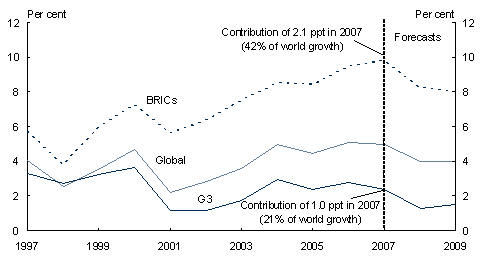
- Global GDP growth rates are calculated using GDP weights based on purchasing power parity. The BRICs comprise Brazil, Russia, India and China, while the G3 comprises the US, euro area and Japan.
Source: International Monetary Fund (IMF) and Treasury.
Despite the forecast for slower global growth, global inflationary pressures remain elevated and represent another key risk to the outlook. High energy and food prices have lifted headline rates of inflation in most countries, and the risk remains that elevated rates of headline inflation could feed into higher inflation expectations. If this risk were to materialise, it could restrict the degree to which global monetary policy might be eased in response to any further deterioration in growth.
Box 1: Global financial market turbulence Beginning in mid‑2007, increasing default rates on US sub‑prime mortgages — and associated declines in the value of financial securities backed by these mortgages — led to a fundamental reassessment of the risks inherent in a broad range of structured credit securities. In turn, concerns over the value of structured credit securities offered as collateral quickly led to the almost total evaporation of liquidity in the US asset‑backed commercial paper (ABCP) market. As a result, an array of complex investment vehicles that had previously relied on the ABCP market for much of their funding were unable to rollover their existing liabilities and were forced to call upon emergency lines of credit with their sponsoring banks. Funding demands from these notionally 'off‑balance sheet' vehicles and direct losses on holdings of structured credit securities have resulted in a significant erosion of banks' balance sheet positions. In response, banks have increasingly chosen to shore up their own capital positions by restricting their lending to counterpart institutions. This 'liquidity hoarding' has manifested itself in dramatically increased liquidity premiums and a reduction in the availability of funding in inter‑bank lending markets. Despite concerted central bank action aimed at alleviating these pressures, spreads in inter‑bank markets in most advanced economies remain elevated (Chart A). More recently, ongoing tightness in funding markets has exposed balance sheet fragilities amongst institutions whose financial health is important to the stability of the US and international financial systems. For example, a weakening in the balance sheet positions of US 'mono‑line' bond insurers — who offer insurance against the possibility that bond issuers might default — has raised questions over the soundness of the market for credit default swaps. Chart A: Inter‑bank lending rates
Note: Data are as at close 7 May 2008. Source: Reuters EcoWin. The virtual collapse of Bear Stearns, a large US investment bank, prompted the US Federal Reserve to take the extraordinary policy action of providing funding for its ultimate purchase by JP Morgan Chase. To limit the potential for another investment bank to suffer a similar liquidity crisis, access to the Federal Reserve's emergency lending facility has subsequently been extended to include investment banks. |
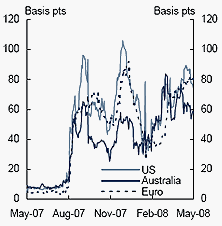
Table 2: International GDP growth forecasts(a)
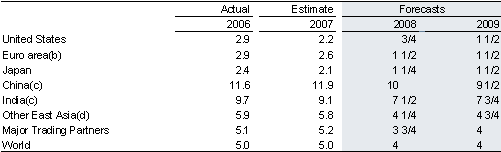
- World and euro area growth rates are calculated using GDP weights based on purchasing power parity. Calculations for Major Trading Partners and Other East Asia use export trade weights.
- Euro area numbers are working‑day adjusted.
- Production‑based measures of GDP.
- Other East Asia comprises the Newly Industrialised Economies (NIEs) of Hong Kong, Korea, Singapore and Taiwan, and the Association of Southeast Asian Nations group of five (ASEAN‑5), which consists of Indonesia, Malaysia, the Philippines, Thailand and Vietnam.
Source: National statistical publications, IMF and Treasury.
The US economic outlook has deteriorated significantly since the start of the year. Given deteriorating consumer confidence and continued stress in credit markets, a mild US recession is now expected. For 2008 as a whole, US consumers face the possibility of further house price falls, deteriorating employment prospects, tighter borrowing conditions, lower equity market returns and higher energy costs.
Moreover, tighter credit conditions and weaker business sentiment are likely to restrain business investment over 2008 and into 2009. The housing sector is also likely to continue to detract from growth until at least early 2009. In contrast to the softness in the domestic economy, net exports are expected to remain solid, with exports boosted by solid trading partner growth and a lower exchange rate, while weaker domestic demand should restrain imports. This development should help to reduce the sizable US current account deficit, although the risk of a disorderly adjustment of current account imbalances remains a concern for the US economy and global outlook.
With the deteriorating outlook, US authorities have acted quickly to support growth. The Federal Reserve has aggressively cut interest rates and taken a series of steps to improve liquidity and boost confidence in the financial system. Supporting these monetary policy actions, the US Administration has implemented a fiscal stimulus package (of 1 per cent of GDP) that is targeted at boosting household spending and business investment, with the effects most likely to be seen in the second half of 2008.
Despite weakening advanced economy growth, strength in emerging economies, particularly China and India, has continued. While demand for emerging economy exports will soften, growth is expected to remain robust.
China's growth in 2007, at close to 12 per cent, was its strongest in over a decade. The outlook is for continued strong Chinese growth, albeit at a slightly slower rate than last year. Urbanisation and infrastructure investment are continuing at a brisk pace, driving rising demand for energy and raw materials. The rapid economic expansion is generating strong growth in incomes, which will continue to support the momentum in private consumption.
Self‑sustaining growth from domestic sources is likely to continue, and the Chinese Government has ample financial resources to support growth should the slowdown in the US have a more serious adverse impact than is currently anticipated. The lack of highly sophisticated financial markets in China, along with the relatively closed capital account, should also limit the impacts arising from the current financial turmoil. However, China will not remain immune from spillovers that arise from trade linkages with the developed world. Export growth is expected to continue to slow, given softer external demand and further appreciation of the Chinese currency.
The main challenge facing the Chinese economy this year is expected to arise from accelerating inflation. Until recently, the increase in inflation has been contained to food prices. However, inflationary pressures have intensified and now appear more broadly based.
In 2007, the Indian economy recorded the third largest contribution to world growth after China and the US. Growth in India's economy is expected to slow, but remain strong, over the next two years reflecting the impacts of tighter monetary conditions and slower global growth. Consumption will be supported through fiscal stimulus in the 2008‑09 budget and significant increases to public sector wages.
In the Newly Industrialised Economies (NIEs) and ASEAN‑5, growth is expected to ease this year before accelerating slightly in 2009 as advanced economy demand recovers. The moderation in growth in 2008 largely reflects slowing exports.
As mentioned above, other major advanced economies are also expected to slow sharply this year. Following two consecutive years of strong growth, the euro area is forecast to slow in 2008. A key feature of the recent growth performance has been strong export growth — both intra‑regional and to emerging economies, particularly emerging Europe. Strong export growth has boosted investment in the region. However, with a deteriorating world growth outlook, export growth is expected to slow significantly while tightening credit conditions are expected to dampen investment and consumption growth.
The Japanese economy finished 2007 on a strong note as it has benefited from strong intra‑regional trade. However, while the Japanese financial sector has not been significantly affected by disruptions in the US and euro area financial markets, growth is still expected to slow over the next few years. Consumption growth is expected to only partially offset moderating business investment and exports as global growth slows.
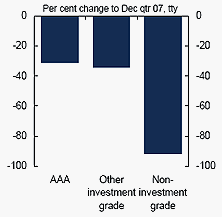
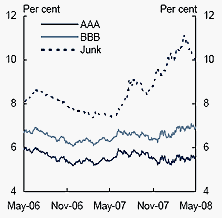
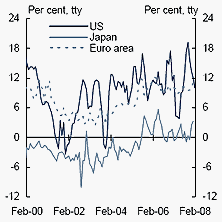
Box 2: Financial and credit market disruptions in advanced economies Disruptions in US and euro area financial markets have led to a re‑appraisal of the outlook for the global economy. The provision of credit is one of the key functions of financial markets in supporting the real economy. Dislocations in credit and funding markets can reduce the capacity of the financial system to channel funds from savers to borrowers, raising the overall cost of credit and restricting the access to liquid funds. This can hamper investment and economic growth. Within a modern financial system, the provision of credit generally occurs either via issuance of debt securities (such as those backed by household and commercial mortgages, and corporate bonds and notes) or via traditional bank intermediation of savings deposits. Securities marketsThe seizing up of markets for a range of financial securities has restricted the ability to raise capital in these markets. An important example of this is the sharp fall in issuance of securities backed by household mortgages in most advanced economies. Total issuance of international debt securities remains well below levels seen prior to the current turmoil, due largely to a decline in issuance by US private financial institutions. Issuance has fallen across all credit ratings, but by more amongst non‑investment grade ratings (Chart A). Chart A: Decline in gross
Source: Bank for International Settlements. In advanced economy corporate bond markets, risk premiums attached to all classes of borrowers have risen, but by proportionally more for higher risk borrowers. At the same time, long‑term government bond yields — which form the base, or risk‑free, component of most long‑term interest rates — have generally declined as investors have sought the relative safety of this asset class. For higher risk corporate borrowers, the increase in risk premiums has more than offset the decline in risk‑free interest rates so that borrowing costs have risen substantially. In contrast, increases in the cost of credit for lower risk corporate borrowers have been comparatively muted (Chart B). Indeed, borrowing costs for lower risk borrowers have fallen in some cases. At shorter maturities, particularly in the US, borrowing costs for investment‑grade borrowers have fallen, with aggressive reductions in official US policy rates. Chart B: US corporate bond yields
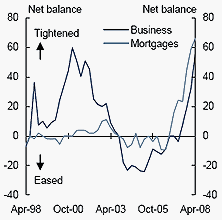
Note: Data are as at close 6 May 2008. Source: Reuters EcoWin. Bank intermediationDifficulty raising finance in securities markets has forced borrowers to rely on more traditional bank finance. As a result, business credit growth in most major advanced economies rose in the second half of 2007. Moreover, given their dependence on wholesale short‑term funding markets, non‑bank finance providers have become a less prominent source of finance for households and a rising proportion of mortgage finance demand has been met by commercial banks. In aggregate, total loan growth in the US and euro area has remained reasonably robust given the current turmoil (Chart C). The added demand for credit from banks has put further pressure on their already constrained capital positions. Banks have generally responded by charging higher risk premiums and tightening lending standards, particularly for higher risk household and corporate borrowers. Bank lending surveys in most major advanced economies point to a broad‑based tightening in lending standards since mid‑2007 (Chart D). |
||
Chart C: Total loan growth
Note: Data are a three‑month moving average. Source: IMF World Economic Outlook April 2008. |
Chart D: US lending standards
Source: Reuters EcoWin. | |
If www.budget.gov.au responds slowly or you are having trouble downloading a document, try one of the Budget Website Mirrors
Note: Where possible, Budget documents are available in HTML and for downloading in Portable Document Format(PDF). If you require further information on any of the tables or charts on this website, please contact Treasury.