




Medium‑term fiscal outlook
Sustainability of public finances is the primary objective of the Government's medium‑term fiscal strategy.
Fiscal sustainability is important for broader economic sustainability, including meeting the challenges of an ageing society, dealing with climate change and improving participation and productivity. Maintaining fiscal sustainability is also a core requirement of improving intergenerational equity (Box 3).
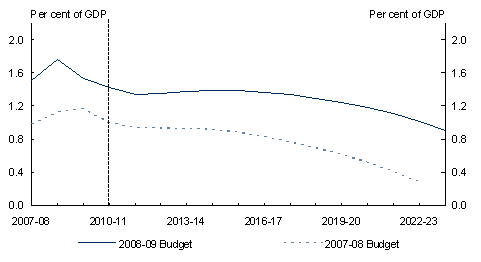
Chart 2 below shows that over a 20 year projection period on a consistent underlying cash balance basis, in the absence of policy changes, spending pressures associated with an ageing population increase. These pressures will constrain the capacity of governments to meet the community's future needs. Targeting policies towards expanding the productive capacity of the economy, through investments in skills and infrastructure, is the key to raising productivity and prosperity to meet the challenges of the future. Lifting the real growth rate of the economy in sustainable ways increases the ability of governments to finance future spending, as well as directly improving the wellbeing of Australians.
Chart 2: Fiscal projections over the medium term
Source: Treasury projections.
These projections are based on the same estimation methodology used in the second Intergenerational Report 2007 (IGR2), except net interest payments are included and IGR2 growth rates for spending apply from the end of the current forward estimates period. Like IGR2, revenue is assumed to remain at a constant percentage of GDP from the end of the forward estimates period. The projections incorporate the effect on the forward estimates of the 2008‑09 Budget, which lowers the expense starting point for the projections. Structural effects on spending growth rates for the Government's policies in this Budget have not been included and will be updated following the full estimates review process normally conducted as part of the next Intergenerational Report.
Box 3: Economic and fiscal sustainability Economic sustainability requires resources to be allocated in a way that improves the expected wellbeing of current and future generations, with no generation suffering lower wellbeing than any past generation. This recognises that people tend to aspire to higher living standards, a cleaner environment and less risky economic circumstances for both current and future generations. Rather than simply maintaining existing levels of wellbeing, in practice a more sustainable economy is one that provides well founded expectations of persistent improvements in wellbeing through time. To be sustainable, an economy needs to improve both efficiency and intergenerational equity. A more efficient economy — with high levels of productivity and participation — is able to satisfy a higher level of overall wellbeing. Intergenerational equity means future generations should always expect to be no worse off than previous generations. Policies which support economic growth are more likely to meet both the efficiency and equity elements of sustainability. A more efficient, growing economy is likely to improve the chances of achieving a more equitable society. More resources means governments are better able to redistribute within and between generations. Current generations may also feel inclined to maintain the wellbeing of future generations if their own wellbeing is improving. Economic growth is generally of benefit to current and future generations. A key way governments impact on economic sustainability is through their fiscal policy. In particular, fiscal sustainability is important for delivering sustainable improvements in living standards over time. Fiscal sustainability can be defined as the ability of government to manage its finances so it can meet its spending commitments, both now and in the future. When governments do not manage their finances in a sustainable manner, economic growth and ultimately the services that the government provides the community suffer. The wasting of scarce resources reduces economic sustainability. Fiscal sustainability can be assessed by looking at the expected path of spending in the future and what that implies for taxes, as well as the risks around that path. A fiscal policy focused on sustainability provides greater stability and certainty of future tax burdens and is likely to lead to better long‑term decision making, encouraging investment and economic growth. |
If www.budget.gov.au responds slowly or you are having trouble downloading a document, try one of the Budget Website Mirrors
Note: Where possible, Budget documents are available in HTML and for downloading in Portable Document Format(PDF). If you require further information on any of the tables or charts on this website, please contact Treasury.