




Section 3: Explanatory tables and budgeted financial statements
3.1 Explanatory tables
3.1.1 Reconciliation of total available appropriation and outcomes
The Agency Resource Statement (Table 1.1) details the total available appropriation to APRA from all sources. For departmental operating appropriations (outputs) this includes carry‑forward amounts as well as amounts appropriated at budget. As APRA incurs and is funded for future liabilities, generally depreciation and employee entitlements, the total amount of departmental operating appropriation available to APRA is unlikely to be fully utilised in the budget year. The difference between the agency resource statements and the sum of all payments made at the departmental outputs level is the expected carry‑forward amount of resources for the 2009‑10 budget year, including amounts related to meeting future obligations to maintain APRA's asset base and to meet employee entitlement liabilities.
Table 3.1.1: Reconciliation of total available appropriation and outcomes

3.1.2 Movement of administered funds between years
Table 3.1.2: Movement of administered funds between years
APRA has not moved any administered funds between years.
3.1.3 Special accounts
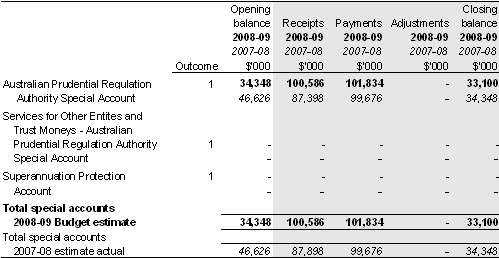
Special accounts provide a means to set aside and record amounts used for specified purposes. Special accounts can be created by a Finance Minister's Determination under the Financial Management and Accountability Act 1997 or under separate enabling legislation. Table 3.1.3 shows the expected additions (receipts) and reductions (payments) for each account used by APRA.
Table 3.1.3: Estimates of special account cash flows and balances
3.1.4 Australian Government Indigenous Expenditure
Table 3.1.4: Australian Government Indigenous Expenditure
APRA does not have any Australian Government Indigenous Expenditure.
3.2 Budgeted financial statements
3.2.1 Differences in agency resourcing and financial statements
There are no material differences between the resource information presented in the Budget Papers and Portfolio Budget Statements and APRA's financial statements as a result of differences between Australian Accounting Standards and Government Finance Statistics.
In addition, APRA is not a party to related entity transactions that would result in significant differences between the resource information presented in the Budget Papers and Portfolio Budget Statements and APRA's financial statements.
3.2.2 Analysis of budgeted financial statements
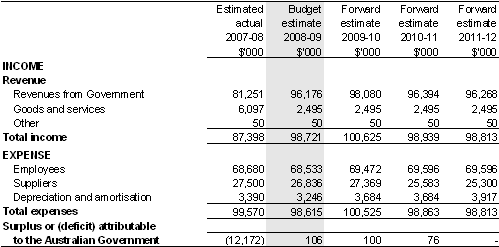
The departmental income statement (Table 3.2.1) shows a net increase in appropriations from $81.3 million forecast for 2007‑08 to $96.2 million in 2008‑09. The increase mainly reflects the funding of operations from current period industry levies after running down reserves built up from previous levy over‑collections to partially meet 2007‑08 operating costs. In addition, $1.6 million has been provided as departmental appropriation for Standard Business Reporting (SBR).
Budgeted lower non‑government revenue of $2.5 million in 2008‑09 reflects the completion of a major part of Basel II accreditation work that was met in 2007‑08 by fees charged on those ADIs applying for accreditation.
Employee expenses of $68.5 million (compared to the 2007‑08 forecast of $68.7 million) take into account a reduction in APRA's average staffing level (ASL) from 580 to 570 as a consequence of the consolidation of the superannuation industry post licensing.
Supplier costs will decrease from $27.5 million forecast in 2007‑08 to $26.8 million in 2008‑09. Supplier costs in 2007‑08 included one‑off expenditure related to completion of major supervisory infrastructure projects and additional staff training initiatives.
APRA is budgeting for an operating surplus of $0.1 million in 2008‑09, compared to a forecast operating loss of $12.2 million in 2007‑08 (the counterpart to APRA's use of reserves to fund part of its 2007‑08 operating costs).
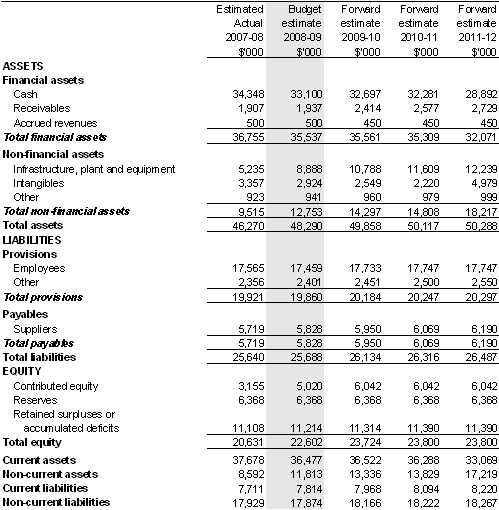
The budgeted departmental balance sheet (Table 3.2.2) shows that APRA will maintain sufficient financial assets to meet all employee and supplier commitments as and when they fall due.
Continued investment in core supervisory and corporate infrastructure, coupled with investment in SBR, will see non‑financial asset balances increase in 2008‑09 and beyond.
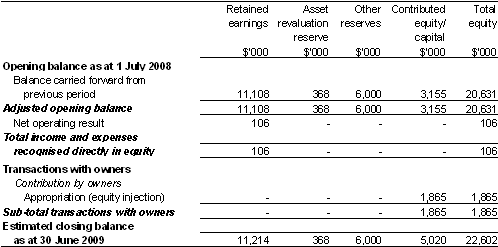
Contributed equity will increase over 2008‑09 and 2009‑10, reflecting government equity injections for SBR.
Retained surpluses are budgeted to maintain general reserves at a level sufficient to accommodate unforseen business needs which may arise from supervision of at‑risk institutions.
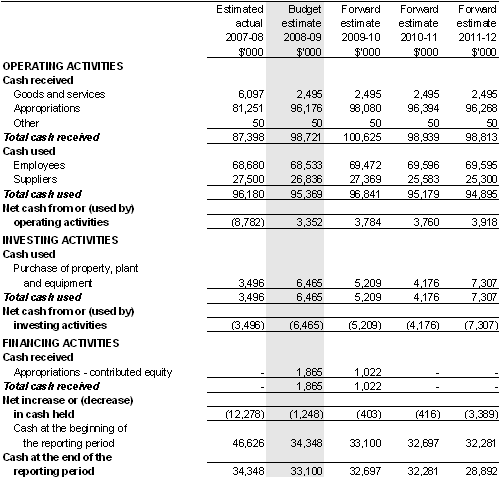
The budgeted departmental statement of cash flows (Table 3.2.3) reflects the source and application of appropriations and other revenue, as detailed in Table 3.2.1.
Table 3.2.4 shows the expected changes in equity between 2007‑08 and 2008‑09. The main item of change across this period will be the equity injection related to SBR.
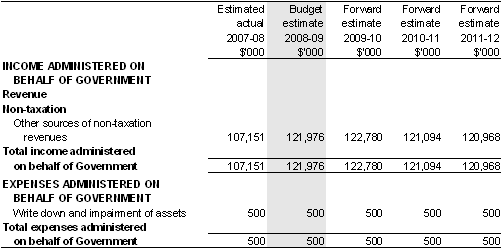
The schedule of budgeted income and expenses administered on behalf of government (Table 3.2.5) shows the amounts APRA collects in supervisory levies from the finance industry on behalf of the Government under the Financial Institutions Supervisory Levies Collection Act 1998. In addition to the amount required to fund APRA, the levies also include amounts to fund the activities of the Australian Taxation Office for unclaimed moneys and lost member functions and the Australian Securities and Investments Commission for consumer protection and market integrity functions. The expenses shown are an estimate of the amount of levies and penalties that will be waived or written off in the year.
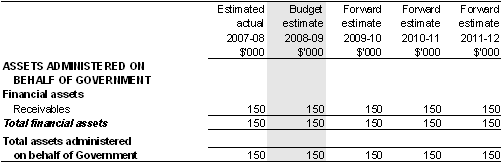
Table 3.2.6 refers to minor amounts of the administered income that may not be collected at the year end.
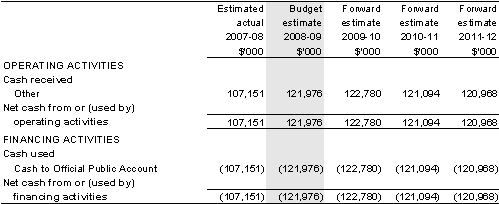
As indicated in the schedule of budgeted administered cash flows (Table 3.2.7), the cash collected is swept daily from the APRA account to the Official Public Account, from which APRA, in turn, draws down the amounts appropriated to it by the Parliament, as shown in Table 3.2.3.
APRA does not administer any non‑financial assets on behalf of the Government.
3.2.3 Budgeted financial statements tables
Table 3.2.1: Budgeted departmental income statement
(for the period ended 30 June)
Prepared on an Australian Accounting Standards basis.
Table 3.2.2: Budgeted departmental balance sheet
(as at 30 June)
Prepared on an Australian Accounting Standards basis.
Table 3.2.3: Budgeted departmental statement of cash flows
(for the period ended 30 June)
Prepared on an Australian Accounting Standards basis.
Table 3.2.4: Departmental statement of changes in equity — summary of
movement (Budget year 2008‑09)
Prepared on an Australian Accounting Standards basis.
Table 3.2.5: Schedule of budgeted income and expenses administered on
behalf of Government (for the period ended 30 June)
Prepared on an Australian Accounting Standards basis.
Table 3.2.6: Schedule of budgeted assets and liabilities administered on
behalf of Government (as at 30 June)
Prepared on an Australian Accounting Standards basis.
Table 3.2.7: Schedule of budgeted administered cash flows
(for the period ended 30 June)
Prepared on an Australian Accounting Standards basis.
3.2.4 Notes to the financial statements
Basis of accounting
The financial statements have been prepared on an accrual basis in accordance with historical cost convention.
Budgeted departmental statement of financial performance
Revenues from Government
APRA is funded by a special appropriation for levies and late payment penalties collected under the Financial Institutions Supervisory Levies Collection Act 1998. The revenue reported by APRA is net of the levies retained in the Official Public Account to fund the Australian Securities and Investments Commission (ASIC) for consumer protection and market integrity functions, and the Australian Taxation Office (ATO), for unclaimed moneys and lost member functions.
Other revenue
Revenue from rendering of specific services is recognised by reference to the stage of completion of contracts or other agreements. Revenue from licence fees is recognised on receipt of the application and licence fee.
Depreciation and amortisation
APRA's depreciation expense remains in balance with the capital program aimed at maintaining APRA's processes and infrastructure to an appropriate standard.
Budgeted departmental statement of financial position
Financial assets
Receivables include levies invoiced but still outstanding at the financial year end and accrued revenues, being fees prorated over the periods to which they relate.
All accounts receivable are recorded at their estimated recoverable amount.
Non‑financial assets
Non‑financial assets include leasehold improvements, furniture and fittings, computer hardware and office equipment. All of the foregoing assets are shown at fair value. Intangible assets comprise capitalised software, including works in progress and are shown at cost. APRA does not own any land or buildings.
Other non‑financial assets include prepayments.
Provisions and payables
Provisions and payables represent liabilities for miscellaneous accruals and employee benefits, including accrued salary and leave entitlements, provisions for making good leased premises and payments to trade creditors.
Equity
The opening balance of contributed equity represents the net value of assets and liabilities transferred from the Reserve Bank of Australia and the Insurance and Superannuation Commission on the formation of APRA on 1 July 1998, less an amount of $2.1 million returned to the Consolidated Revenue Fund as a return of unused appropriation in 2004‑05.
Budgeted departmental statement of cash flows
Cash received from operating activities includes the appropriation for levies collected from industry less amounts collected on behalf of the ATO and ASIC and cash from fees and charges.
Schedule of budgeted revenues and expenses administered on behalf of Government
Revenues
The other non‑taxation revenues are the levies and late payment penalties collected under the Financial Institutions Supervisory Levies Collection Act 1998. The revenue reported in this statement is higher than that reported by APRA in the budgeted agency statement of financial position by the amount retained in the Official Public Account to fund ASIC and ATO activities described above.
Write down and impairment of assets
Write down and impairment of assets represents waivers and write‑offs of levies.
Schedule of budgeted assets and liabilities administered on behalf of Government
Financial assets
The financial assets include levy debt invoiced and still outstanding at year end.
Schedule of budgeted administered cash flows
All cash collected by APRA for levies, late lodgement and late payment penalties under the Financial Institutions Supervisory Levies Collection Act 1998 is transferred to the Official Public Account at the close of business each day.
If www.budget.gov.au responds slowly or you are having trouble downloading a document, try one of the Budget Website Mirrors
Note: Where possible, Budget documents are available in HTML and for downloading in Portable Document Format(PDF). If you require further information on any of the tables or charts on this website, please contact Treasury.